Clear Sky Science · en
EEG microstate alterations in Parkinson’s disease dementia
Why tiny brain patterns matter in Parkinson’s
Parkinson’s disease is best known for its tremors and stiffness, but for many people the most life‑changing symptoms are problems with memory, attention, and everyday thinking. Doctors can measure these changes with paper‑and‑pencil tests, yet those scores say little about what the brain itself is doing. This study looks at fleeting electrical patterns on the scalp, called EEG microstates, to see whether they can reveal early warning signs and hidden mechanisms of dementia in Parkinson’s disease.
Listening to the brain’s resting “snapshots”
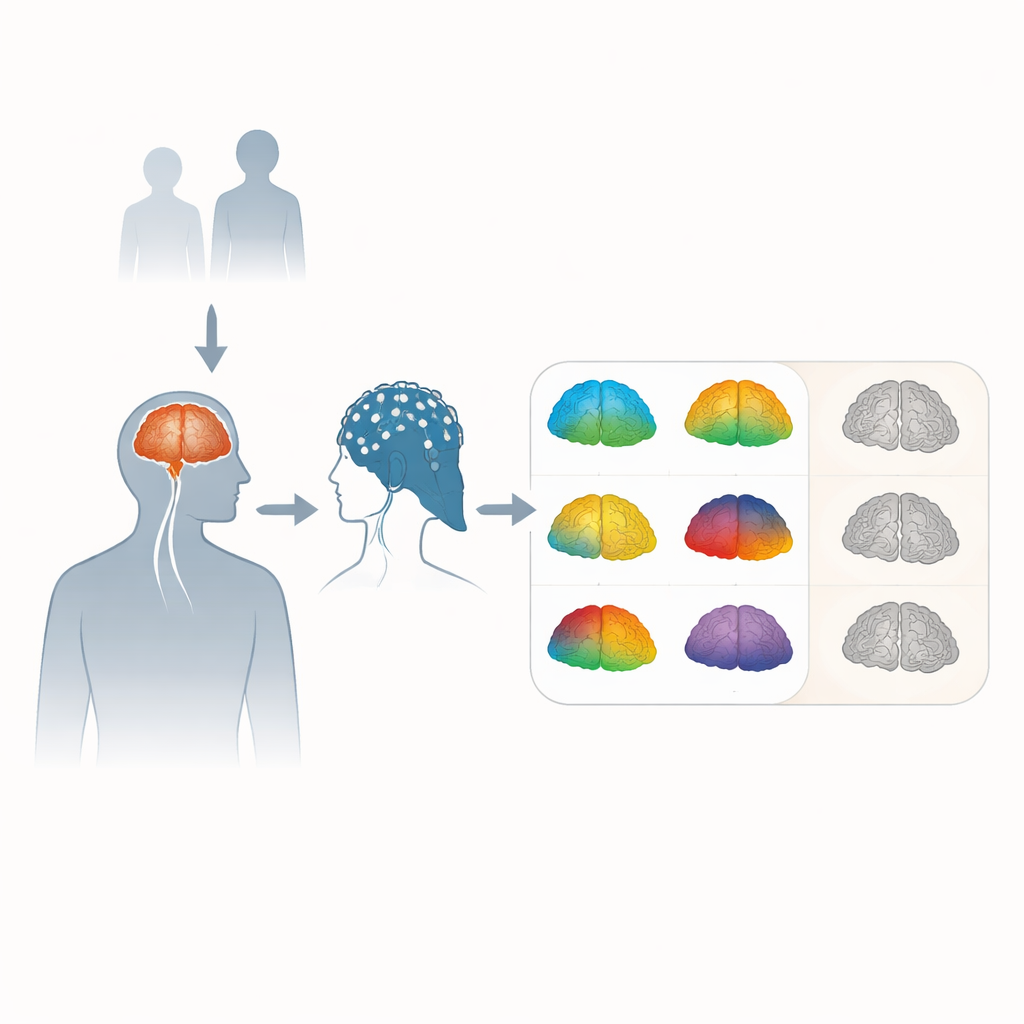
Our brains never truly rest. Even with eyes closed and no task at hand, large networks of nerve cells flicker in and out of action in patterns that last only fractions of a second. These brief, stable configurations are known as microstates and can be captured by electroencephalography (EEG), which records tiny voltage changes at the scalp. Earlier work has linked certain microstates to broad functions such as hearing, vision, and inward‑focused thought, and has shown that their timing shifts in conditions like Alzheimer’s disease. The new study asked whether the same kind of shifts might mark the journey from normal thinking to dementia in people with Parkinson’s.
Comparing healthy adults and people with Parkinson’s
The researchers recorded three minutes of eyes‑closed, resting‑state EEG from 113 volunteers: healthy older adults, people with Parkinson’s whose thinking remained normal, and people with Parkinson’s who had developed dementia. All participants completed a standard thinking test called the Montreal Cognitive Assessment. The team carefully cleaned the EEG signals, removed noise such as blinks and muscle activity, and then broke the data into short segments. Using established software, they labeled each moment of brain activity as belonging to one of six common microstate types, known in the field as A through F, and calculated how long each type stayed active, how often it appeared, and how much total time it occupied.
Patterns that track thinking problems
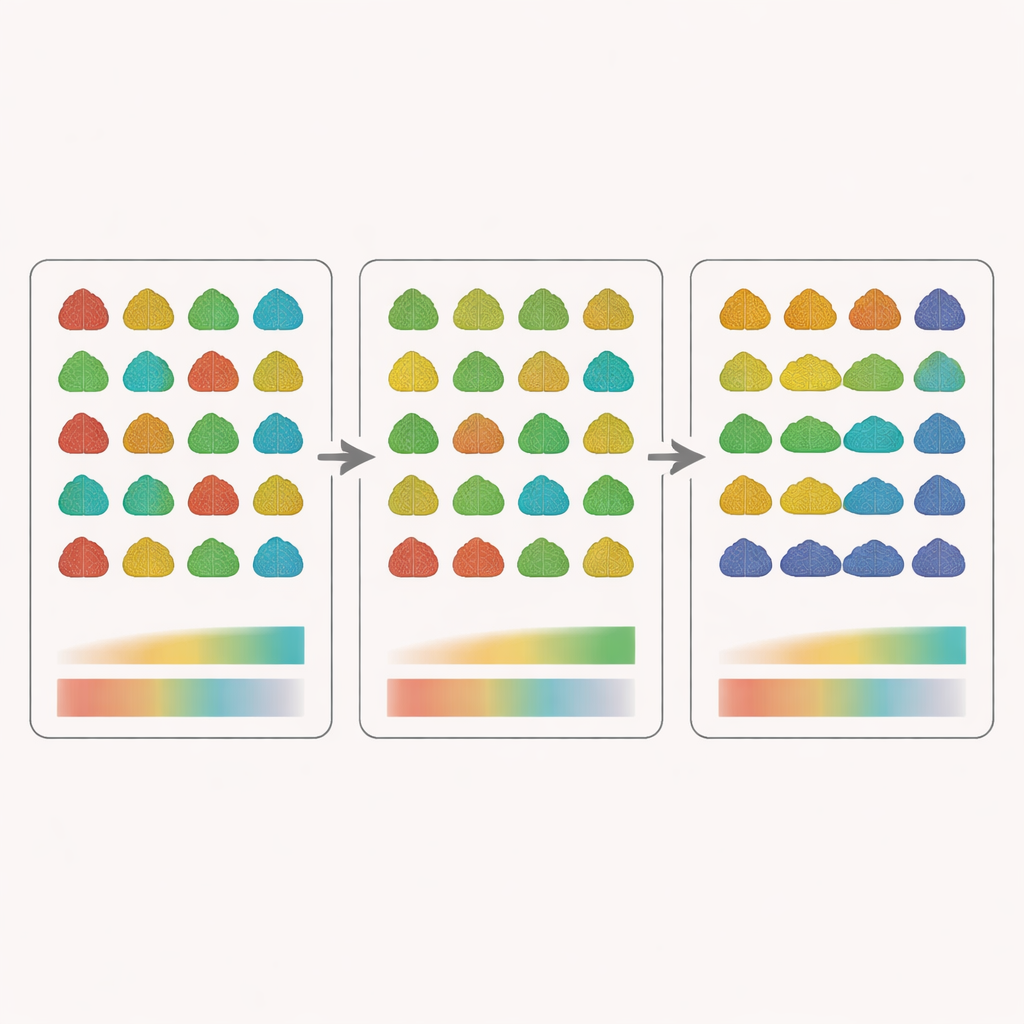
When the three groups were compared, the clearest difference involved a microstate linked in past work to networks that decide what information is important and support daydreaming and self‑reflection. In people with Parkinson’s disease dementia, this microstate occurred less often than in healthy volunteers. Across all participants with Parkinson’s, longer‑lasting episodes of two microstates, including this one, went hand in hand with worse overall thinking scores and poorer memory, visuospatial skills, and attention. In contrast, a microstate tied to visual processing tended to appear more frequently in those who performed better, suggesting that a flexible, active visual network may help preserve cognitive abilities.
What the findings reveal about brain networks
These results point to a picture of the Parkinson’s brain in which large‑scale networks become less flexible and efficient as dementia develops. Instead of smoothly switching among configurations, the brain in affected individuals appears to linger too long in certain states and fail to engage others often enough. The study also showed that worse movement symptoms, especially slowness and stiffness, were linked to poorer thinking, underlining how motor and cognitive decline are intertwined. Although not every group difference remained strong after strict statistical corrections—partly due to the modest sample size—the consistent relationships between microstate timing and cognitive scores suggest that these fast electrical snapshots capture something meaningful about underlying network health.
How this could help people with Parkinson’s
For a layperson, the key message is that the brain’s “background hum” carries clues about who with Parkinson’s disease is most at risk for serious thinking problems. A reduced and sluggish pattern in specific microstates, particularly those involved in picking out important events, seems to signal greater vulnerability to dementia, while a more active visual pattern appears protective. Because EEG is non‑invasive, relatively inexpensive, and widely available, refining these microstate measures could one day help doctors monitor brain health, tailor treatments, and perhaps evaluate therapies aimed at keeping thinking abilities intact for as long as possible.
Citation: Zhao, Y., Xu, J., Xu, X. et al. EEG microstate alterations in Parkinson’s disease dementia. Sci Rep 16, 11278 (2026). https://doi.org/10.1038/s41598-026-40029-0
Keywords: Parkinson’s disease, dementia, EEG microstates, brain networks, cognitive impairment