Clear Sky Science · en
CDX2 expression dynamics in tumor clusters: a morpho-molecular biomarker in rectal cancer pretreatment biopsies revealed by sequential immunofluorescence
Why tiny tumor shapes may matter
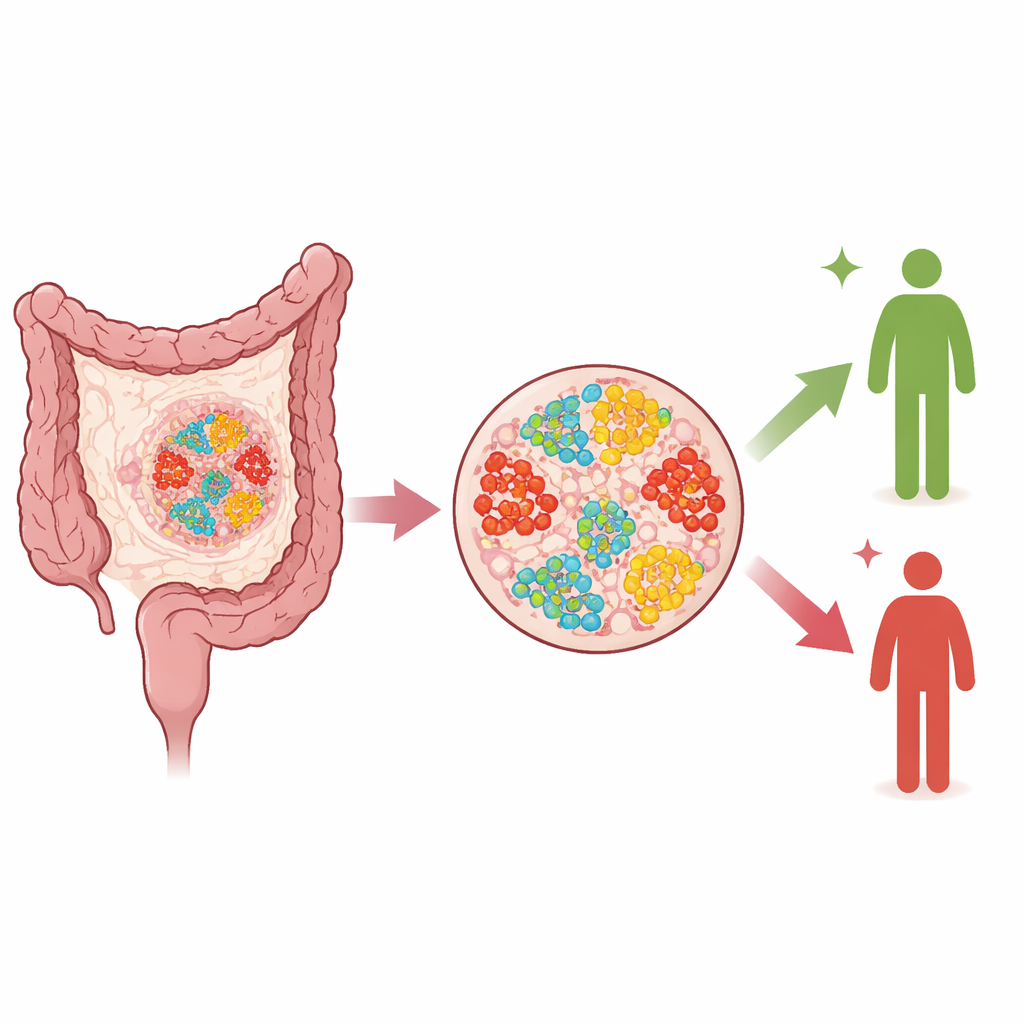
When someone is diagnosed with rectal cancer, doctors would love to know early on who will respond well to treatment and who may need a different strategy. Today, the small tissue samples taken before therapy are mainly used just to confirm the diagnosis, not to predict the future. This study shows that by looking closely at how cancer cells are arranged in tiny groups and how a key “identity” signal inside these cells changes, those routine biopsies could help forecast how the disease will behave.
Small cell groups with big consequences
Rectal and colon cancers often contain very small groups of cancer cells that seem to break away from the main mass. These tiny clusters, called “tumor buds,” have long been linked to a more aggressive disease that spreads more easily. However, they are hard to measure reliably, especially in the thin biopsy samples taken before treatment, and doctors have not fully understood what makes them dangerous. The authors suspected that these small clusters represent one end of a slow shape-shifting process in which cancer cells lose some of their usual gut-like features and become better at invading surrounding tissue.
Reading the glow of many proteins at once
To probe this idea, the team used a cutting-edge imaging method that can stain the same piece of tissue for more than 30 different proteins in cycles, capturing detailed color maps of where each protein appears. This allowed them to identify cancer cells, surrounding support cells, and immune cells, and to measure, cell by cell, how strongly certain markers were expressed. Central among these was CDX2, a protein that helps cells behave like normal intestinal lining. Loss of CDX2 has been linked to more aggressive cancers. The researchers first fine-tuned their imaging and computer pipeline on whole surgical samples from colon cancer, then applied it to 159 pretreatment rectal cancer biopsies taken before chemoradiotherapy.
From solid islands to scattered buds
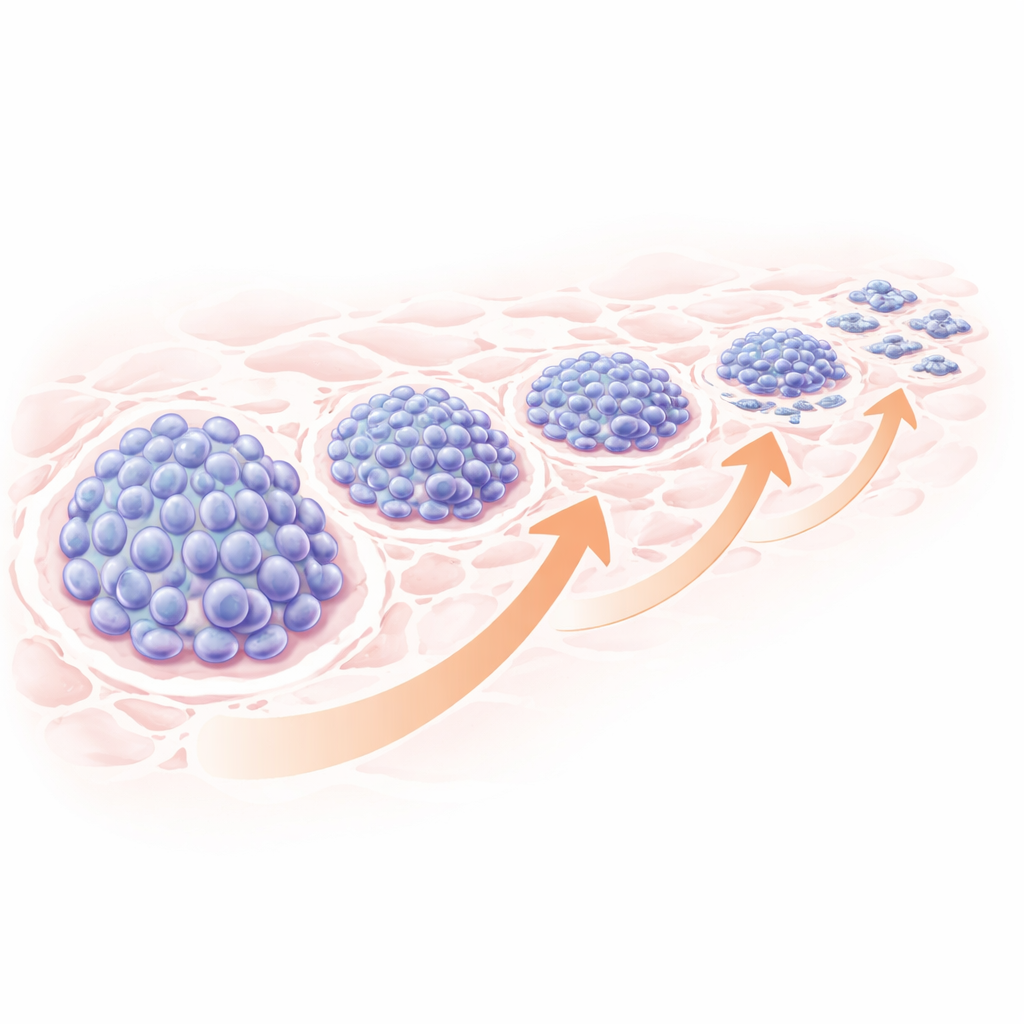
Instead of simply labeling clusters as “budding” or “not budding,” the researchers treated tumor architecture as a continuum. They used automated image analysis to segment the epithelial tumor tissue, count how many cancer cells belonged to each cluster, and measure how closely each cluster interacted with nearby scar-like stromal tissue. Large, compact islands of tumor cells tended to show stronger CDX2 and other epithelial markers, whereas small clusters and finger-like projections at the edge of the tumor more often showed weakened signals. This gradual fading of epithelial identity was seen not only at the invasive edge of the tumor but also deep in the center, exactly where pretreatment biopsies are usually taken.
A dynamic link between signal loss and cluster size
Looking at the biopsies, the crucial insight was not simply how much CDX2 the tumor had overall, nor how many small clusters were present on average. Instead, what mattered was how CDX2 levels changed as cluster size shrank within a given patient. In some tumors, small clusters kept nearly the same CDX2 signal as larger ones; in others, CDX2 dropped sharply specifically in the tiniest, most disconnected groups. Patients whose tumors showed this stronger negative link between CDX2 and cluster size had worse disease-free and overall survival, even after accounting for age, sex, and treatment type. This suggests that active loss of intestinal identity in small clusters is a hallmark of particularly infiltrative, high-risk cancers.
What this could mean for patients
Overall, the study argues that tiny cancer cell clusters in routine rectal biopsies are not just random fragments, but part of an orderly shift from solid tumors toward more invasive forms. By tracking how the CDX2 signal fades as clusters get smaller, pathologists may be able to flag patients whose cancers are especially prone to spread and resist therapy, using tissue that is already collected as part of standard care. While larger validation studies are still needed, this morpho-molecular “signature” could one day help personalize rectal cancer treatment and better identify patients who require closer monitoring or intensified therapy.
Citation: Gwerder, M., Demir, C.S., Williams, H.L. et al. CDX2 expression dynamics in tumor clusters: a morpho-molecular biomarker in rectal cancer pretreatment biopsies revealed by sequential immunofluorescence. Sci Rep 16, 10129 (2026). https://doi.org/10.1038/s41598-026-40005-8
Keywords: rectal cancer, tumor budding, CDX2, biomarkers, immunofluorescence