Clear Sky Science · en
Synthesis and quantum chemical studies of polyfunctionally substituted pyridines incorporating pyrimidine moiety for corrosion Inhibition
Why stopping rust matters
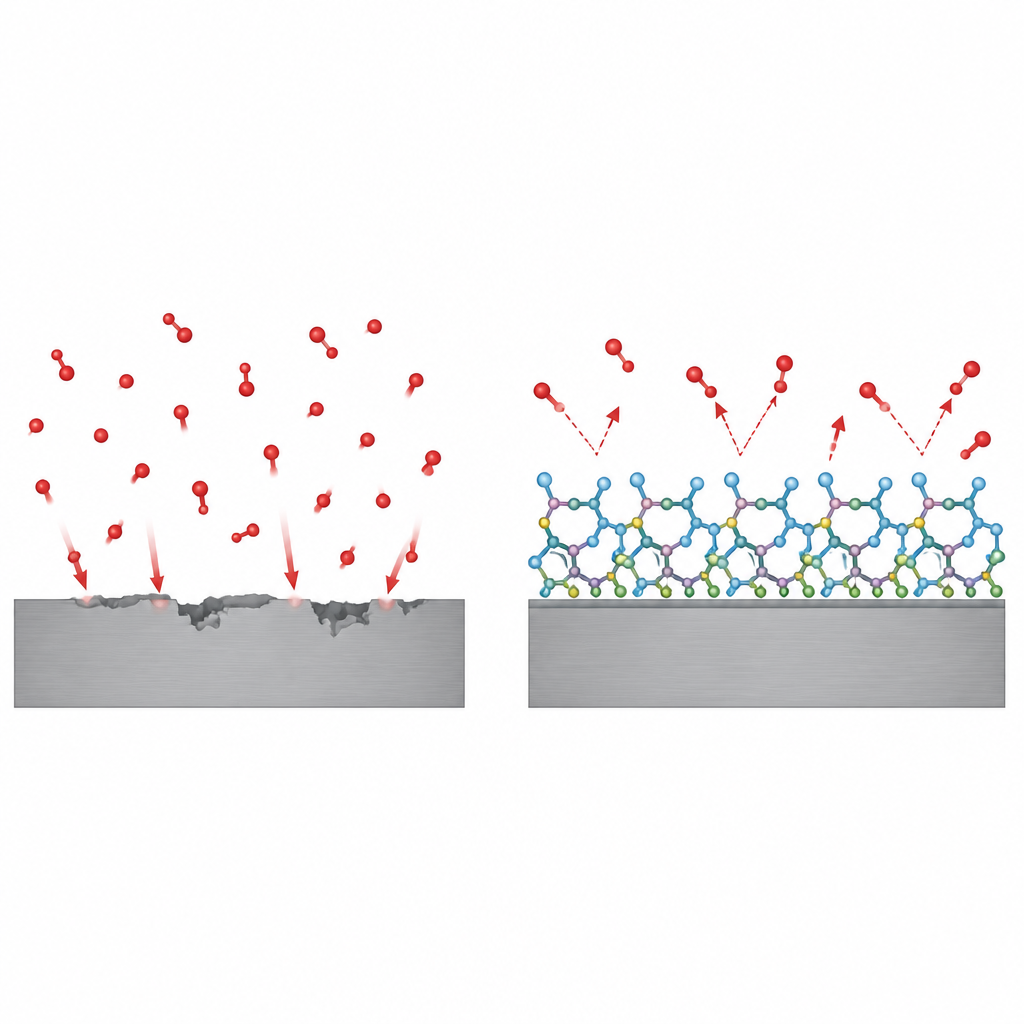
From bridges and oil pipelines to cars and household appliances, metal is everywhere in modern life. But metal slowly eats itself away in a process we call corrosion, often sped up by acids and salty water. Finding coatings that can gently cling to metal and slow this decay helps save money, energy, and resources, and can cut down on waste. This study explores a new family of small carbon-based molecules designed to “sit” on metal surfaces and act as tiny shields against corrosion, using both lab chemistry and computer modeling to understand how and why they work.
Designing new shield molecules
The researchers started from a known chemical building block and used it to construct a series of related molecules that all share a ring-shaped core containing nitrogen atoms. These ring systems, called pyridines and pyrimidines, are already common in medicines and agricultural products, and they have attracted interest as gentle, eco-friendly corrosion fighters. By reacting the starting material with different small partners, the team produced a network of new, more complex ring structures, including fused rings and sulfur-containing rings. Careful analysis with standard tools such as infrared, nuclear magnetic resonance, and mass spectrometry confirmed the exact shape and composition of each new compound.
How computers see the molecules
Making a new molecule is only half the story; the other half is understanding how it behaves near a metal surface. Here the team turned to quantum chemical calculations, a technique that uses the rules of quantum physics to predict how electrons are arranged in a molecule. They focused on features such as the energy of the outermost occupied electrons, the energy gap between filled and empty states, and how soft or hard the electron cloud is. Molecules that easily donate electrons and that have certain patterns of charge on nitrogen, oxygen, and sulfur atoms are expected to cling more strongly to metal and block the approach of corrosive species in acid.
Finding the most active sites
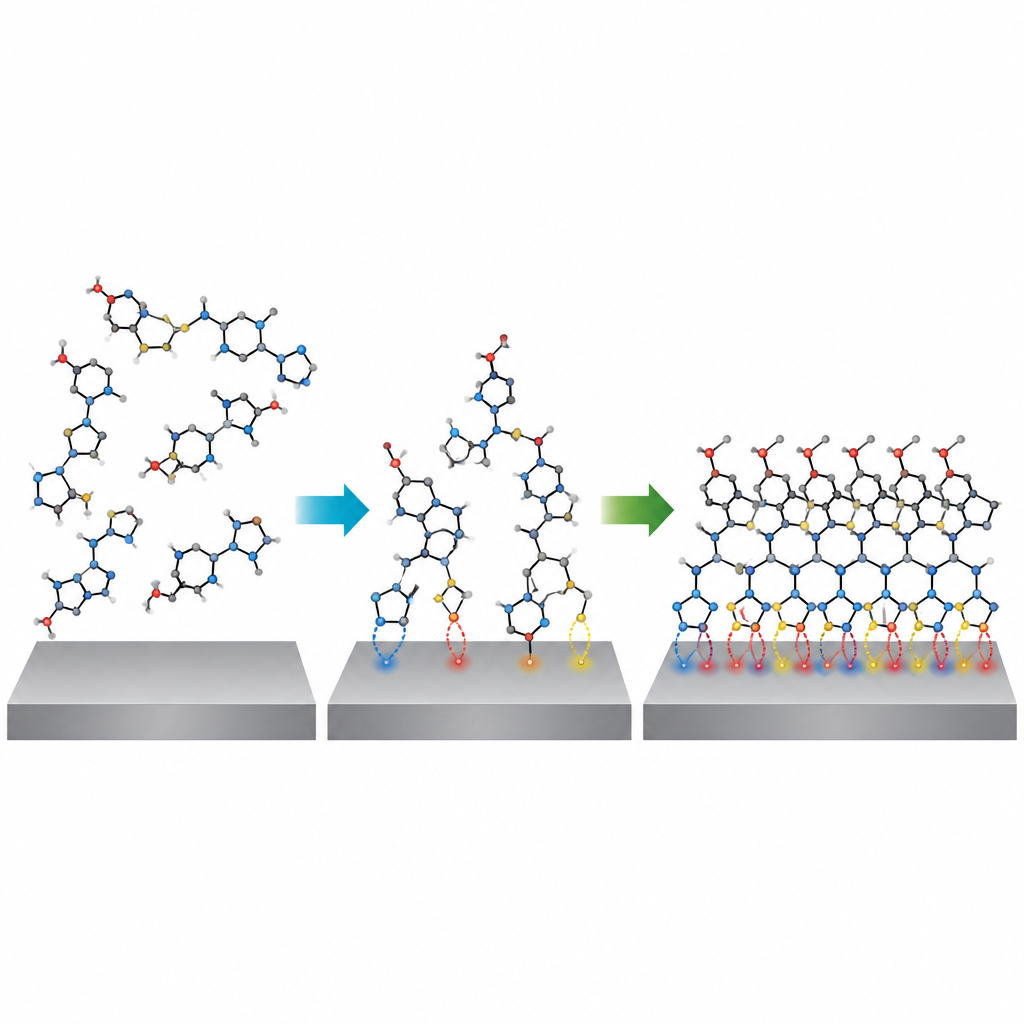
The calculations revealed that the most important regions of these molecules are the nitrogen-rich ring units and attached amino groups. In the computer models, the highest electron density often sits on the pyrimidine portion and on nitrogen atoms that can share their lone pairs with the metal. This suggests that, in a corrosive solution, these parts of the molecule will be drawn toward the metal, forming chemical or electrostatic bonds. The study also examined how replacing hydrogen atoms with electron-releasing groups changes the softness and charge distribution, generally boosting the ability of the molecule to act as a corrosion barrier.
The standout protector
By comparing the calculated properties across all of the synthesized molecules, the researchers could rank their likely performance as inhibitors. One particular compound, an isoquinoline derivative labeled 22b in the study, stood out. It has a very small energy gap between its key electron levels, a high softness value, and many potential binding points, including several amino groups, two oxygen atoms, and one sulfur atom. Together, these features give it a high tendency to donate electrons and spread charge over its structure, making it especially capable of attaching to metal surfaces and covering them with a protective film in acidic conditions.
What this means for real-world metals
For non-specialists, the takeaway is that small changes in molecular structure can strongly affect how well a compound protects metal. By combining synthetic chemistry with quantum calculations, this work shows how scientists can pre-screen families of molecules on a computer before moving to full corrosion tests. The results suggest that the newly designed nitrogen- and sulfur-containing rings, especially the isoquinoline candidate 22b, are promising building blocks for the next generation of metal-saving additives in harsh industrial environments.
Citation: Hussein, A.H.M., Ashmawy, A.M., Rady, M.A. et al. Synthesis and quantum chemical studies of polyfunctionally substituted pyridines incorporating pyrimidine moiety for corrosion Inhibition. Sci Rep 16, 14637 (2026). https://doi.org/10.1038/s41598-026-39989-0
Keywords: corrosion inhibition, pyridine compounds, pyrimidine derivatives, DFT calculations, metal protection