Clear Sky Science · en
MI-SOH: a multi-indicator feature dependency model for lithium-ion battery state-of-health Estimation
Why Smarter Battery Health Matters
Electric cars and home energy storage systems increasingly rely on lithium-ion batteries. Yet, like all batteries, they slowly wear out. Knowing how “healthy” a battery really is, long before it fails, is crucial for safety, cost, and convenience. This paper introduces a new way to estimate battery health that looks at many signals at once and learns how their relationships change as the battery ages, promising more accurate and robust monitoring for real-world use.

Seeing Battery Health as More Than One Number
Battery health, often called state-of-health, describes how much useful energy a battery can still store compared with when it was new. Traditional methods to assess this rely on lab measurements, such as internal resistance or detailed electrochemical tests, which are accurate but expensive and hard to perform continuously in a car. Newer, data-driven methods watch simple measurements like voltage, current, and temperature during everyday charging, and use machine learning to estimate health. However, most of these approaches either focus on a single indicator, or treat multiple indicators as if their importance never changes, even though the battery’s behavior clearly evolves over its lifetime.
Listening to Many Battery Signals at Once
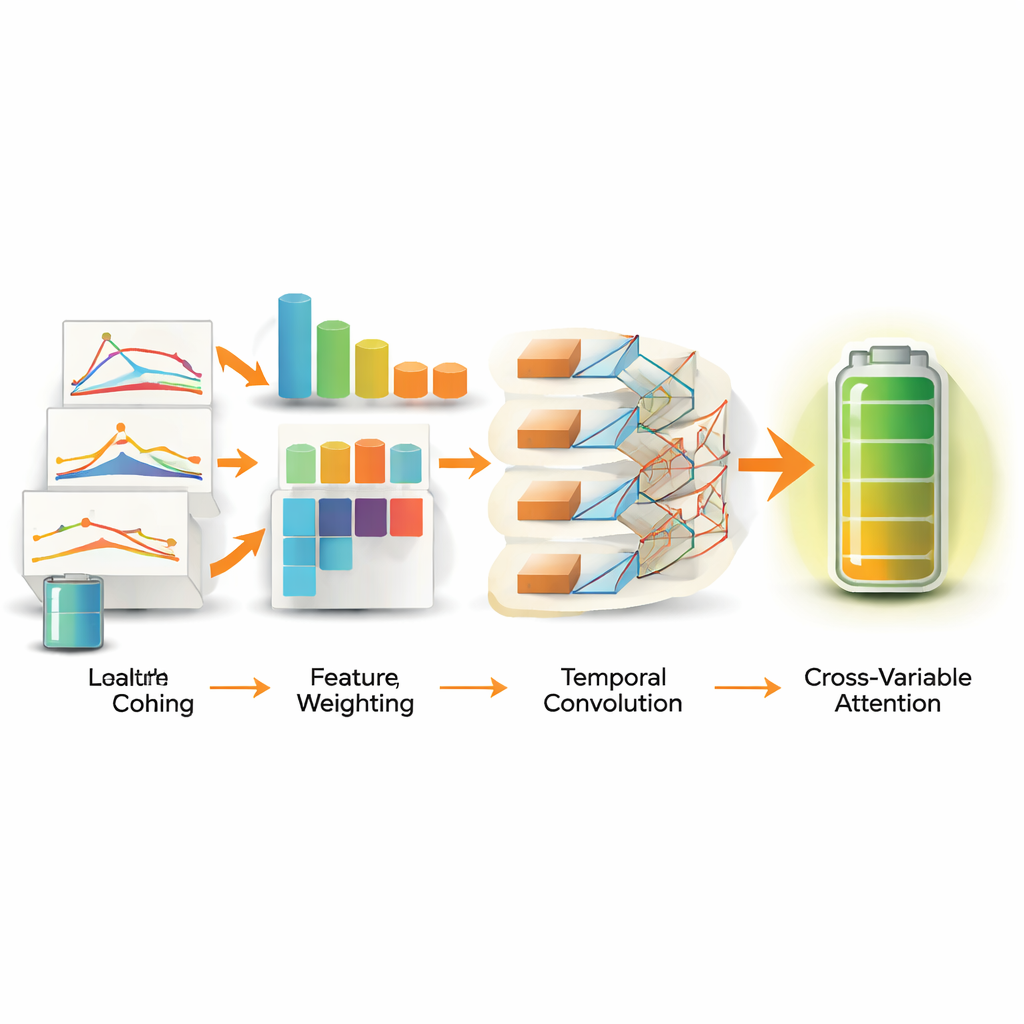
The authors show that key battery signals do not stay in fixed relationships with each other as the battery ages. For example, how strongly a charging-time feature is linked to a peak in a diagnostic curve can fall sharply later in life, while some voltage-related pairs flip from weakly negative to strongly positive correlation. To handle this shifting landscape, they propose MI-SOH, a framework that combines eight different health indicators extracted from charging data, including how long constant-current and constant-voltage phases last, how quickly voltage and current change, how hot the cell gets, and characteristics of a so‑called incremental-capacity peak that reflects internal chemistry. A special weighting step blends two forms of correlation analysis so the model can emphasize the most informative indicators and downplay those that become less reliable as the battery moves through different aging stages.
Teaching the Model to Follow Time and Interactions
Once the indicators are weighted, MI-SOH feeds them into a temporal convolutional network that excels at spotting patterns over time, from single charge cycles all the way to long-term fading trends. Unlike traditional recurrent networks, this design can be computed efficiently and avoids common training pitfalls. The output is then passed to an inverted transformer module, which flips the usual perspective: instead of focusing on each moment in time, it treats each indicator as a separate “channel” and learns how these channels influence one another across the full history. This allows the model to capture how voltage, current, temperature, and incremental-capacity features jointly reflect the underlying wear of the battery.
Automatically Finding the Best Settings
Modern deep models have many internal settings—such as how many layers to use and how wide they should be—that strongly affect performance. Manually tuning them, or scanning them systematically, is tedious and often impractical. The authors therefore add an optimization layer inspired by zebra group behavior, which searches for good combinations of these settings by alternating between “foraging” (refining promising candidates) and “defense” (exploring new regions). This automated tuner configures the temporal and transformer blocks, as well as training parameters like learning rate and batch size, so that MI-SOH adapts to different types of batteries and usage conditions without exhaustive trial-and-error.
What the Tests Say for Real Batteries
The team evaluated MI-SOH on two widely used public datasets: NASA’s cylindrical cells and CALCE’s prismatic cells, which differ in chemistry, size, and lifetime. In both cases, their method tracked battery health more accurately than several strong baselines, including stand‑alone temporal models, stand‑alone transformer models, and a simple combination of the two without adaptive weighting or automated tuning. On average, MI-SOH reduced prediction errors by roughly one-third to three-quarters compared with these alternatives, while maintaining very high agreement with the true measured capacity over hundreds of cycles. Ablation tests—where individual components are removed—confirmed that each building block (adaptive weighting, temporal modeling, cross-indicator attention, and automated optimization) contributes meaningfully to the final accuracy.
Clear Takeaways for Everyday Technology
For a lay reader, the key message is that battery health is best understood not from a single number or fixed rule, but from a shifting pattern of many signals that change as the cell ages. MI-SOH captures this complexity by learning which signals matter most at each stage of life, how they evolve over time, and how they influence each other. The result is a practical, data-driven tool that can be embedded in battery management systems for electric vehicles and energy storage. By giving more precise and reliable health estimates, it can help prevent unexpected failures, extend battery lifetimes, and lower the overall cost and risk of electrified transport and renewable energy systems.
Citation: Zhuo, S., Zou, F., Liao, L. et al. MI-SOH: a multi-indicator feature dependency model for lithium-ion battery state-of-health Estimation. Sci Rep 16, 12309 (2026). https://doi.org/10.1038/s41598-026-39986-3
Keywords: lithium-ion battery health, state-of-health estimation, battery diagnostics, data-driven battery modeling, electric vehicle batteries