Clear Sky Science · en
New energy vehicle fault identification based on improved activation functions and parameter-free attention mechanisms
Why smarter car checkups matter
As electric and hybrid cars spread worldwide, keeping them safe and reliable becomes just as important as making them clean and efficient. Unlike traditional engines, new energy vehicles rely on batteries, motors, and power electronics that can fail in subtle ways long before a dashboard warning light appears. This study explores how modern artificial intelligence can sift through streams of sensor data inside these vehicles to spot early signs of trouble more accurately and more quickly than today’s rule-based systems—potentially reducing breakdowns, repair costs, and safety risks for everyday drivers.
Hidden patterns inside electric cars
New energy vehicles constantly monitor many signals: voltage and current from the battery, motor speed, temperatures, vibration, and the surrounding environment. Under harsh real-world conditions, these measurements can be noisy, unbalanced, and riddled with outliers, making it difficult to separate normal behavior from genuine faults. Traditional fault diagnosis often depends on expert-designed rules or simple statistical models, which struggle with the messy, nonlinear patterns that arise when parts age, loads fluctuate, or weather changes quickly. The authors argue that a more flexible, data-driven approach is needed—one that learns patterns directly from sensor histories rather than relying on fixed thresholds.
A smarter pattern-spotting engine
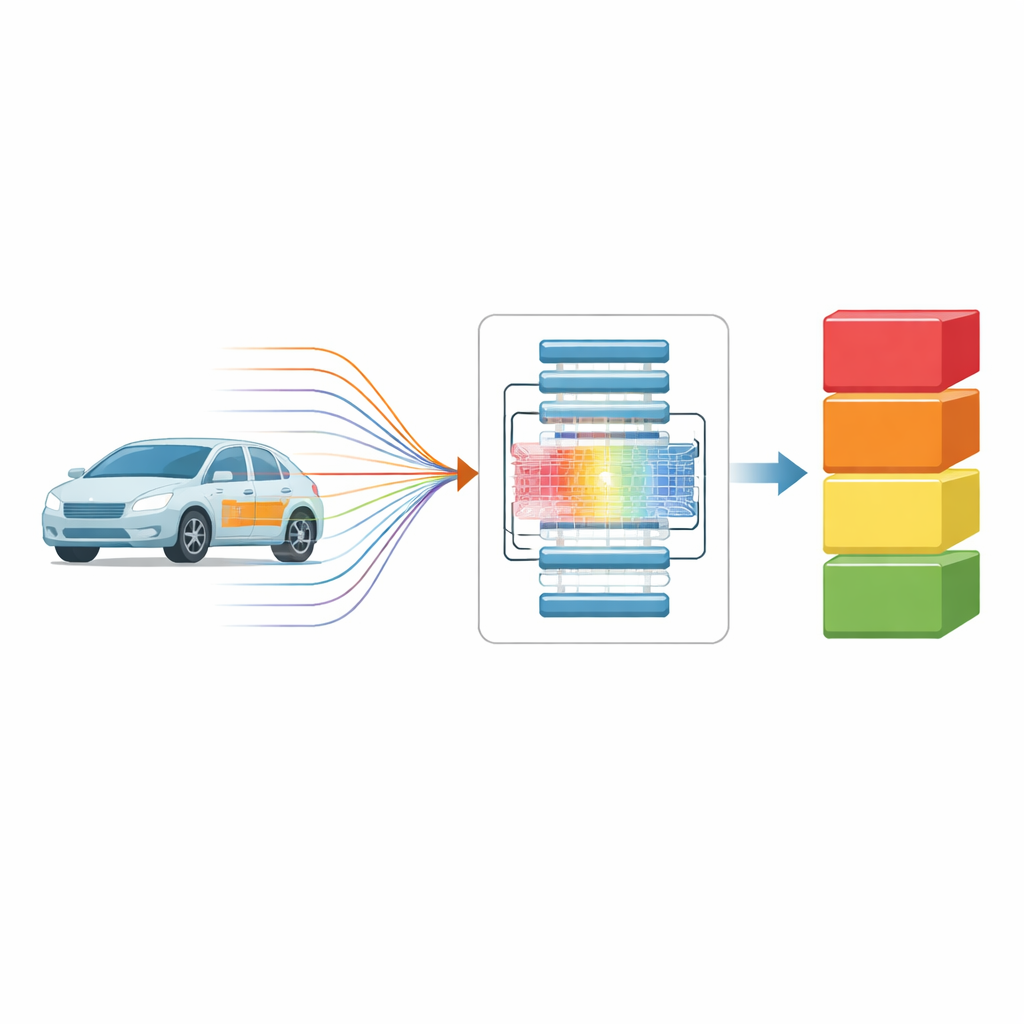
To tackle this challenge, the researchers design an upgraded version of a convolutional neural network, a type of AI already known for finding patterns in images and signals. Their model is tailored to the quirks of electric vehicle data. First, they introduce a new mathematical element, called ReLUT, that helps the network respond smoothly to both strong and weak signals, instead of ignoring faint but important hints of trouble. Second, they add a special attention component, SimAM, which automatically emphasizes the most informative parts of each sensor snapshot without adding extra adjustable knobs that would bloat the model. Finally, they weave in residual shortcuts—detours that let information skip ahead through the network—so learning remains stable and efficient even as the model becomes deeper.
Putting the model to the test
The team evaluates their design on NEVData, a custom-built dataset of 11,000 ten-second slices of real driving data, each labeled as either healthy operation or one of three fault types. The dataset reflects practical complications: most samples are normal, some fault types are rarer, and certain measurements contain extreme values. After standardizing the signals and splitting the data into training and test sets, they compare their Improved CNN against a wide range of popular approaches, from classic methods such as support vector machines and k-nearest neighbors to modern deep learning models including LSTMs, Transformers, and advanced temporal convolution networks. Across accuracy, precision, recall, and F1-score, the proposed model consistently comes out on top, reaching about 99% accuracy and outperforming strong competitors by noticeable margins.
Why attention and activation matter
To understand which ingredients truly make a difference, the authors conduct an ablation study, systematically turning features on and off. A plain CNN with residual links already performs well, but adding their ReLUT function improves its ability to capture complex fault shapes. Adding the SimAM attention module alone yields a slightly larger boost by sharpening focus on subtle but diagnostic cues. When both pieces are combined, performance is highest, and the model is more robust to imbalanced classes and noisy data. Despite these gains, the system remains lightweight enough to run on compact on-board computers, delivering millisecond-level responses and modest memory use—key requirements for real-time monitoring inside vehicles.

What this means for everyday drivers
In plain terms, this work shows that a carefully tuned AI can act like a highly skilled mechanic living inside each electric car, continuously listening to dozens of digital “stethoscopes” and spotting problems before they become serious. By blending a smarter way of reacting to signals (ReLUT), a focused way of paying attention (SimAM), and efficient network wiring (residual shortcuts), the proposed model delivers more reliable fault warnings than existing techniques without overwhelming the car’s computer. As such tools mature and are integrated into vehicle control systems, they could support predictive maintenance, fewer unexpected breakdowns, and longer component lifetimes—making new energy vehicles safer and more dependable for everyday use.
Citation: Yan, J., Wu, H. & Dai, W. New energy vehicle fault identification based on improved activation functions and parameter-free attention mechanisms. Sci Rep 16, 11528 (2026). https://doi.org/10.1038/s41598-026-39957-8
Keywords: electric vehicle diagnostics, fault detection, deep learning, sensor data, predictive maintenance