Clear Sky Science · en
Neuroimaging-driven recommendation systems for personalized sports training and injury prevention
Why brain scans matter for everyday athletes
Most people think of brain scans as tools for diagnosing disease, not for deciding how to train for a race or avoid a sprained knee. This study shows how reading the brain during movement can help coaches and athletes tailor workouts to each person, lowering injury risk while improving performance. By linking brain activity with body signals such as motion and heart rate, the researchers describe a system that could turn complex neuroscience into practical guidance on when to push harder and when to back off.
From one-size-fits-all plans to brain-aware training
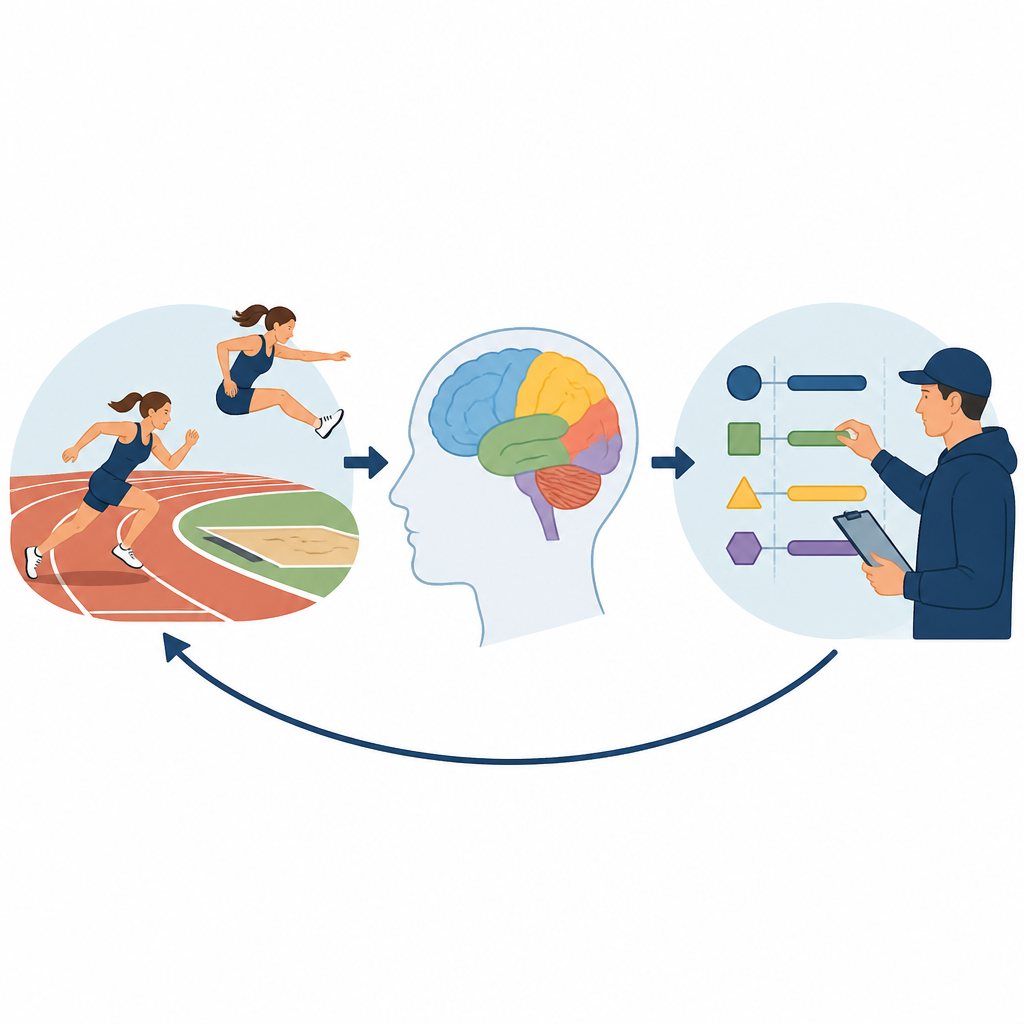
Traditional training programs treat most athletes alike and rely mainly on visible signs like speed, strength, or heart rate. Yet the brain quietly shapes every movement, from reaction time at the starting gun to balance during a landing. Earlier computer systems for training used fixed rules crafted by experts. These were clear to understand but could not adapt well to individual differences or changing conditions. Later, machine learning models learned from large collections of performance and video data, but still mostly ignored the brain. As a result, they could optimize sets and reps, but not account for mental fatigue, focus, or subtle neural warning signs that often appear before an injury.
Reading the brain to guide performance
The authors propose a new model, NeuroAthleteNet, that places brain signals at the center of training advice. It works with many kinds of brain measurements, including scalp recordings and brain scans, treated as time-varying patterns across many regions. First, the system passes these signals through layers that detect short bursts and longer trends in brain activity over time. Then it represents the brain as a network, where each region is a node and the strength of their interaction forms the links. Special network-learning tools capture how patterns of co-activity across this brain map relate to real performance measures such as reaction speed, movement accuracy, and early signs of fatigue. The model is trained so that its learned brain connections stay close to patterns already known from neuroscience, helping keep the system grounded in biology rather than becoming a black box.
Blending brain, motion, and body signals
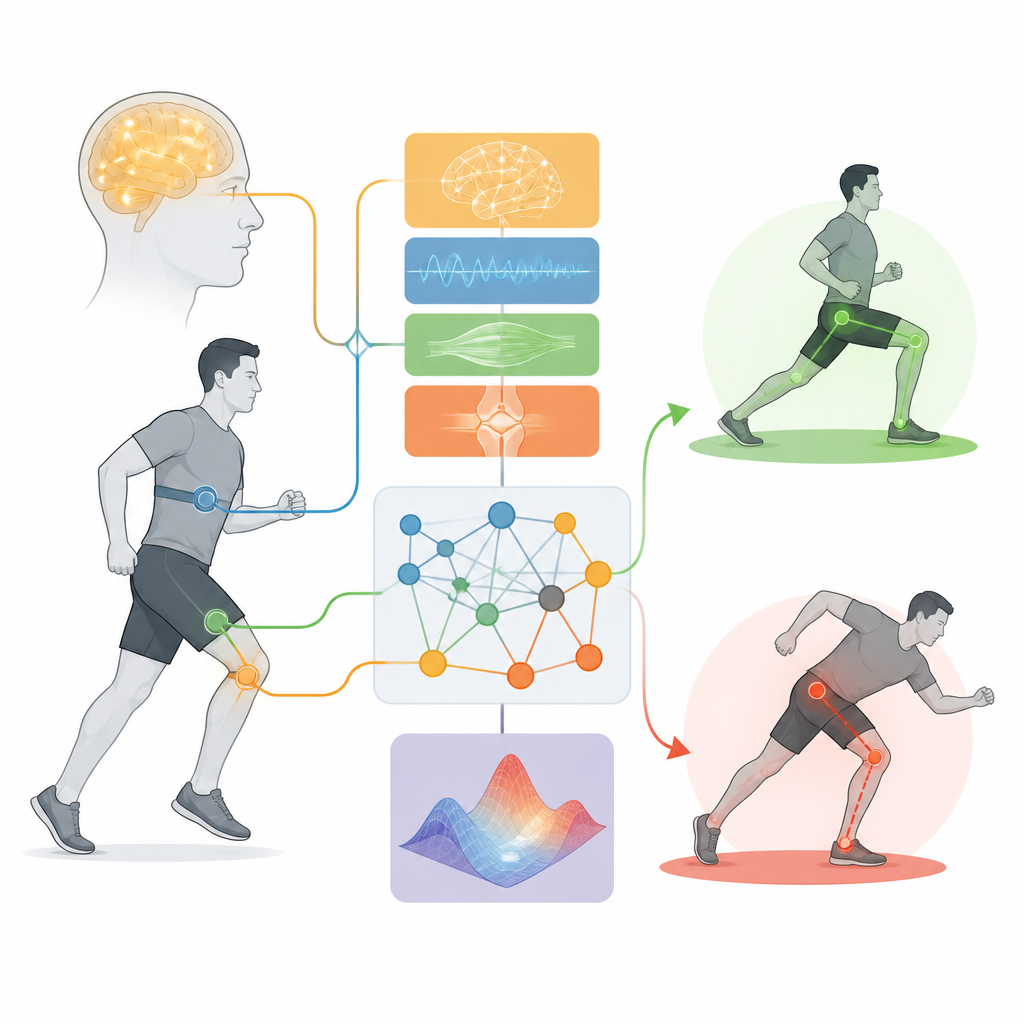
Building on this brain-centered core, the authors introduce a second framework called NeuroSportSync, which ties together brain data with movement, muscle, and heart signals recorded during exercise. Because each sensor operates on a different time scale and range, the system first resizes and normalizes all the streams so they line up in time and scale. It then picks out the most informative pieces and compresses them into a shared hidden representation. A spotlight-like mechanism lets the model focus on whichever signals matter most in each moment, for example emphasizing knee motion during cutting movements or frontal brain activity during mentally demanding drills. These combined signals feed into a network that predicts both performance and the likelihood that an athlete is entering a risky state.
Spotting silent warning signs before injuries
The study highlights that many non-contact injuries, such as ligament tears, have roots in the nervous system as well as the muscles and joints. Past research has found that changes in brain regions involved in planning movement, sensing joint position, and filtering distractions can appear days or weeks before a visible injury. The authors use such findings to define markers of high and low injury risk in their system. Their model looks for patterns like shifts in brain rhythms and weakened links between key regions, and combines them with body measures like heart rhythm or muscle activity. In tests on brain-signal datasets, this approach outperformed standard methods that use simpler statistics and classic machine learning, showing better accuracy in recognizing when athletes were performing well and when they might be at higher risk.
What this means for the future of training
The work suggests a path toward training plans that respond not just to how fast or strong someone is, but to how their brain and body are coping with stress on any given day. In principle, such systems could recommend lighter drills when mental fatigue rises, flag hidden risk before a serious injury, or tailor skill practice to how each athlete’s brain learns new movements. The authors note that current hardware is still complex and costly, and that more studies on real teams and sports are needed. Still, their neuroimaging-driven recommendation framework offers a blueprint for bringing brain-aware personalization into everyday sports practice, with the twin goals of better performance and safer play.
Citation: Zhu, D., Li, Q., Li, M. et al. Neuroimaging-driven recommendation systems for personalized sports training and injury prevention. Sci Rep 16, 14783 (2026). https://doi.org/10.1038/s41598-026-39956-9
Keywords: neuroimaging, sports training, injury prevention, brain signals, personalized coaching