Clear Sky Science · en
Dual-band composite high gain MIMO antenna for 5G NR applications employing shareable small cell radio unit
Why faster indoor wireless matters
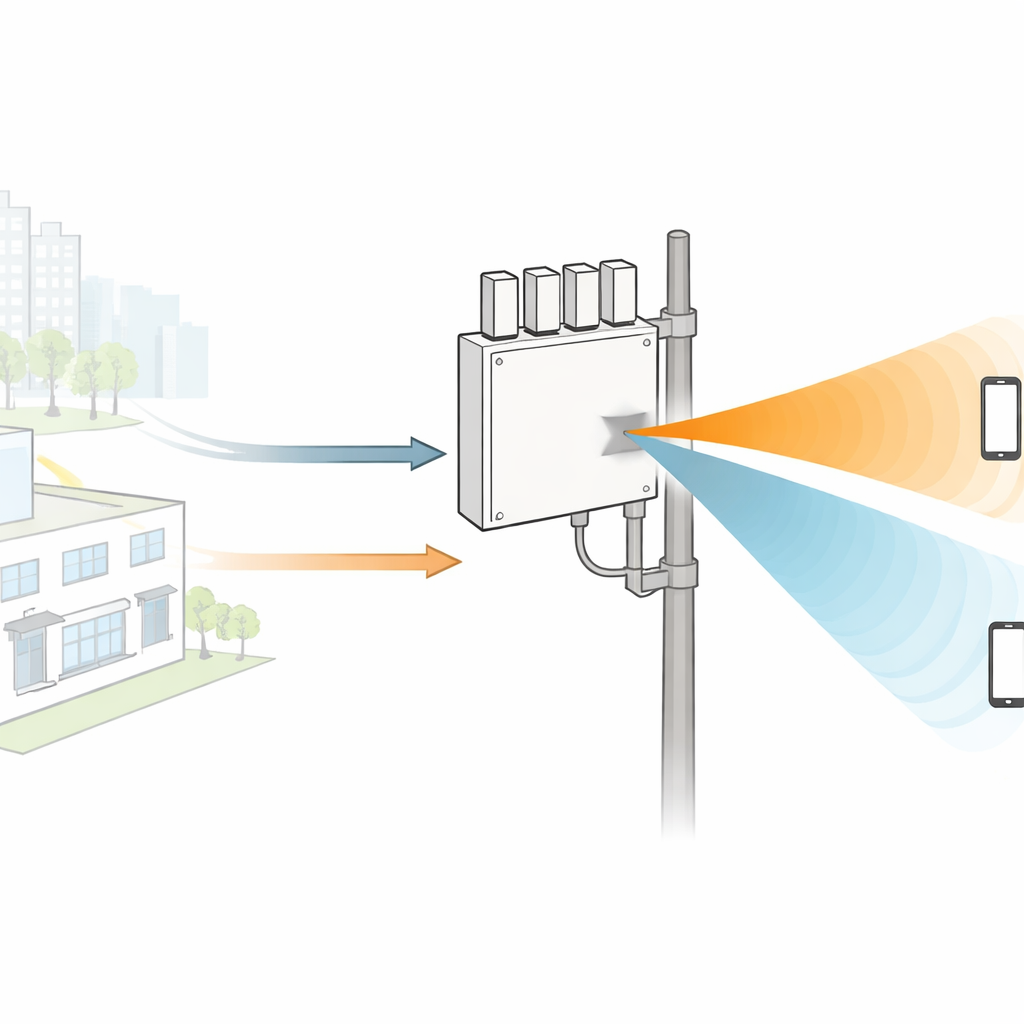
From 4K video streams to virtual reality headsets and smart devices in every room, most of today’s internet traffic actually comes from inside buildings. To keep all these gadgets connected, networks are adding many small, low‑power base stations—called small cells—closely spaced in offices, malls, stadiums, and city streets. This paper presents a new compact antenna design that helps a single 5G small cell serve multiple operators and work efficiently across both the main 5G frequency ranges, boosting speed and coverage where people use data the most.
Two key 5G lanes in one compact design
Modern 5G systems rely on two very different slices of the airwaves. One sits below 6 GHz and carries signals reliably through walls over moderate distances; the other lives in the millimeter‑wave range around 26 GHz and above, where data rates are very high but signals are more easily blocked. A radio unit that different mobile operators can share must work across both of these “lanes” at once. Existing dual‑band antennas can do this, but they often suffer from narrow usable bandwidth, bulky 3D structures that are hard to manufacture, or limited gain, which reduces coverage. The authors tackle this challenge by creating a single antenna module that is both compact and capable of strong performance in widely separated frequency bands.
How the new antenna is built
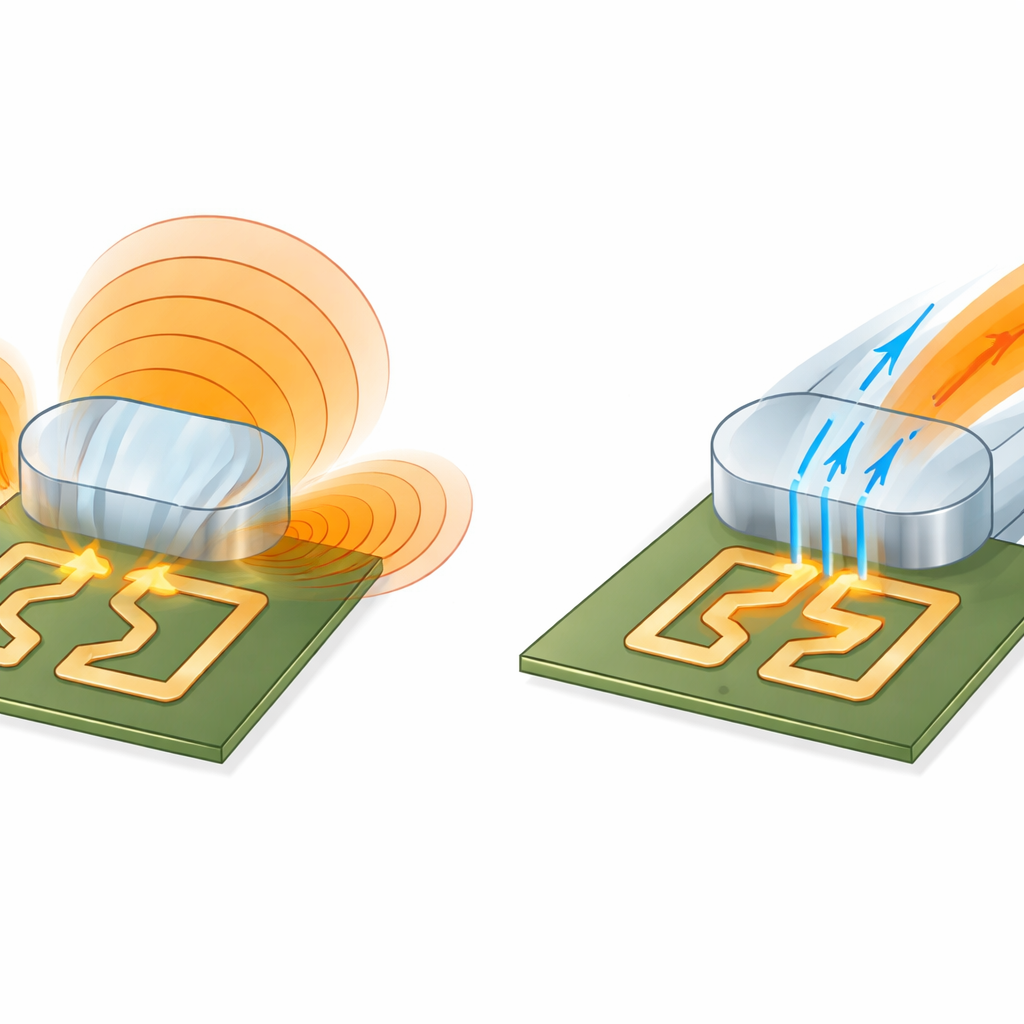
The heart of the work is a four‑element MIMO (multiple‑input multiple‑output) antenna, meaning four small antennas working together to improve data throughput and reliability. Each element combines a flat metal pattern and a carefully shaped block of insulating material. On the printed circuit board, a U‑shaped metal trace acts as the main radiator in the lower 5G band, and a small bow‑tie‑shaped metal patch placed between its arms boosts its effective size and gain. Sitting directly above this is a “perturbed barrel” dielectric block—a piece of material that guides radio waves without conducting electricity. Its shape is carved from a cylinder and then cut and modified so that it supports a useful higher‑order mode at millimeter‑wave frequencies.
One structure, two roles
A clever aspect of the design is that the same physical parts behave differently at low and high frequencies. In the sub‑6 GHz band, the dielectric block mainly acts like a passive cover that slightly shifts and broadens the response of the U‑shaped metal antenna while the bow‑tie patch enhances gain. At millimeter‑wave frequencies, the roles flip: the metal pattern now primarily feeds energy into the dielectric block, which becomes the main radiator. Because of its tailored shape and material, the block supports a hybrid mode that naturally sends power in an end‑fire direction—that is, out along the surface of the small cell, ideal for line‑of‑sight indoor links and dense urban hotspots. Careful choice of the material’s permittivity balances strong radiation with sufficiently wide bandwidth.
Measured performance in realistic 5G bands
The team fabricated the antenna using standard circuit etching and water‑jet cutting for the dielectric pieces, then measured its performance in the lab and in a real indoor 5G testbed. In the lower band, the antenna covers roughly 2.8 to 4.9 GHz with a high fractional bandwidth of about 53%, comfortably spanning the widely used n77 and n78 5G bands. Here it delivers a peak gain about 8.2 dB with broadside radiation suitable for room‑filling coverage. In the millimeter‑wave band, it operates from 24 to 29.3 GHz, covering popular bands such as n257 to n261, with about 20% fractional bandwidth and a peak gain around 13.1 dB in an end‑fire direction. The four‑element arrangement shows very low coupling between elements and favorable diversity metrics, which are important for robust MIMO performance.
What this means for everyday connectivity
In simpler terms, the authors have engineered a single, compact antenna module that can efficiently handle both the “reach” band and the “speed” band of 5G at once, while staying compatible with open, shareable radio architectures like Open RAN. Its wide bandwidth, strong gain, and ability to support multiple antennas in a small footprint make it well‑suited to small cells that several mobile operators can share in busy indoor or dense urban environments. As networks continue to densify, designs like this one offer a practical building block for faster, more flexible wireless service where people actually use it: inside homes, offices, arenas, and city streets.
Citation: Asadullah, Shoaib, N., Khan, M.U. et al. Dual-band composite high gain MIMO antenna for 5G NR applications employing shareable small cell radio unit. Sci Rep 16, 11008 (2026). https://doi.org/10.1038/s41598-026-39955-w
Keywords: 5G small cells, MIMO antenna, millimeter wave, dual-band design, Open RAN