Clear Sky Science · en
Modeling the impacts of climate-smart practices on soil–water interaction and wheat yield under climate change in central Ethiopia
Why saving rain on farms matters
In much of Ethiopia, millions of rural families depend on rain-fed wheat fields that are increasingly stressed by a warming, less predictable climate. When precious rain hits bare, hard soil, much of it runs off or evaporates instead of feeding crops. This study asks a simple but vital question: can smarter ways of preparing and protecting the soil help farmers keep more of that water in the ground, grow more wheat, and stay resilient to climate change in the coming decades?
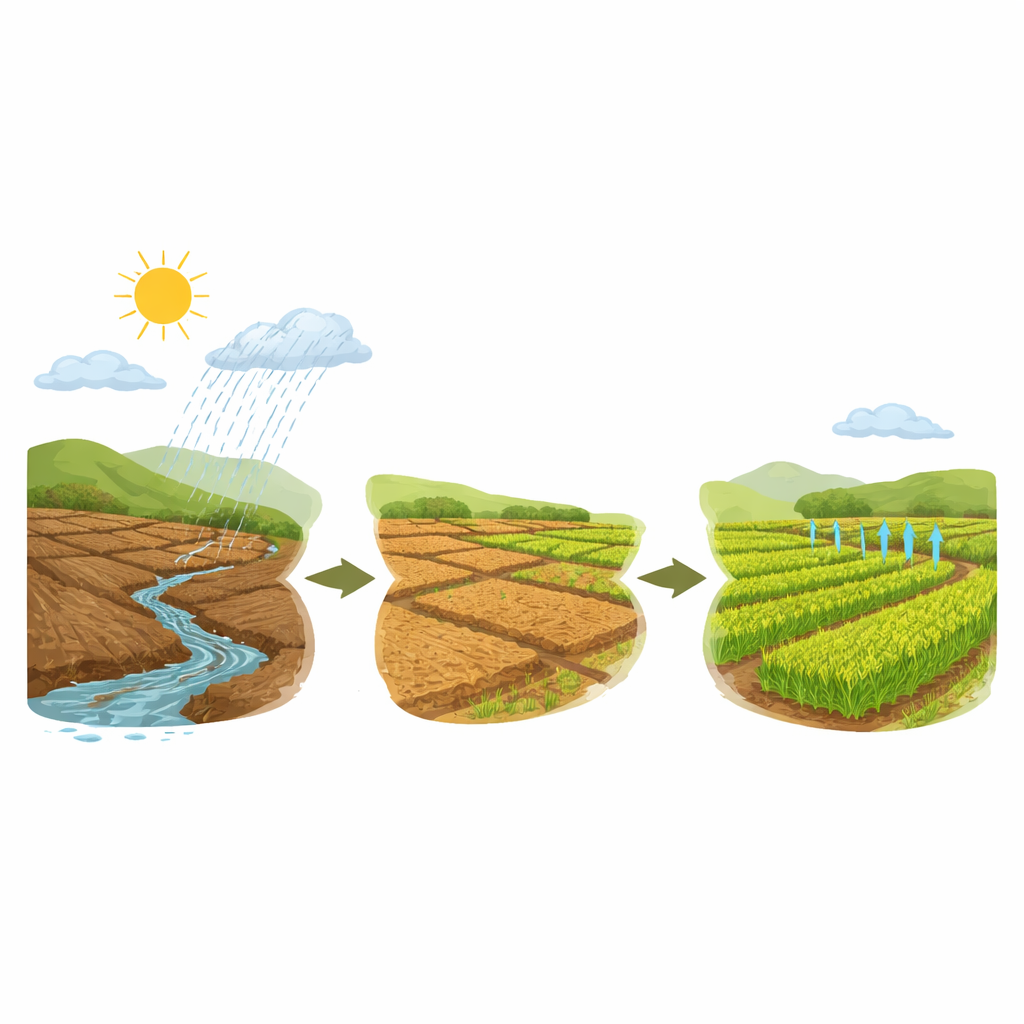
Farms on the front line of a changing climate
The research takes place in central Ethiopia’s Kulumssa region, where smallholder farmers work gently sloping fields under a single rainy season. Here, traditional plowing leaves narrow, shallow furrows and bare soil. Earlier work across East Africa shows that up to 70–85% of rainfall can be lost as runoff, evaporation, or deep seepage, leaving crops thirsty even in years with decent rain. At the same time, growing populations demand more food from the same land, making it urgent to produce higher yields without depleting soils or water.
Testing new ways to treat the soil
The team compared conventional plowing with four “climate-smart” options that change how soil is disturbed, covered, and shaped. Crop residue plots kept part of the previous wheat harvest on the surface as a light mulch. Berken plow plots used a locally developed tool that cuts deeper U-shaped furrows along the contour of the slope, helping water soak in. Soil bund plots added low earth embankments built across the slope to slow runoff. Finally, the integrated conservation practice combined improved tillage, residue cover, and physical structures in one package. Over two years, the researchers measured rainfall, runoff, soil moisture, and wheat growth in large, carefully isolated plots.
Using a crop model to see into the future
Field measurements alone capture only a few seasons, so the scientists turned to AquaCrop, a crop-water model developed by the UN Food and Agriculture Organization. After tuning the model with the 2020 data and checking its accuracy against 2021 results, they used it to simulate how each practice would perform under today’s climate and in the 2050s under a moderate global warming scenario. The model tracks how incoming rain is split into productive plant use (transpiration), wasteful soil evaporation, runoff, and deep percolation, and how these flows translate into grain yield and water-use efficiency—how many kilograms of wheat are produced for each cubic meter of water.
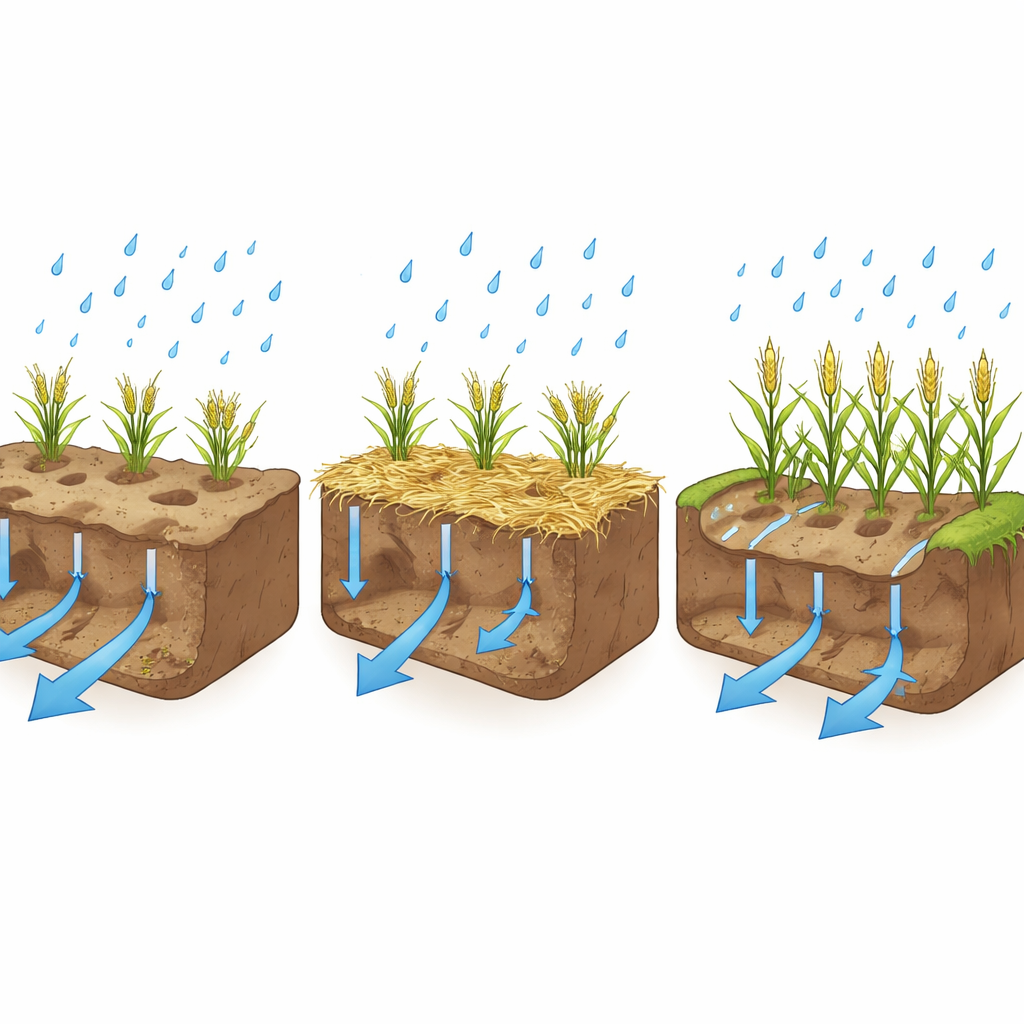
How smarter soil care reshapes the water cycle
The simulations show that climate change alone is likely to slightly reduce wheat yield and sharply reduce water-use efficiency under conventional practice by midcentury. In contrast, all four improved practices keep more water in the root zone and turn more of it into grain. Integrated conservation stands out: across both current conditions and the 2050 projections, it produces the highest transpiration, the lowest runoff and evaporation, and the deepest percolation to replenish groundwater. Under future climate, this combined approach raises grain yield to about 4.5 tonnes per hectare and boosts water-use efficiency by more than 30% compared with conventional plowing. Crop residues and the Berken plow also give strong gains, while soil bunds mainly shine for reducing erosion and storing water, with more modest yield benefits in the short term.
What this means for farmers and food security
Taken together, the findings suggest that climate-smart soil and water management can more than offset the local yield losses expected from climate change in this part of Ethiopia. While business-as-usual plowing leads to declining yields by 2050, the improved practices maintain or slightly increase production and use every drop of rainfall more efficiently. For farmers, this means better harvests, more stable incomes, and fields that are less likely to fail during dry spells. For policymakers and extension services, the study highlights integrated conservation practices—combining deeper contour tillage, residue cover, and simple earth structures—as a promising package to promote in similar highland farming systems, especially when paired with long-term trials and economic support to ease adoption.
Citation: Biratu, A.A., Bedadi, B., Gebrehiwot, S.G. et al. Modeling the impacts of climate-smart practices on soil–water interaction and wheat yield under climate change in central Ethiopia. Sci Rep 16, 12002 (2026). https://doi.org/10.1038/s41598-026-39954-x
Keywords: climate-smart agriculture, wheat yield, soil water balance, Ethiopia, AquaCrop modeling