Clear Sky Science · en
Rapid calibration of atrial electrophysiology models using Gaussian process emulators in the ensemble Kalman filter
Why this matters for heart patients
Atrial fibrillation is a common heart rhythm problem that can leave people tired, short of breath, and at higher risk of stroke. Doctors often treat it by burning small patches of heart tissue in a procedure called catheter ablation, but success is far from guaranteed and the treatment cannot be undone. This paper explores how computer models of a patient’s heart could be tuned quickly enough during routine procedures to help doctors decide who is likely to benefit from ablation and how best to perform it.

From noisy heart signals to useful models
Modern scanners and catheters can measure how electrical waves spread across the top chambers of the heart, the atria. These measurements, however, are sparse, noisy, and usually limited to when the doctor paces the atrium with a programmed sequence of beats. To build a personalized model of a patient’s left atrium, researchers must work backwards from these imperfect observations to the underlying tissue properties that control how quickly cells fire and recover. This is known as a calibration or inverse problem: instead of predicting signals from known tissue properties, the goal is to infer the properties from the signals.
Speeding up heavy computations
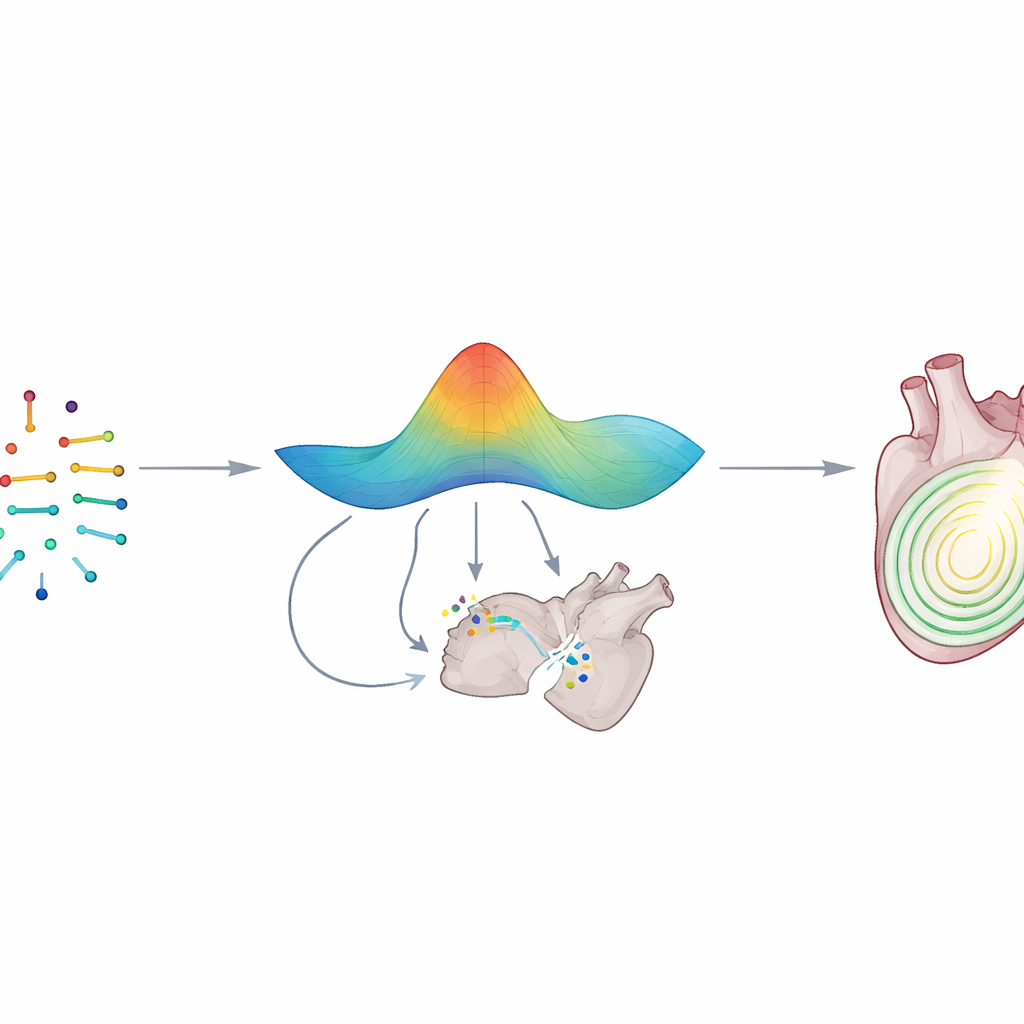
Directly simulating detailed electrical activity on a realistic left atrium can take many minutes of supercomputer time for a single choice of tissue properties. Traditional statistical methods that fully explore uncertainty, such as Markov chain Monte Carlo, need tens or hundreds of thousands of such simulations, making them far too slow for clinical use. The authors address this by first running a carefully chosen but limited set of high‑fidelity simulations offline and using them to train faster “surrogate” models called Gaussian process emulators. These emulators learn how key outputs, such as the time each region activates or how long it stays excited, depend on a small number of tissue parameters and can then predict new cases almost instantly, along with an estimate of their own uncertainty.
A smarter way to update beliefs
With this fast surrogate in place, the next challenge is to update our best guess of the tissue parameters when new measurements arrive. The authors adapt a technique called the ensemble Kalman filter, which normally tracks how a system changes over time, to a static setting where tissue properties are fixed but unknown. They represent possible parameter values as an ensemble of samples and repeatedly nudge this cloud of possibilities toward values that better match the observed activation times. A key innovation is that the method explicitly accounts for the fact that the forward model is itself an uncertain emulator rather than an exact simulator, adjusting the way new data are blended with prior expectations to avoid overconfidence.
What the tests reveal
The team first checks their method on synthetic data generated from known tissue properties on a realistic left‑atrial geometry. They show that, using only a modest number of emulator‑based updates, the algorithm recovers key parameters such as the speed of activation and the tissue’s electrical conductivity, along with sensible uncertainty ranges. Adding more types of measurements, like responses to premature beats and estimates of how long cells stay refractory, improves the identifiability of more subtle parameters. When compared with the much slower Markov chain Monte Carlo approach, the ensemble method produces similar central estimates for well‑informed parameters, with uncertainties that track the strength of the data, but completes in under a minute on a standard computer.
Toward guiding treatment decisions
To explore clinical relevance, the authors perform a pilot study in which they first calibrate the tissue properties using paced‑beat measurements, then use these properties to predict whether atrial fibrillation will persist or terminate under a simulated triggering protocol. For two representative cases, most parameter samples drawn from the calibrated distributions correctly classify the behavior of fibrillation, whereas samples drawn from uncalibrated prior beliefs often do not. This suggests that even partial information about tissue properties, obtained quickly, can meaningfully sharpen predictions about treatment outcomes.
Big picture and future promise
Overall, the study shows that by combining fast surrogate models with an adapted ensemble Kalman filter, it is possible to rapidly estimate patient‑specific electrical properties of the atrial wall from routine clinical data, including credible ranges that reflect remaining uncertainty. While the current work assumes uniform tissue properties and a simplified cell model, the same framework could be extended to more detailed and spatially varying descriptions as richer data become available. In practical terms, this approach moves computational heart models closer to real‑time decision support, where doctors might one day use on‑the‑fly simulations to plan ablation strategies tailored to each patient’s unique electrical landscape.
Citation: Mamajiwala, M., Corrado, C., Lanyon, C.W. et al. Rapid calibration of atrial electrophysiology models using Gaussian process emulators in the ensemble Kalman filter. Sci Rep 16, 10257 (2026). https://doi.org/10.1038/s41598-026-39948-9
Keywords: atrial fibrillation, cardiac modeling, ensemble Kalman filter, Gaussian process emulator, catheter ablation