Clear Sky Science · en
In silico DNA barcoding surpasses whole genome sequencing for species identification from vector surveillance pools
Why tiny insects matter
Mosquitoes kill more people each year than any other animal, mostly through diseases like malaria, dengue and yellow fever. Public health teams try to track which mosquito species are present in a region and whether they are carrying parasites, but this is hard to do quickly and accurately, especially in many parts of sub-Saharan Africa. This study explores a faster, cheaper way to read the genetic “barcodes” of mosquitoes and the germs they carry, using a pocket‑sized DNA sequencer that could be run in regional laboratories close to where outbreaks occur. 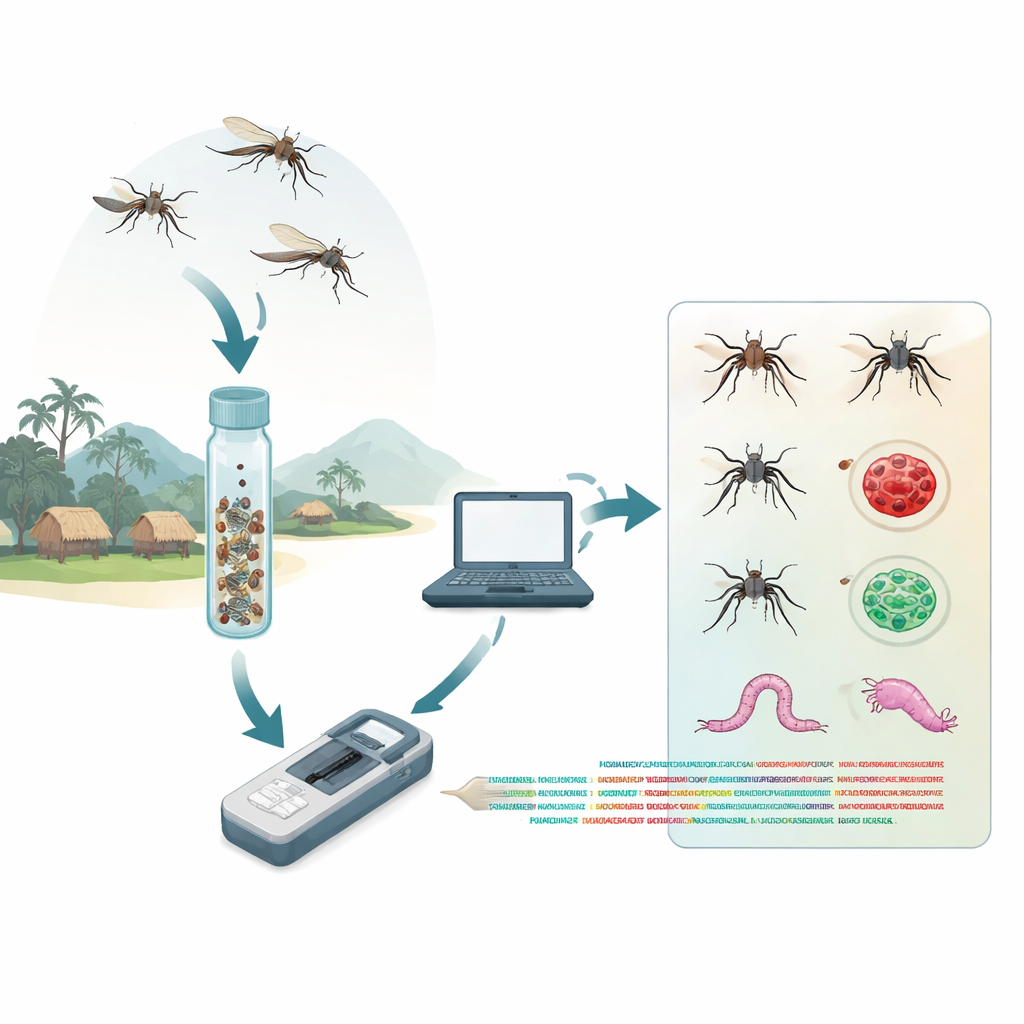
From field traps to mixed mosquito samples
In real surveillance, traps often catch a jumble of species rather than neat, single‑mosquito samples. To mimic this, the researchers created five laboratory “pools” made from four common disease‑carrying mosquito species: Aedes aegypti, two malaria‑spreading Anopheles species, and Culex quinquefasciatus. In two of the pools they also added DNA from three parasites, including the malaria parasite Plasmodium falciparum and two worms that cause filarial disease. Each pool therefore resembled the messy reality of a trap: many individuals, several species, and sometimes hidden pathogens at low levels.
A portable sequencer in place of big machines
The team tested the MinION, a handheld device from Oxford Nanopore Technologies that can read long stretches of DNA. Unlike large, expensive sequencing machines that are mostly found in wealthy laboratories, the MinION is relatively cheap, runs on a laptop and is already used for outbreak investigations. Here, DNA from each pool was run on its own MinION flow cell. The resulting genetic reads were then analysed with five different software approaches to see which gave the best picture of which species and parasites were present, and in what proportions.
Whole genomes versus DNA barcodes
One strategy used the genetic reads to try to cover entire genomes for mosquitoes and parasites. This “whole genome” approach did find the main species in each pool, but it regularly mis‑estimated their true proportions. Closely related mosquito species were particularly hard to distinguish, and some software pipelines even assigned small numbers of reads to species that were not actually present. The researchers then tried a more focused tactic: instead of mapping reads to every part of each genome, they mapped them only to short, well‑chosen regions that act like barcodes. These regions, such as a piece of ribosomal DNA called ITS2, differ enough between species to tell them apart but are short and easy to sequence thoroughly. 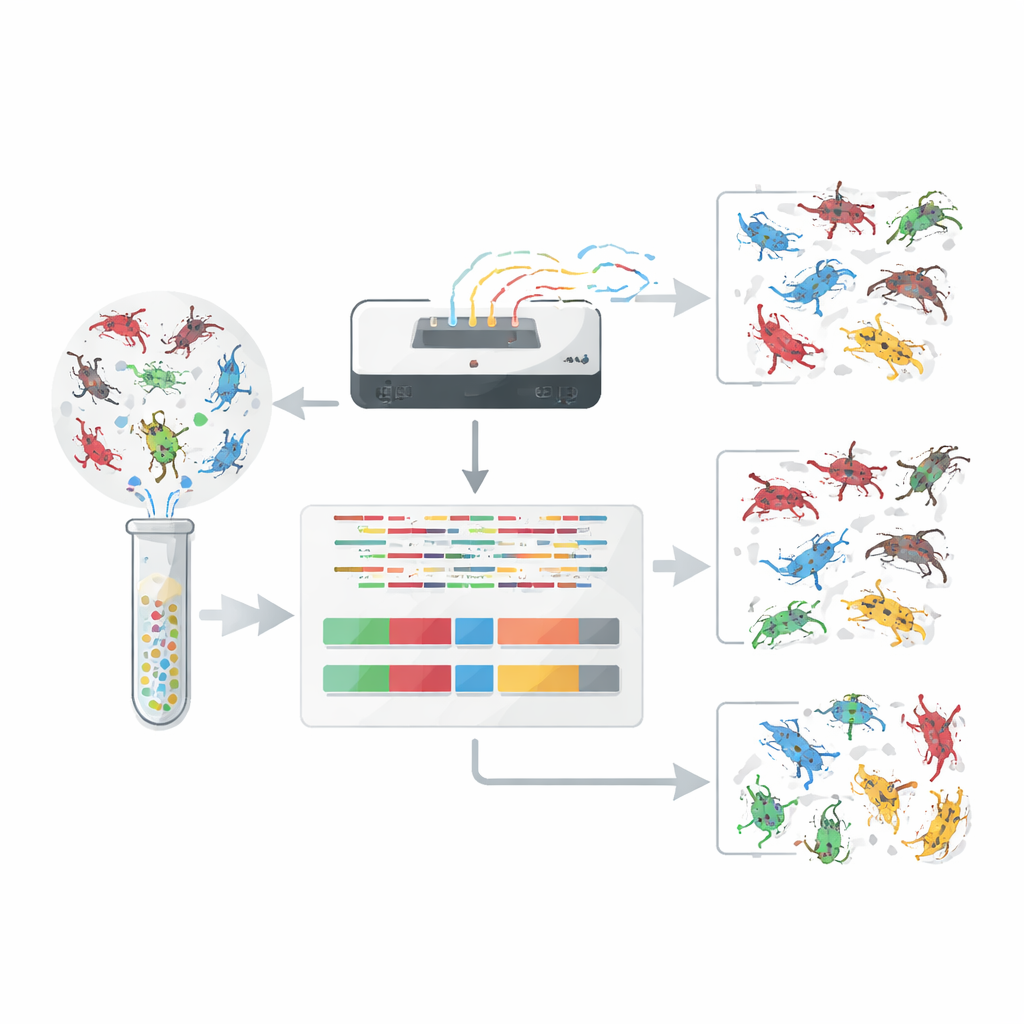
Sharper results from targeted barcodes
When the team concentrated on these barcode regions, estimates of species abundances lined up much more closely with the known makeup of each pool. The ITS2 region and certain combinations of barcode segments gave the strongest match to reality, especially for separating the two Anopheles malaria vectors. Importantly, this focused method also avoided “false positives”: it did not invent species that were not actually in the mixture. Even though the starting DNA was of only moderate quality—similar to what might be expected from warm, humid field conditions—the MinION still produced enough barcode coverage to reliably pick up both mosquitoes and, at low levels, some of the worm parasites.
Cost, simplicity and real‑world use
The researchers compared costs and found that running these experiments on MinION flow cells was roughly half as expensive as using a leading Illumina sequencing platform, without counting the much higher purchase price and software fees of the larger machine. Because barcode‑based analysis focuses on small DNA fragments, it would allow laboratories to use simple PCR reactions to amplify those regions, pool many samples together using barcodes assigned in the lab, and analyse them on a single MinION run. The data processing demands are modest enough that trained staff in regional African laboratories could handle them without relying on distant high‑performance computing centres.
What this means for fighting disease
In plain terms, the study shows that “smart sampling” of DNA—reading only the key barcode stretches instead of trying to read everything—can give a clearer and cheaper picture of which mosquito species and parasites are present in a mixed sample. This in silico proof of concept suggests that future field‑ready kits could let local teams quickly scan pools of trapped mosquitoes, see whether dangerous species or pathogens are present, and adjust control measures before outbreaks grow. By putting powerful genetic tools into smaller, more affordable devices, the work points toward more responsive and locally informed strategies for controlling mosquito‑borne diseases.
Citation: Nascimento, C.L., Tonge, D.P. & Tripet, F. In silico DNA barcoding surpasses whole genome sequencing for species identification from vector surveillance pools. Sci Rep 16, 10231 (2026). https://doi.org/10.1038/s41598-026-39937-y
Keywords: mosquito surveillance, DNA barcoding, nanopore sequencing, vector-borne diseases, molecular diagnostics