Clear Sky Science · en
Investigation and enhancement of stress-dependent compliance characteristics in deep in-situ stress measurements based on anelastic strain recovery (ASR) method
Why Deep Underground Pressure Matters
As mines and tunnels reach ever deeper into the Earth, the natural pressure inside the surrounding rock becomes a central safety concern. If this hidden stress is underestimated, rock bursts, collapses, and costly failures can follow. Directly measuring such stress kilometres underground is difficult and expensive, so engineers are eager for reliable, low-cost methods. This study refines a promising technique called anelastic strain recovery (ASR), which reads the “memory” of stress stored in rock cores, and shows how to tune it for safer construction in ultra-deep shafts.
Reading Stress from Rock Cores
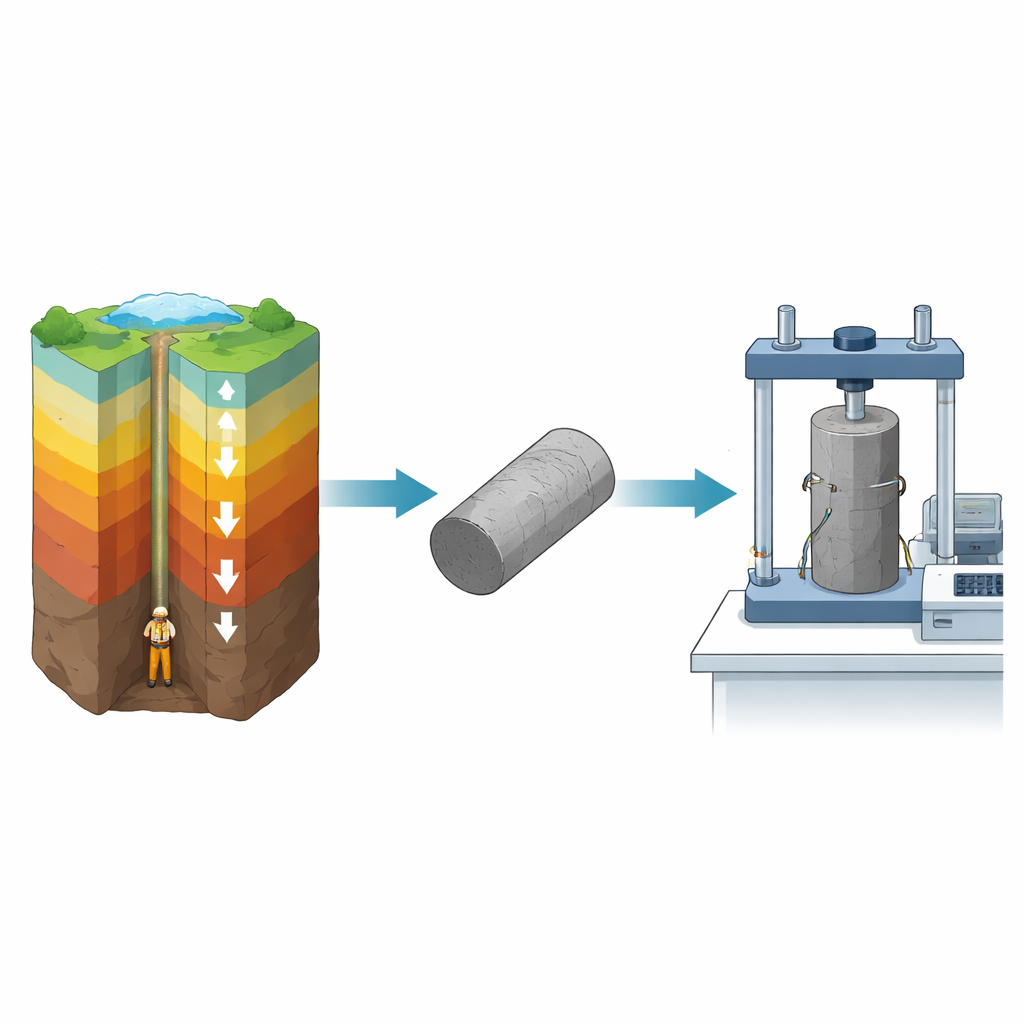
When a cylindrical rock core is drilled from deep underground, it suddenly moves from a high-pressure environment to normal surface conditions. The rock first springs back almost instantly, like a compressed spring being released, but then continues to creep and adjust slowly over hours to days. This delayed, time-dependent change in shape is known as anelastic strain recovery. By tracking these tiny changes with glued-on strain gauges in several directions, scientists can work backward to infer the three-dimensional stress that once acted on the rock at depth.
Building a Better Laboratory Test
The authors focused on granite cores taken from more than 1.7 kilometres below ground at the Sanshandao Gold Mine in China. In the laboratory, they shaped cores into standard cylinders and pressed them under carefully controlled loads equal to one quarter and one half of the rock’s uniaxial compressive strength (a common measure of how much pressure it can withstand). After holding these loads for either 24 or 48 hours, they released the pressure and recorded how the rock slowly recovered over the next two days. This allowed them to calculate two key quantities that describe how the rock relaxes: one linked to changes in overall volume and one linked to shape-changing shear. Together, these “compliances” form the calibration necessary to turn field ASR measurements into actual stress values.
How Stress Level Changes Rock’s Response
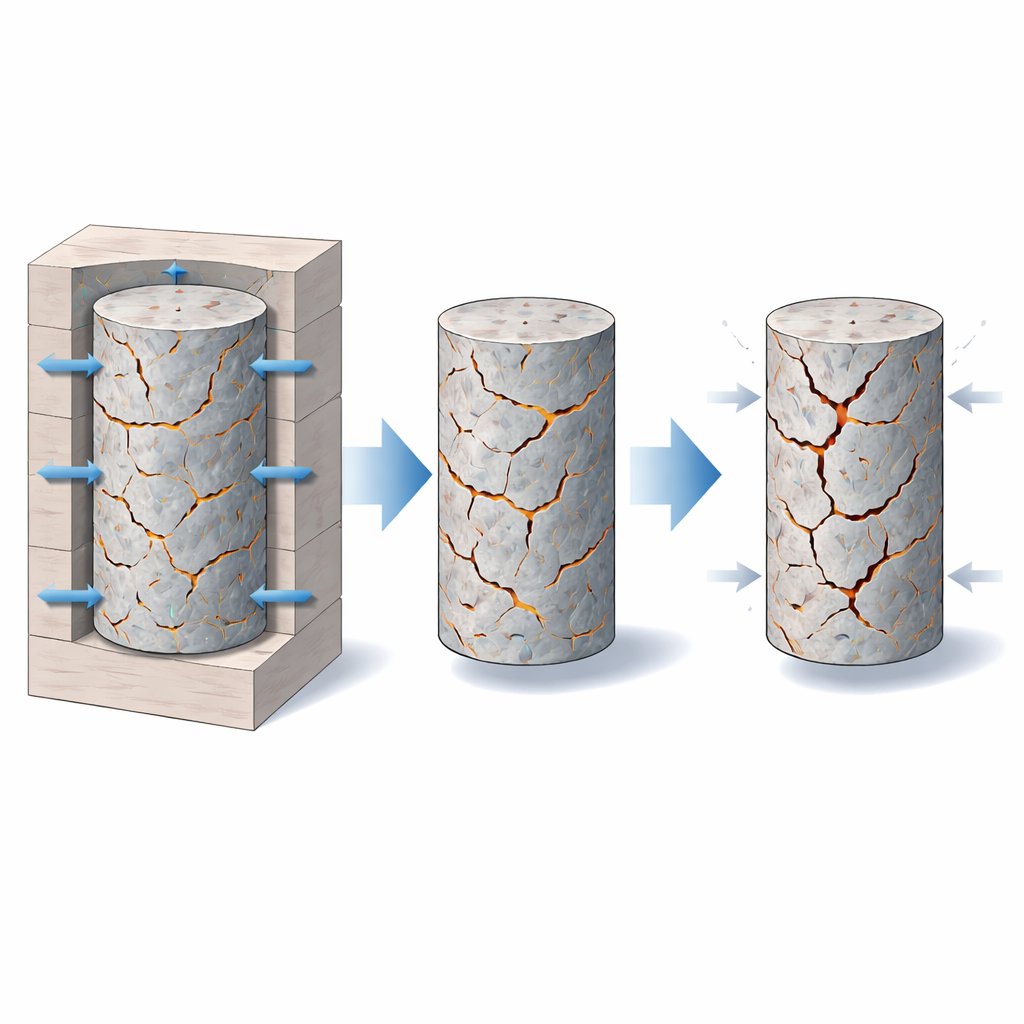
The experiments showed that the rock’s recovery behavior is not fixed but depends strongly on how much stress it has experienced. Under both tested stress levels, the recovery curves for volume and shear changes approached stable values within about 48 hours after unloading. Holding the load longer before release made the later recovery slower, but did not change the final plateau much. Crucially, the ratio between shear and volumetric compliance, long assumed to be a simple constant of 2, actually varied between about 1.85 and 2.48 for these deep granites and was higher at greater applied stress. Microscopic observations and acoustic emission monitoring revealed that this behavior is tied to the reopening and growth of tiny pre-existing cracks and the differing responses of minerals such as quartz, feldspar, and weaker grains like biotite and calcite.
Testing the Method in a Real Deep Shaft
To see whether better calibration improves field measurements, the team applied the ASR method to cores from a vertical shaft more than 2,000 meters deep in the same mine. They instrumented long cores with arrays of strain gauges and acoustic sensors, monitored strain recovery for about 72 hours, and then used their laboratory-derived compliance values—computed separately for different stress levels—to estimate the in-situ stresses at depth. These estimates were compared with an independent benchmark: hydraulic fracturing tests carried out in nearby boreholes, which are widely accepted in rock engineering but costly and technically demanding at great depth.
A Clearer Picture of Underground Forces
The comparison revealed that when the ASR calculations used compliance values calibrated at one quarter of the rock’s compressive strength—matching the typical ratio between natural vertical stress and rock strength in that shaft—the results closely tracked the hydraulic fracturing data. Differences in the main horizontal stresses were generally within a few percent, substantially smaller than errors obtained when using the traditional “ratio = 2” shortcut. In simple terms, the study shows that ASR can provide accurate, economical measurements of deep rock stress, but only if the laboratory calibration mimics the real stress conditions underground and allows enough time—at least two days—for recovery to stabilize. This improved approach offers mining and tunneling engineers a sharper, more reliable window into the forces at work far beneath our feet.
Citation: Li, T., Xiang, P., Ji, H. et al. Investigation and enhancement of stress-dependent compliance characteristics in deep in-situ stress measurements based on anelastic strain recovery (ASR) method. Sci Rep 16, 11859 (2026). https://doi.org/10.1038/s41598-026-39935-0
Keywords: deep in-situ stress, anelastic strain recovery, granite rock mechanics, underground mining shafts, hydraulic fracturing comparison