Clear Sky Science · en
Unravelling water sustainability: a decentralised, data-driven model for water governance
Why Water in Villages Matters to Us All
Clean, reliable water is something many of us take for granted, yet more than two billion people worldwide still lack safe drinking water at home. This study looks closely at that reality in rural India and asks a simple but powerful question: how can villages themselves, armed with good information, help solve their own water problems? The researchers built and tested a digital platform called “Mera Gaon Hamara Jal” (My Village, Our Water) that turns everyday observations from households, community meetings, and sensors into clear guidance for action. Their work offers a glimpse of how data and local voices can come together to protect one of our most basic needs.
The Challenge: Thirst in a World Full of Water
Although Earth is often called the blue planet, many communities struggle to find water that is both available and safe. In India, the picture is especially complex. Unpredictable monsoon rains, shrinking groundwater levels, and pollution from farms and industry all put pressure on rivers, wells, and pipes. These physical problems are tangled with social and economic ones: poorer households usually live farther from good water sources, pay more in time or money to collect water, and face higher risks of disease. On top of that, government agencies often work in isolation, and national schemes may not fully account for local realities in each village. As a result, well-meaning top-down projects can miss the mark on the ground.
A New Way to Listen to Villages
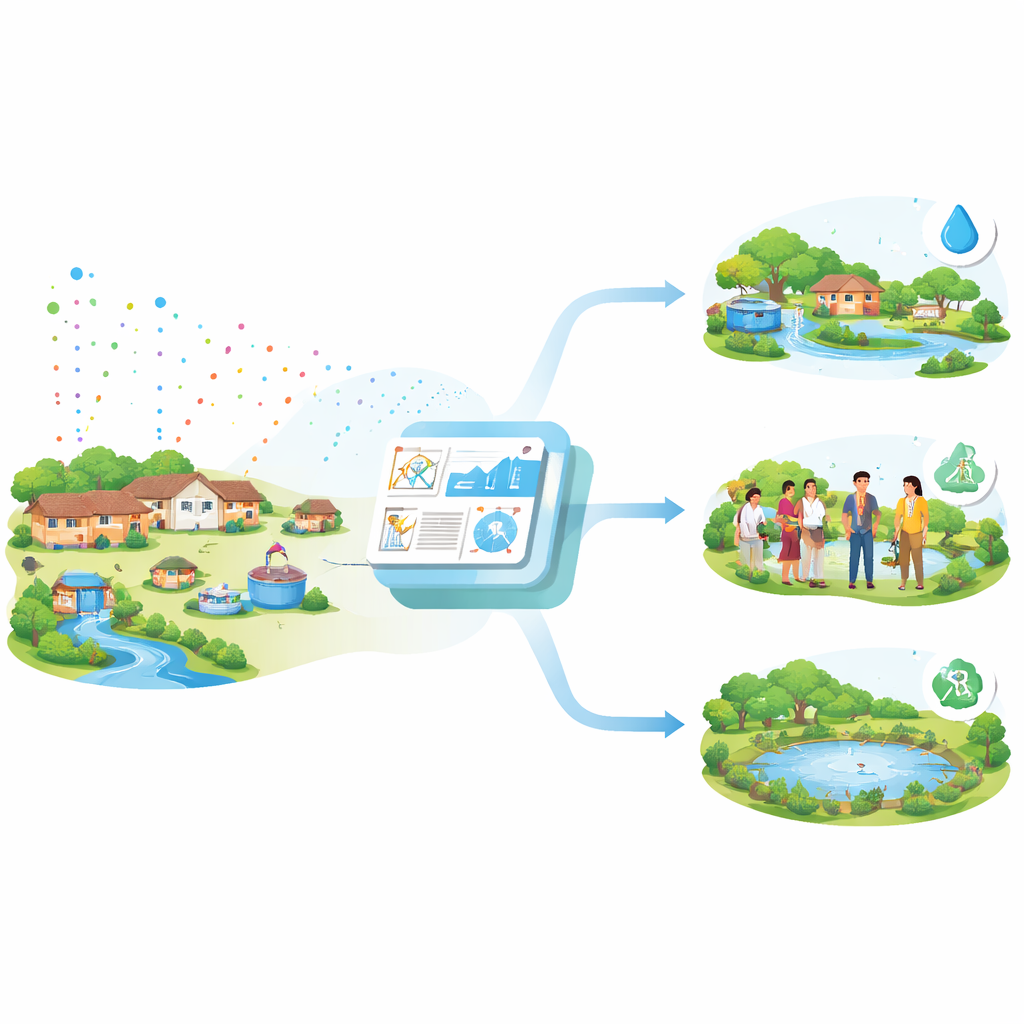
To bridge this gap between policy and daily life, the authors designed a geo-enabled, community-centered digital platform. It brings together three main types of information: household surveys that capture how families use and experience water; participatory tools, such as group discussions and village maps, that reveal local knowledge; and sensors that measure water quality at wells, taps, and other sources. All of this information is tied to specific locations and organized into more than 50 simple indicators spanning social, economic, environmental, and institutional aspects of water. The heart of the platform is a decision engine called the Multi-level, Multi-stakeholder Decision Module, which turns scattered data points into an overall picture of water security for each household and community.
Turning Raw Numbers into Clear Signals
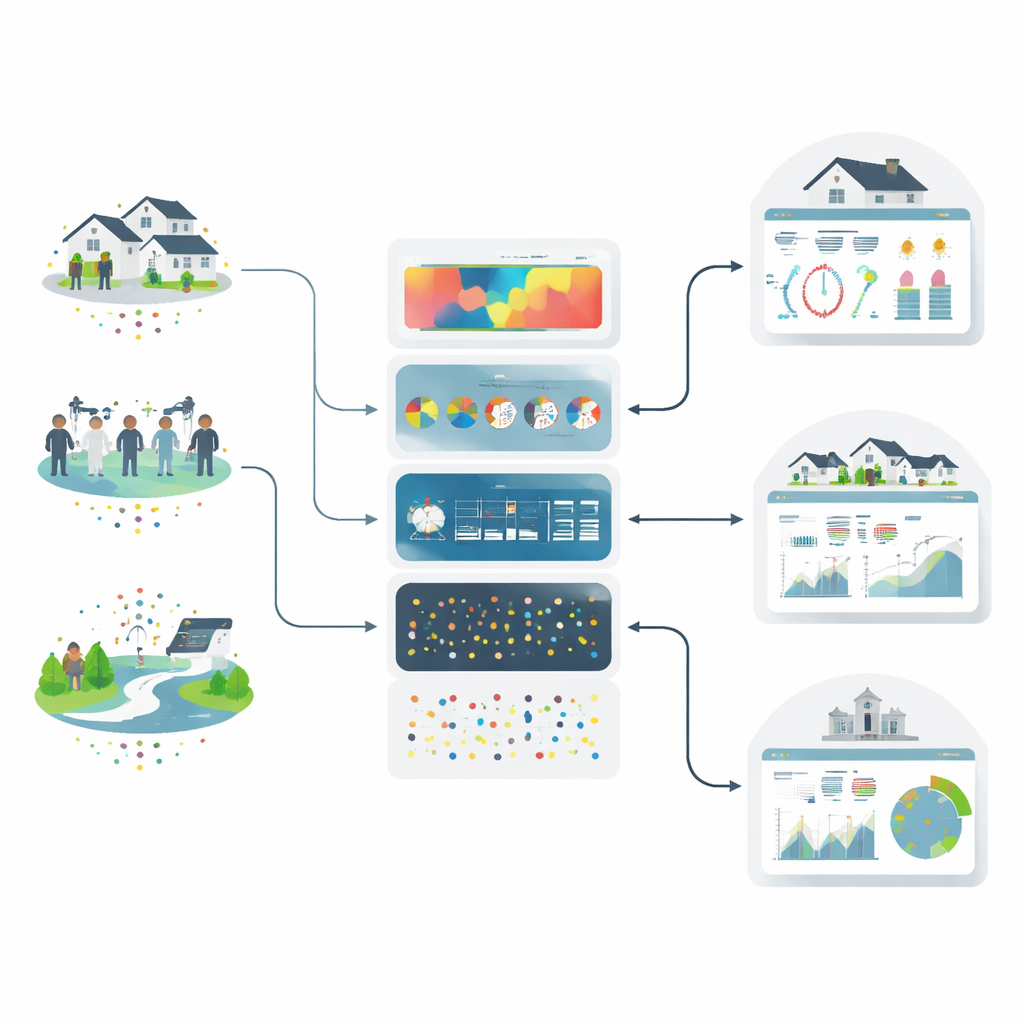
Inside this decision engine, the system first checks each indicator against accepted standards: for example, whether water quality meets health guidelines or whether a family has to walk long distances to fetch water. When a condition crosses a risky level, it is flagged. By counting these flags, the platform gives each household a simple risk score that reflects how many different water-related problems they face at once. These scores can then be combined across homes to reveal which neighborhoods or villages are most vulnerable. The researchers also used established indices to summarize complex realities. A Water Poverty Index blends five aspects—such as access, use, and environment—to show how deprived a community is, while a Water Quality Index condenses ten laboratory measurements into a single rating for each source. To avoid hiding local differences, the platform goes further by looking at how indicators move together, grouping them into themes like community action, technology use, or health outcomes, and creating composite scores for each theme.
What the Villages Revealed
The team tested the platform in ten rural communities across India, covering 1,039 households in very different landscapes, from coastal Kerala to drought-prone Rajasthan. The system uncovered strong contrasts, even within the same area. In one coastal village, for instance, open wells turned out to be widely unsafe, while piped water and borewells showed mixed results from excellent to unsuitable. Some neighborhoods had far higher combined risk scores than others, highlighting pockets where many problems—like poor treatment, weak awareness, and disaster exposure—stacked up. In another comparison, two nearby communities both used more water than national basic norms, but one showed much more uneven use, pointing to hidden inequalities in access and storage. Patterns in the data also linked strong local government support with better practices, such as composting and groundwater restoration, suggesting that institutions and citizens can reinforce each other.
From Insight to Action
The real strength of the platform lies in how it tailors these findings to different decision-makers. A household might receive guidance on treating water, reducing waste, or preparing for floods. Community groups can see maps of hotspots and plan repairs or awareness campaigns. Nonprofit organizations and local officials can prioritize neighborhoods where many families are at risk, and higher-level agencies can track progress toward national and global goals for clean water. Because the system is designed for continuous updates and feedback, it does not merely produce a static report; it creates a living picture that evolves as conditions change and measures are taken.
Why This Approach Offers Hope
This study shows that rural water problems are not just about building more pipes or drilling deeper wells. They are about understanding who is left out, what kinds of risks cluster together, and how communities and institutions respond. By treating every household as a meaningful source of evidence and combining simple observations with careful analysis, the Mera Gaon Hamara Jal platform turns scattered local experiences into a roadmap for action. For a lay reader, the takeaway is straightforward: with the right tools, villages can diagnose their own water challenges, hold institutions accountable, and co-create solutions. This bottom-up, data-informed approach offers a practical path toward making the promise of safe, sustainable water a reality, one community at a time.
Citation: Reshma, A.S., Nandanan, K., Ekkirala, H.C. et al. Unravelling water sustainability: a decentralised, data-driven model for water governance. Sci Rep 16, 11150 (2026). https://doi.org/10.1038/s41598-026-39927-0
Keywords: rural water governance, water sustainability, community participation, digital monitoring, India villages