Clear Sky Science · en
Adult spinal process impingement syndrome: progression and staging
Why Back Bones Bump Into Each Other
Many people develop lower back pain and leg numbness as they grow older, but the exact reasons can be surprisingly complex. This study follows more than a hundred patients over more than a decade to watch, step by step, how small bony bumps in the spine begin to collide, how the ligament between them changes, and how this can slowly squeeze the nerve canal. By mapping this process, the researchers hope to give doctors clearer rules for spotting trouble early and deciding when simple monitoring is enough and when surgery may be needed.
How the Problem Starts
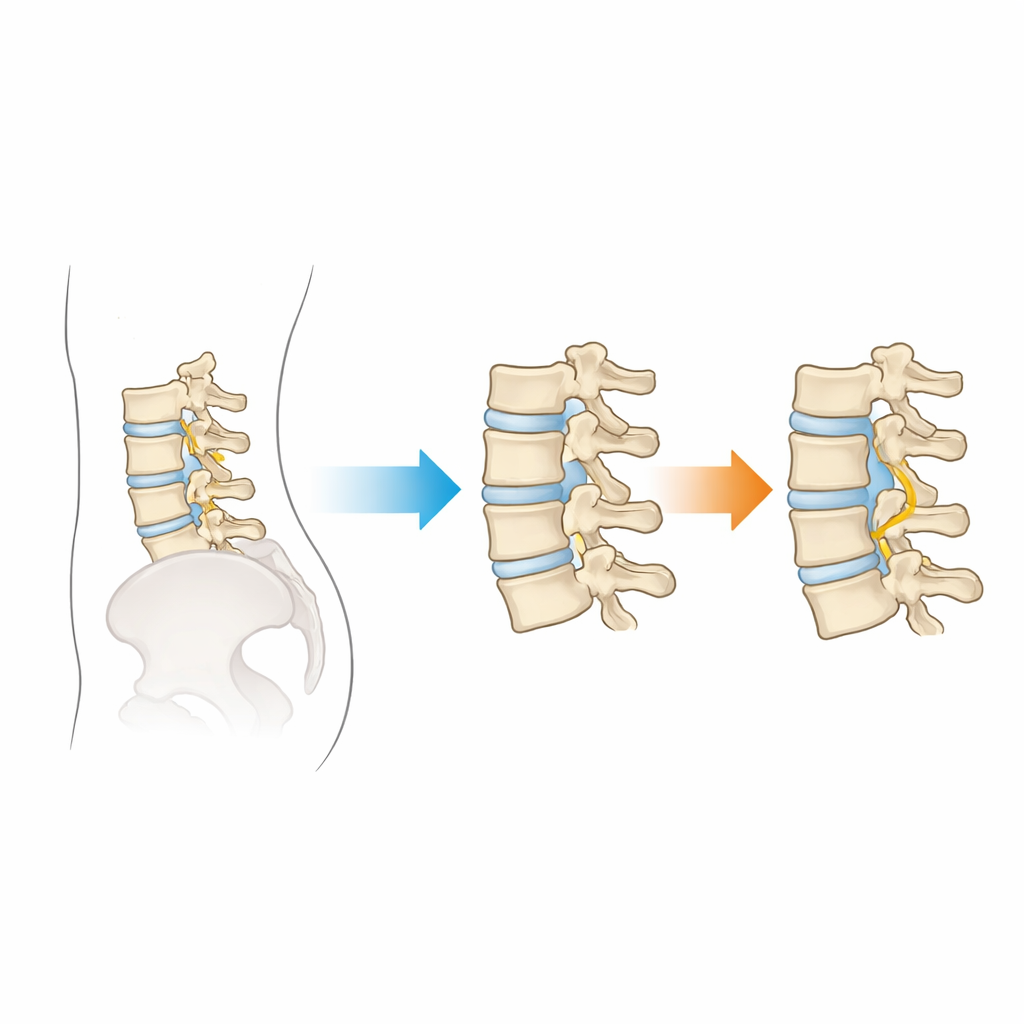
At the back of each spinal bone is a small projection of bone called a spinous process. In youth, these sit apart, cushioned by a strap of tissue known as the interspinous ligament. With age and wear, the shape and position of the lower spine change. Bones may slip slightly, discs may lose height, and the natural curve of the back can exaggerate. As this happens, the spinous processes can move closer together and begin to bump into one another, a situation the authors call adult spinous process impingement. This condition is especially common in older adults and often appears alongside problems such as slipped vertebrae, disc collapse, or side-to-side curvature of the spine.
A Four-Step Journey From Contact to Narrowing
Using serial MRI scans over an average of almost 12 years, the team tracked 132 patients who eventually needed lumbar spine surgery. They divided them into those with and without impingement, and then created a four-stage roadmap of how the condition progresses. In the early stage, only the spacing changes, and the ligament still looks normal; symptoms are often limited to mild stiffness or backache. Next comes a soft-tissue stage, where the ligament becomes inflamed and waterlogged. If stresses continue, the bone itself starts to suffer: tiny fractures, erosion, and small cyst-like spaces appear where the processes clash, forming a "bone stage." Finally, in some people, the ligament bulges forward into the spinal canal, producing spinal stenosis—the nerve tunnel becomes cramped, and leg symptoms appear.
When the Ligament Becomes the Culprit
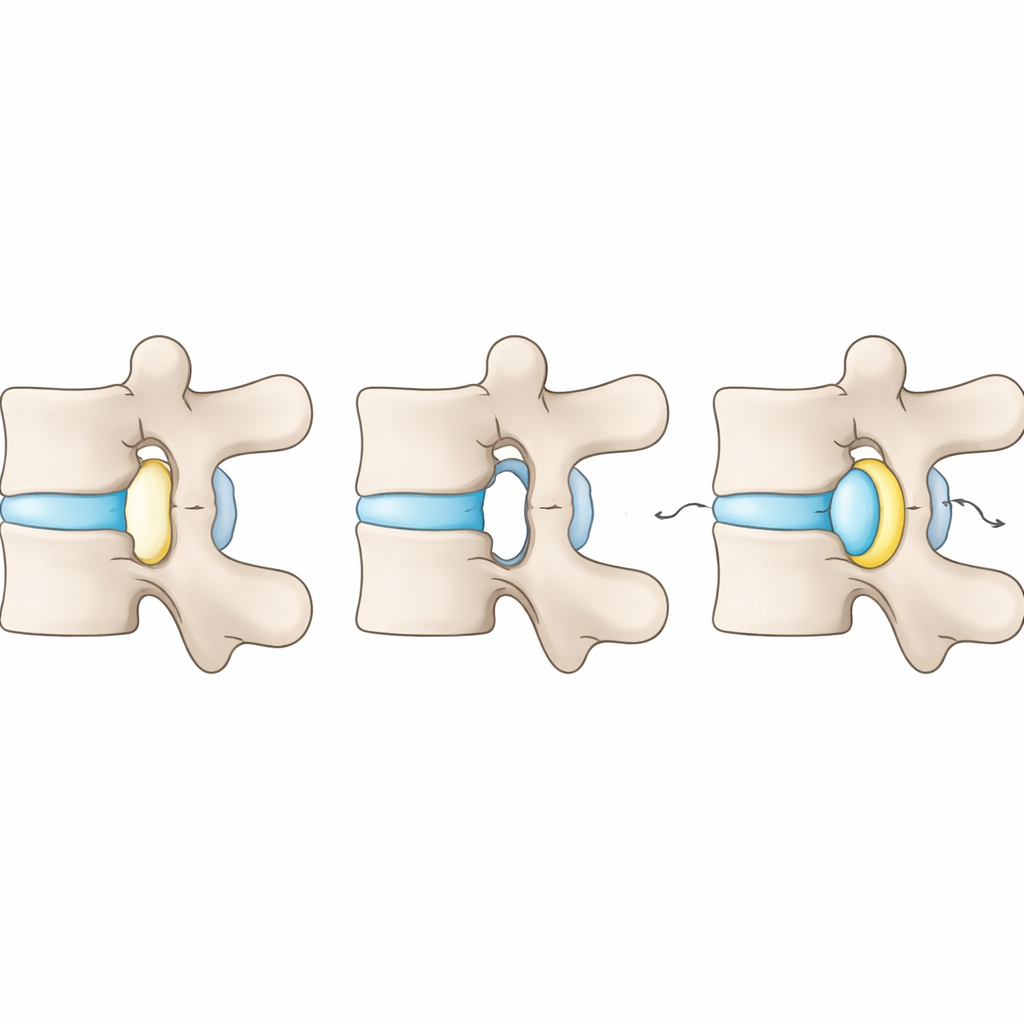
A key focus of the study is what happens to the interspinous ligament as the bones keep knocking together. The researchers describe a herniated interspinous ligament, in which this band of tissue is gradually pushed forward into the space normally reserved for the bundle of nerves. On MRI, this shows up as a cone-shaped mass poking toward the spinal cord. They classified how far it intrudes by dividing the canal into four equal parts and rating the bulge from mild to severe. Crucially, this forward bulging was found in 28 spinal segments, all in people with impingement, and never in segments without impingement. Larger bulges were linked to more serious narrowing and, in many cases, to surgery to relieve pressure.
Bones, Fragility, and the Speed of Change
Not everyone travels this pathway in the same way. Some patients lingered in the earliest stage for more than a decade without major trouble. Others moved from minor soft-tissue changes to full-blown stenosis in little more than a year. The study points to osteoporosis—fragile, less dense bones—as a major driver: weaker bone is more easily chipped and reshaped by repeated contact, helping the ligament detach from its bony anchoring and slide forward. Conditions that disturb normal alignment, such as vertebral slippage or age-related scoliosis, also increased the odds that impingement and ligament herniation would develop at specific levels in the lower spine.
What This Means for Patients
For people with chronic low back pain or leg symptoms, this work suggests that the story is not only about discs and joints at the front of the spine, but also about what happens between the bony spines at the back. The authors show that repeated contact between these bony tips can, over years, damage bone and push the connecting ligament into the nerve canal, often in the setting of weak bones and unstable segments. Their staging system offers a clearer way for clinicians to describe what they see on MRI, estimate how far the process has gone, and decide whether to watch, brace, or operate. In simple terms, they conclude that the size and position of this back ligament—and the strength of the bone it attaches to—are central to who ends up with serious narrowing of the spinal canal and who does not.
Citation: Li, KC., Lin, SC., Hsieh, CH. et al. Adult spinal process impingement syndrome: progression and staging. Sci Rep 16, 12966 (2026). https://doi.org/10.1038/s41598-026-39924-3
Keywords: lumbar spine degeneration, spinal stenosis, osteoporosis and back pain, spine MRI, Baastrup’s disease