Clear Sky Science · en
Pounding imparts internal strength to rubble-piles
Why Pile-of-Rocks Worlds Matter
Many of the asteroids that pass near Earth are not solid rocks but loose piles of stones, gravel, and dust held together by their own weak gravity. These so‑called rubble‑pile asteroids are the kinds of objects targeted by planetary‑defense missions such as NASA’s DART and ESA’s Hera. Understanding how strong these bodies are on the inside, and how that strength changes with depth, is crucial for predicting what happens if we ever need to deflect one—or if a spacecraft tries to land and sample it.
Rocks Held Together by Gravity
Spacecraft visits to asteroids like Itokawa, Bennu, and Ryugu have revealed landscapes covered with boulders and gravel. Observations of their craters suggest that the interiors of these bodies are not uniform: the outermost layers appear extremely loose and fragile, while material a few meters down seems noticeably tougher. On Bennu, for example, some craters show small mounds in their centers, a sign that the subsurface resists excavation more strongly than the surface. Until now, scientists have debated whether this pattern comes from big buried boulders or from some other hidden structure.
Smashing Mini Asteroids in the Lab
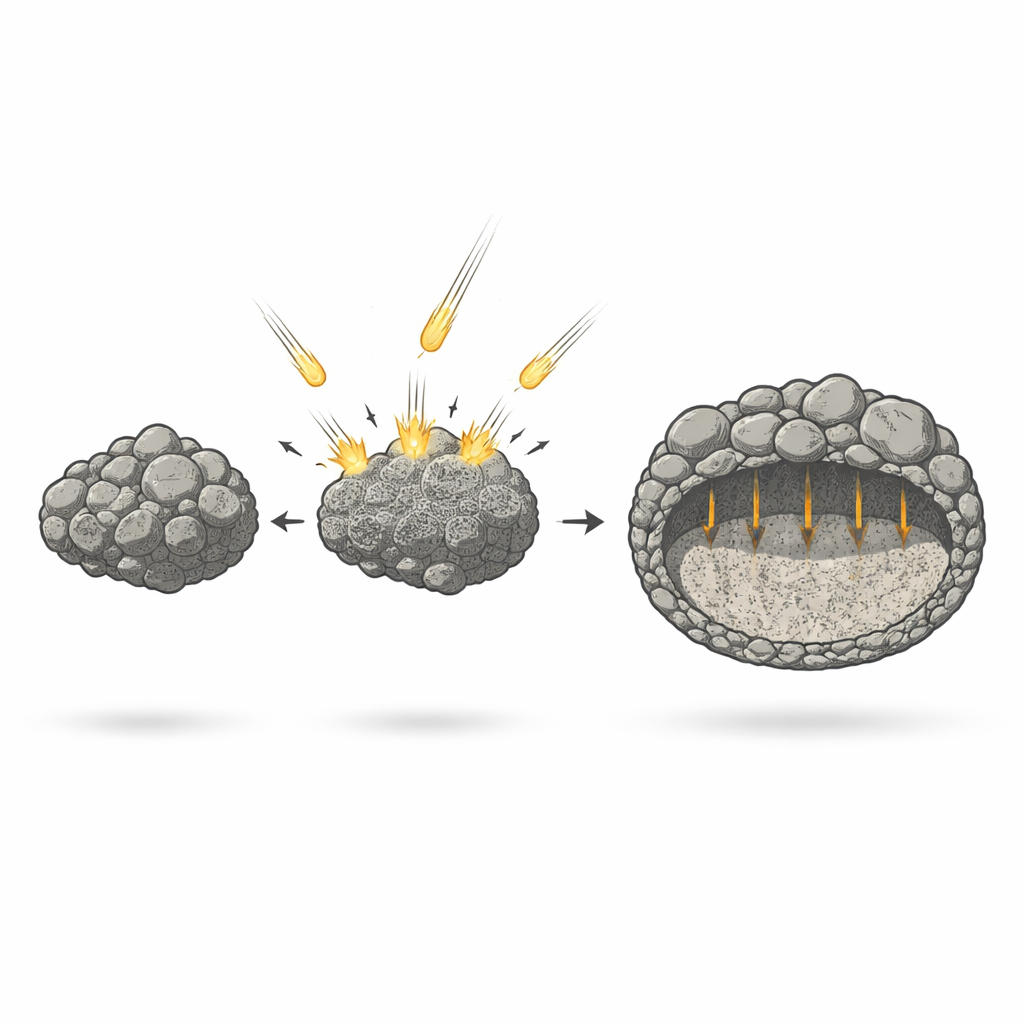
To probe this mystery, the researchers recreated rubble‑pile asteroids inside a laboratory impact chamber. They fired plastic projectiles at targets made either of loose sand, compacted sand, or beds of porous ceramic balls that mimic asteroid boulders. High‑speed cameras recorded the impacts at thousands of frames per second. In the boulder‑only targets, instead of simply blasting material outward, the impacts crushed some of the balls and shot clouds of fine debris downward in narrow, finger‑like jets that penetrated several projectile diameters below the crater floor. In layered targets, where a boulder bed sat atop sand, these downward injections fed the underlying fine layer with new material while still reshaping the surface.
How Repeated Blows Build Hidden Strength
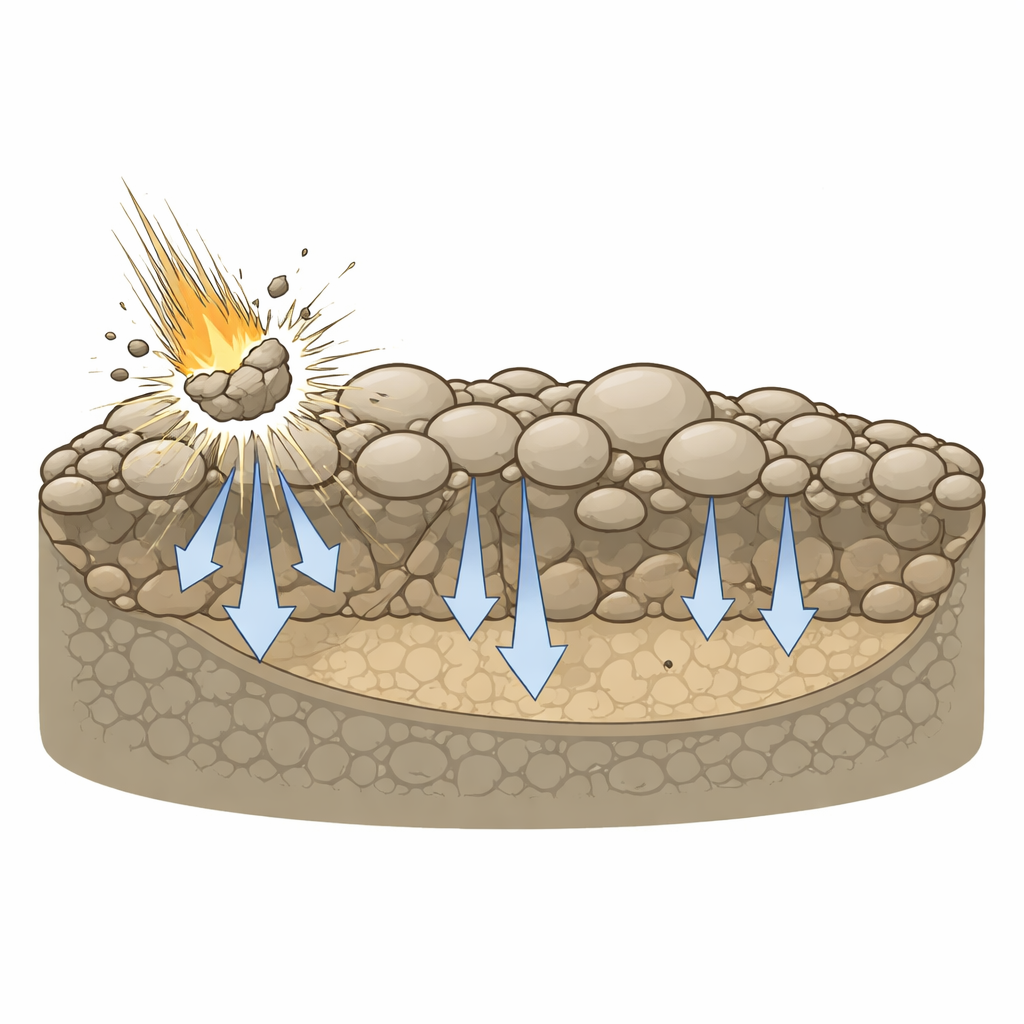
The sand experiments showed that how tightly grains are packed strongly controls crater shape. Loosely poured sand produced deeper craters with no central rise, whereas more compacted sand produced shallower craters with a central hump. This indicates that densely packed fine material can behave as a stronger layer even without any buried blocks. Combining this with the boulder‑bed experiments, the authors propose a long‑term evolution for rubble‑pile asteroids: each new impact crushes surface boulders and injects their dust deep into the pores between remaining blocks. Over many impacts, this process gradually fills and compacts a subsurface zone of fine particles, turning it into a stiffer, stronger layer beneath a looser, boulder‑rich shell.
Shaking, Spinning, and Sorting
Impacts do more than dig craters—they also shake the entire asteroid. On small bodies, even modest hits can jostle the surface as much as the asteroid’s own gravity does. This shaking can cause grains to shuffle and separate by size, a behavior known from everyday mixtures as the “Brazil nut effect,” in which larger pieces rise while smaller ones settle. The study argues that, together with the downward injections of fine debris, this shaking helps sweep small grains into deeper pockets, while centrifugal forces from the asteroid’s spin can make the fine‑under‑coarse layering especially pronounced near the poles. As pathways between boulders gradually clog with fines, new impacts open fresh routes, continuing the cycle.
What This Means for Asteroids We Visit
The work suggests that rubble‑pile asteroids naturally develop a hidden inner “backbone” of compacted fine material beneath a fragile, blocky surface. This structure can explain central mounds seen in craters on Bennu and Ryugu without requiring large, lucky‑placed boulders at specific depths. For mission planners and planetary‑defense experts, the message is that a rubble‑pile can be deceptively weak on top yet considerably tougher just a few meters down. Over countless cosmic hammer blows, pounding does not just break these small worlds apart—it forges internal strength that shapes how they respond when we, or nature, hit them again.
Citation: Ormö, J., Herreros, M.I., Luther, R. et al. Pounding imparts internal strength to rubble-piles. Sci Rep 16, 10054 (2026). https://doi.org/10.1038/s41598-026-39893-7
Keywords: rubble-pile asteroids, impact cratering, asteroid Bennu, granular materials, planetary defense