Clear Sky Science · en
Effective nutrient resources and fertilizer substitution potential of root biomass of major crops in China
Hidden Help Beneath the Fields
When we picture a wheat or rice field, we usually think about what we see above ground: golden heads of grain and tall green stalks. But an enormous and largely invisible world lies underfoot. This study looks at the roots of China’s main crops and asks a simple but powerful question: if we properly counted and used what those roots leave behind in the soil, how much could they help store carbon and replace chemical fertilizers?
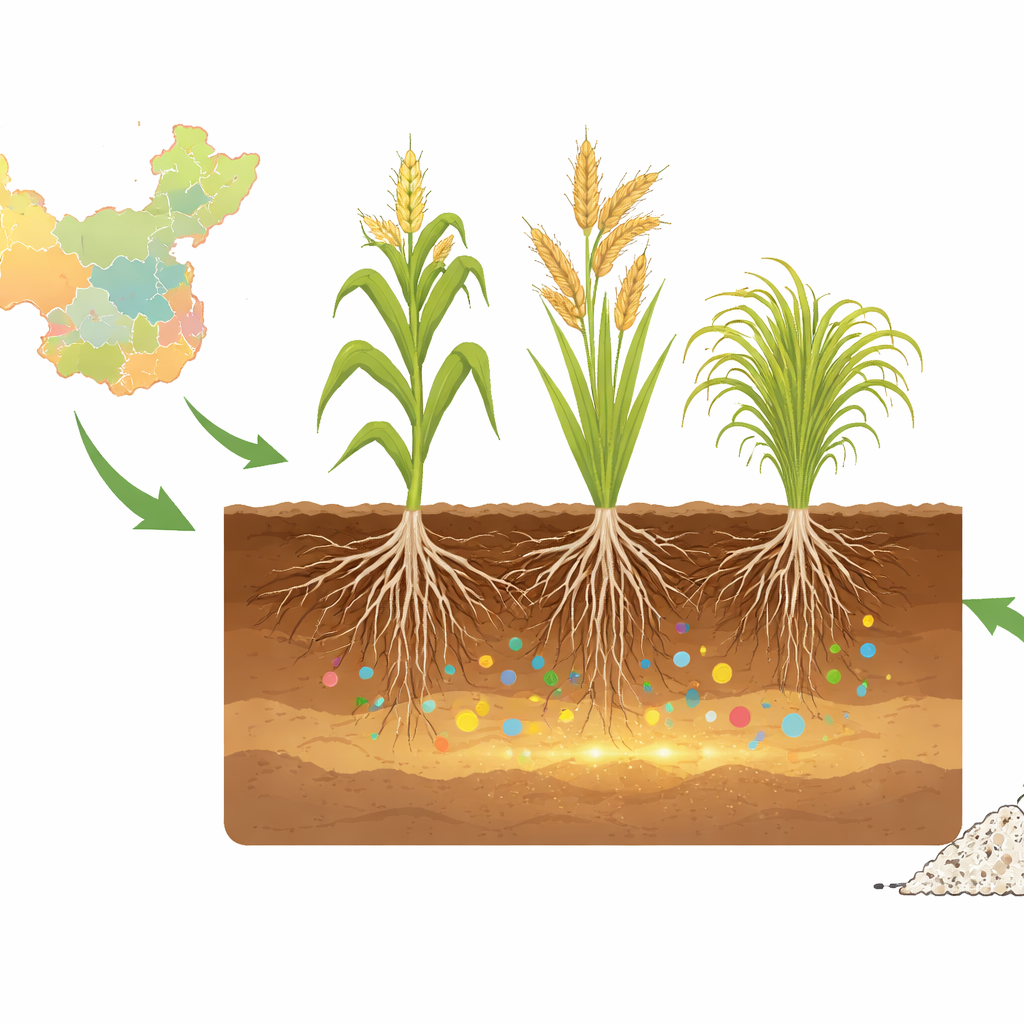
Measuring What We Cannot Easily See
Because roots grow underground, they are much harder to observe and weigh than stems and leaves. The researchers tackled this challenge by combing through experimental studies that had carefully measured root and stalk growth in China’s major crops—maize, wheat, rice, soybeans, cotton, peanuts, and rapeseed. From these data they built a set of "ratios" that link how much root biomass forms for every unit of straw (the stems and leaves left after harvest). They then combined these ratios with up-to-date national statistics on crop areas and straw production for 2022 to estimate how much root material remained in Chinese farmland soils after the crops were harvested.
How Much Root Material Is in the Ground?
The numbers turned out to be very large. In 2022, roots from China’s major crops weighed about 152 million tons—nearly one-fifth as much as all the straw produced above ground. Three familiar grains dominated this underground harvest: maize, wheat, and rice together made up more than 90% of the total root biomass. Most of this root material was concentrated in North China, Northeast China, and the middle and lower reaches of the Yangtze River, which are also the country’s breadbasket regions. Provinces such as Henan and Heilongjiang, with vast and fertile plains, stood out as hotspots of root biomass.
Roots as a Quiet Source of Plant Food
Roots are not just dead tissue when crops are harvested; they are rich packages of nitrogen, phosphorus, and potassium, the same nutrients farmers buy in fertilizer bags. By combining their biomass estimates with data on nutrient content, the authors calculated that the roots of major crops in China contain about 3.22 million tons of these key nutrients. Even more relevant to farmers is how much becomes available to the next crop during the following growing season as roots slowly break down. Using published rates of how quickly different crop residues release nutrients, the team estimated that about 2.32 million tons of nutrients from roots can be taken up by plants within one season, with potassium making up the largest share.
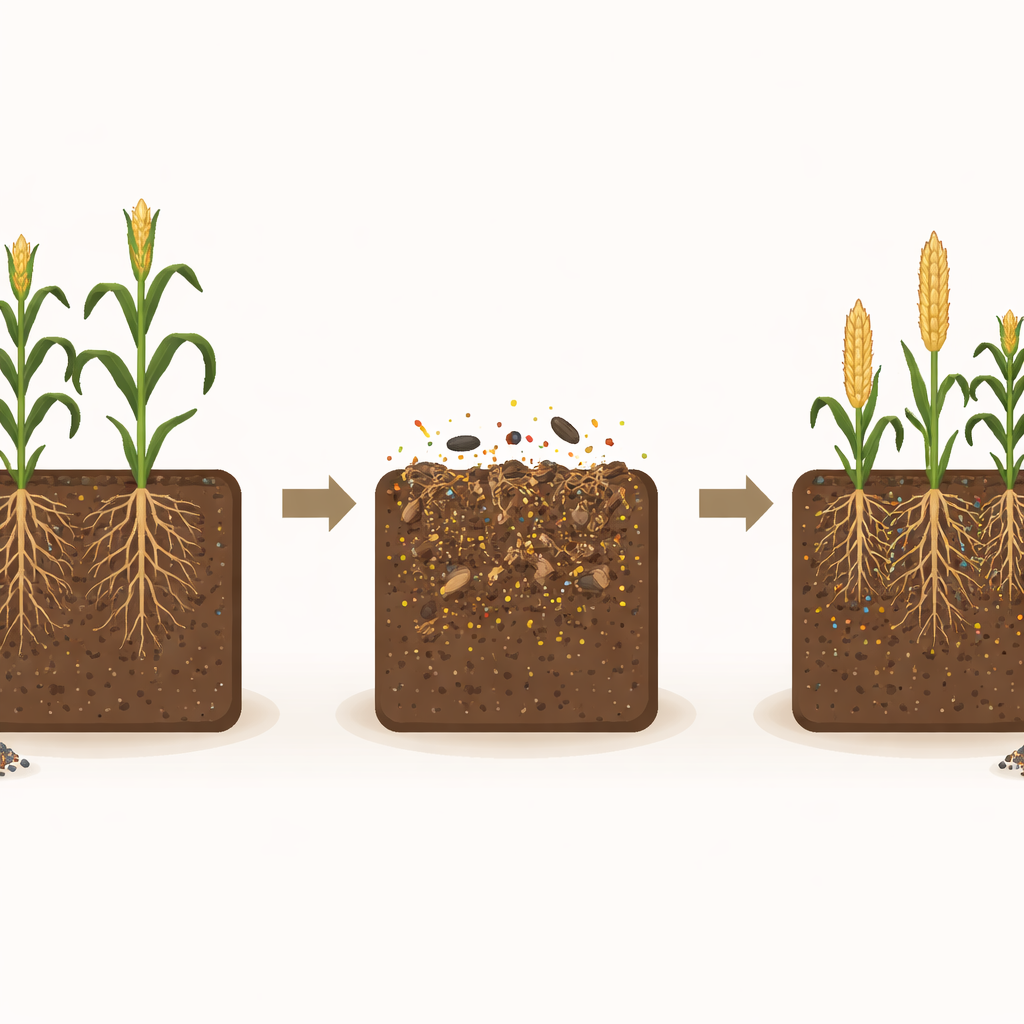
Cutting Back on Fertilizer Without Sacrificing Yield
To understand what these hidden nutrients might mean in practice, the researchers compared their estimates with recommended chemical fertilizer rates for each major crop. They found that nutrients released from roots during a single growing season could, in theory, replace about 5.3% of the optimum chemical fertilizer applied nationwide. The replacement potential was modest for nitrogen and phosphorus—on the order of a few percent—but strikingly high for potassium, at about 13%. Wheat showed the strongest relative benefit, with root-derived nutrients equal to more than 7% of its ideal fertilizer dose. These numbers are "best case" values: real fields differ in soil type, climate, and management, all of which can speed up or slow down how roots decompose and how efficiently crops can use the released nutrients.
What This Means for Soils and Food Security
Seen through a layperson’s lens, the study’s message is that crop roots are a valuable, homegrown resource that China is already producing for free. Properly accounting for this underground biomass helps scientists better estimate how much carbon farmland soils can store and how nutrients move through the landscape. For farmers and policymakers, the work suggests that smarter management of residues and roots—combined with more precise fertilizer use—could reduce reliance on chemical inputs, especially potassium, while supporting soil health and long-term yields. Although there is still uncertainty in the exact numbers and more research is needed to track how quickly different soils release these nutrients, the overall conclusion is clear: paying attention to what happens below ground can play a meaningful role in building low-carbon, resource-efficient agriculture.
Citation: Xie, J., Shao, J., Gao, C. et al. Effective nutrient resources and fertilizer substitution potential of root biomass of major crops in China. Sci Rep 16, 11107 (2026). https://doi.org/10.1038/s41598-026-39892-8
Keywords: crop roots, soil nutrients, fertilizer use, soil carbon, China agriculture