Clear Sky Science · en
Study on the effect of moisture content on the spectral detection of soluble solids in apricot
Why drying apricots can make them easier to judge
When you bite into a dried apricot, its chewy texture and concentrated sweetness are the result of more than just time in an oven. For growers and processors, knowing exactly how sweet apricots are at each stage of drying is vital for delivering consistent flavor and quality. This study explores how the changing water content of apricots affects a modern light-based technique for quickly estimating sweetness, and identifies when during drying this technique works best.
Seeing sweetness with invisible colors
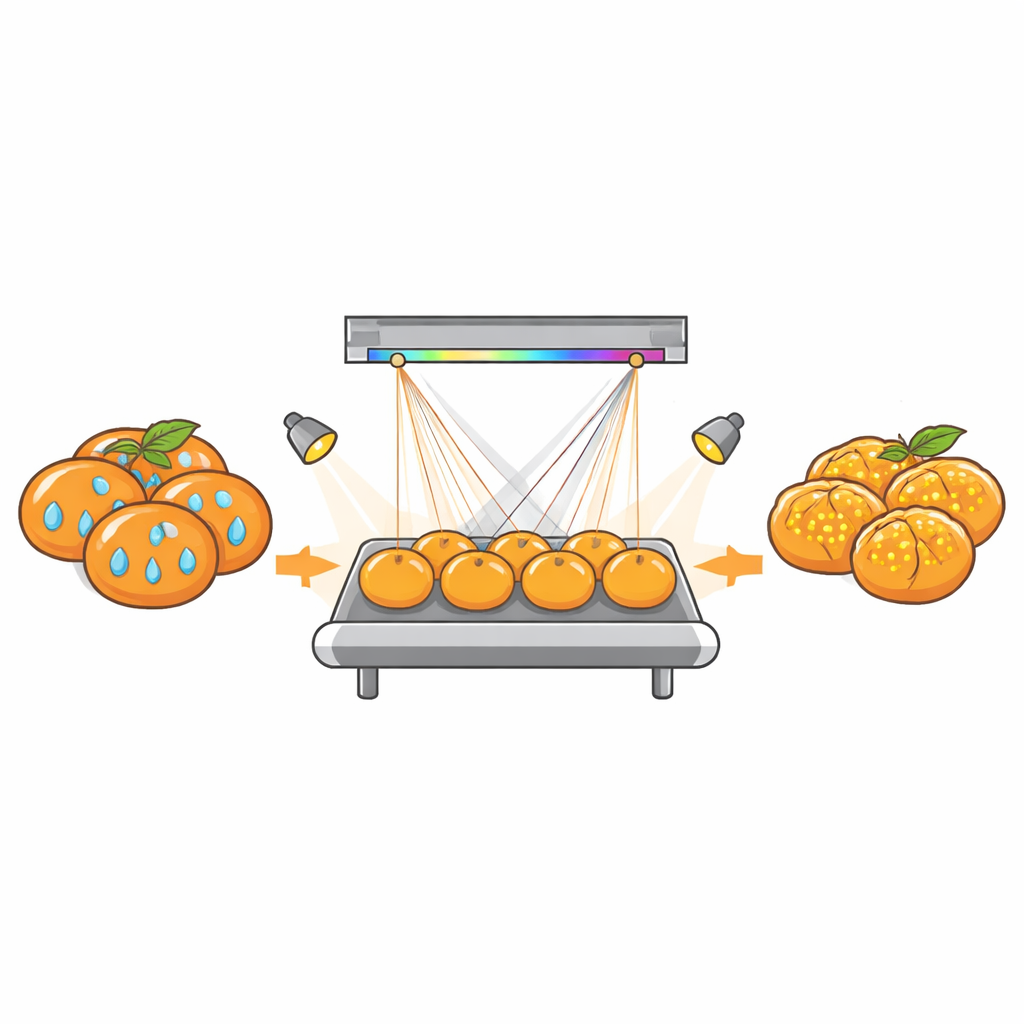
Instead of squeezing juice and using traditional instruments, the researchers used hyperspectral imaging, a method that shines light across a wide range of wavelengths and records how the fruit reflects it. These invisible colors carry clues about both water and dissolved solids such as sugars. The team collected 400 apricots from orchards in Xinjiang, China, and dried them in hot air. At four drying stages—after 2, 4, 6, and 8 hours—they captured detailed images from 450 to 1450 nanometers and then measured the actual sweetness of each fruit with a handheld device.
Following water and sugar as the fruit dries
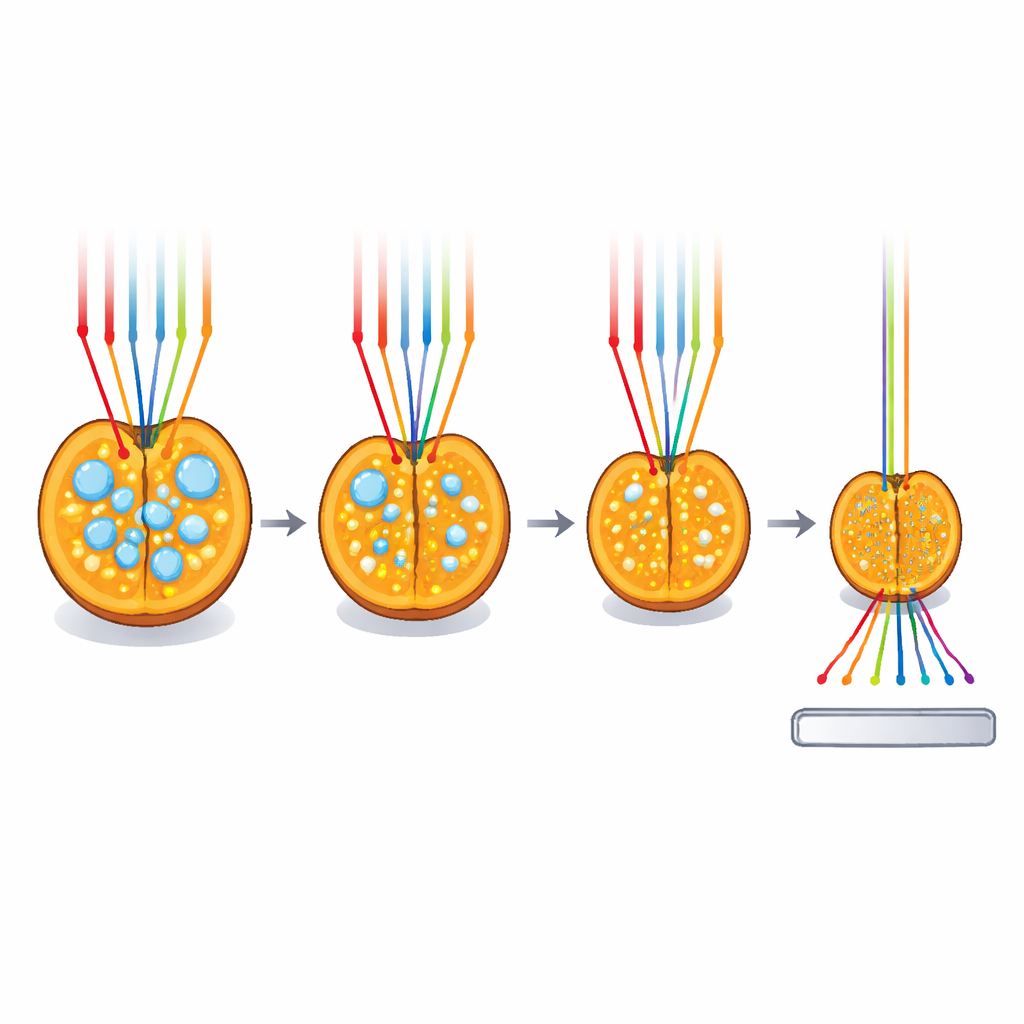
As the apricots dried, their moisture content fell sharply from around two-thirds water to about 40 percent, while measured sweetness, expressed as soluble solids, rose from roughly 16 to over 23 degrees Brix before leveling off. By examining the shapes of the light-reflectance curves, the team found that features linked to water weakened steadily. In particular, a dip near 970 nanometers and a nearby bump around 1000 nanometers, both associated with how water absorbs light, became shallower and smaller as drying progressed. These changes signaled that water’s influence on the spectrum was fading, allowing signals from sugars to stand out more clearly.
Building smart models from complex light data
Turning these rich light patterns into practical sweetness estimates required several data-processing steps. The researchers first cleaned the images and corrected for scattering caused by the fruit’s uneven surfaces. They then removed unusual samples that did not match the general trend. To avoid overloading their models with more than 500 wavelengths, they used a selection method to keep only those bands most strongly tied to sweetness. Finally, they trained statistical models that connect the chosen light signals to measured soluble solids and tested how well these models could predict sweetness for new fruits.
When less water means better predictions
The key finding is that the accuracy of the light-based sweetness predictions improved as the fruit became drier. For very moist apricots, water’s strong absorption of near-infrared light masked some of the information from sugars, limiting the precision of the models. As moisture dropped, especially into the 30–48 percent range, water’s signature in the spectrum shrank and the models captured the link between light and sweetness much more reliably. In this lower-moisture window, the best model produced highly accurate sweetness estimates with small errors and a level of performance suitable for precise quality control.
What this means for better dried fruit
For producers, the study shows that hyperspectral imaging can be a powerful tool for watching sweetness develop as apricots dry, especially once the fruit reaches a moderate to low moisture level. By focusing online monitoring and sorting in the 30–48 percent moisture range, factories could gauge internal quality quickly and without damaging products, helping them standardize flavor and optimize drying schedules. More broadly, the work highlights how water can hide or reveal important chemical information in light-based measurements, offering a roadmap for improving non-destructive testing in other fruits and dried foods as well.
Citation: Kang, L., Luo, H., Ma, X. et al. Study on the effect of moisture content on the spectral detection of soluble solids in apricot. Sci Rep 16, 10006 (2026). https://doi.org/10.1038/s41598-026-39890-w
Keywords: apricot drying, hyperspectral imaging, fruit sweetness, moisture content, non-destructive testing