Clear Sky Science · en
IGMNN: a diagnosis method for vertical root fractures based on an information gated memory neural network
Why finding tiny tooth cracks matters
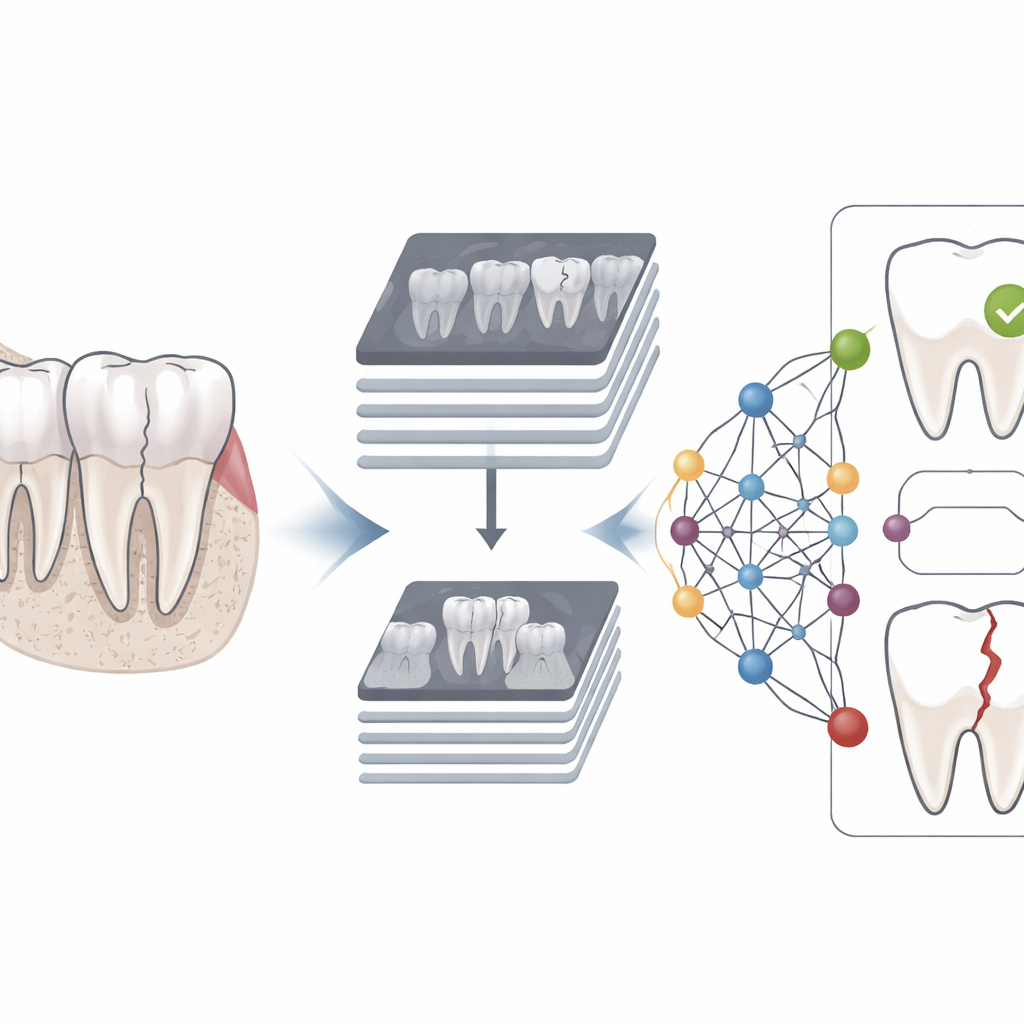
Vertical root fractures—long, thin cracks that run down the roots of teeth—are a quiet troublemaker in dentistry. They can cause pain, infection, and ultimately tooth loss, yet they are notoriously hard to spot, even with modern three‑dimensional X‑ray scans. Dentists must pore over similar‑looking images, often obscured by streaks and shadows from fillings or other dental work. This study presents a new kind of artificial intelligence (AI) system that behaves a bit like a doctor with a memory: it learns what healthy and fractured teeth typically look like, stores those patterns, and then uses this “experience” to make more reliable diagnoses from cone‑beam CT (CBCT) scans.
The hidden crack problem in dental scans
Vertical root fractures are small splits that can run from the root canal out to the surrounding bone, damaging the tooth and nearby tissues. They occur most often in premolars and certain molar roots and can be difficult to diagnose from symptoms alone—patients may have vague pain, and classic warning signs are often missing. CBCT scanners create detailed three‑dimensional images and have become an important tool to search for these cracks. However, the scans are cluttered by many teeth with nearly identical shapes, and metal fillings or root‑canal materials can create bright or dark streaks known as artifacts. These streaks can hide or mimic real fractures, making manual reading slow, tiring, and prone to error.
Why ordinary AI struggles with medical images
Standard image‑recognition systems, such as popular convolutional neural networks and transformers, have learned to recognize everyday objects from millions of photos. Medical images are a different story. They require expert labeling, come in much smaller numbers, and often show subtle differences between sick and healthy tissue. In the case of root fractures, the scans of fractured and intact teeth can look remarkably alike at first glance. Traditional AI tends to treat each training image in isolation and stores what it learns only implicitly in its internal weights. It has no explicit, updatable “memory” of what defines a typical fractured tooth versus a healthy one, which limits its ability to focus on the most telling patterns when data are scarce or noisy.
Teaching a network to remember disease patterns
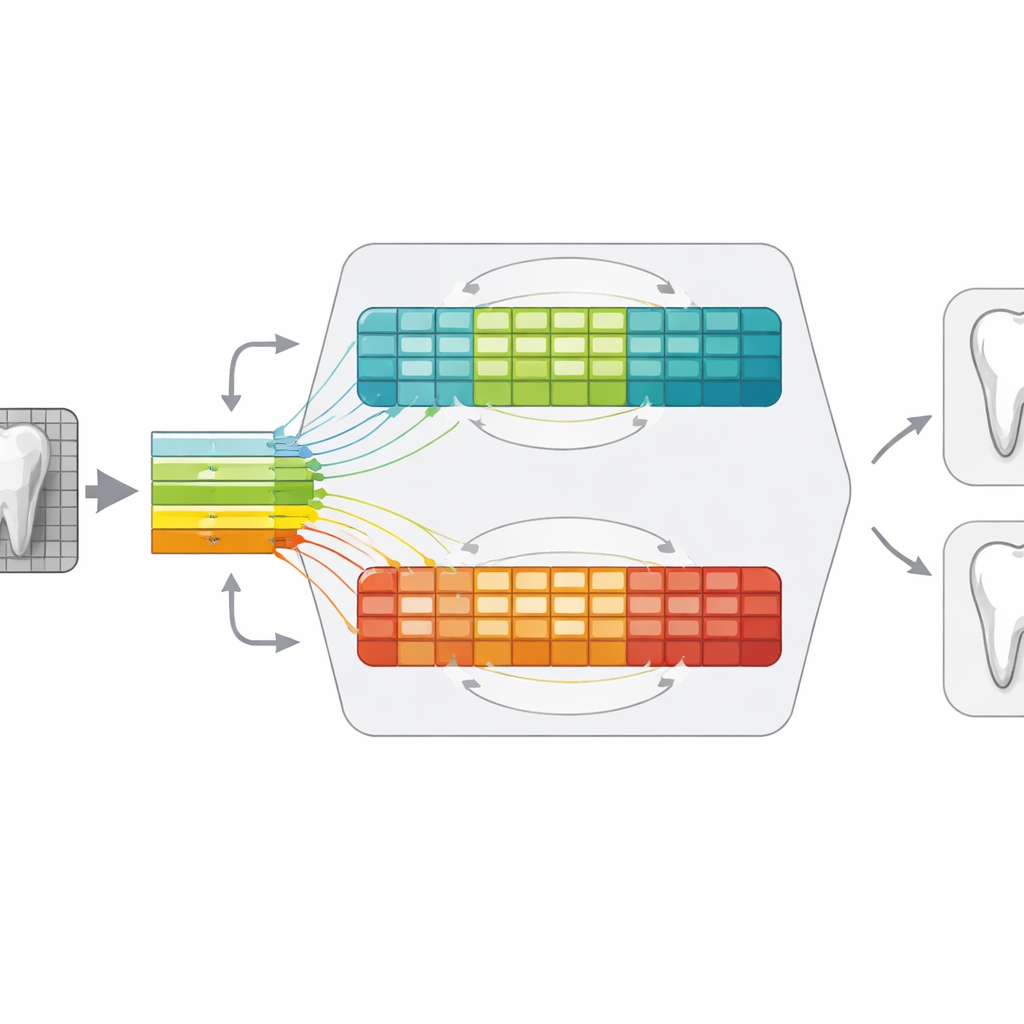
The authors introduce an Information Gated Memory Neural Network (IGMNN) designed to give an AI model explicit, class‑specific memories. The system first uses a strong existing network (ResNet152) to turn each CBCT tooth image into a numerical fingerprint describing its shapes and textures. These fingerprints are then compared with two external memory banks, one for “fractured” teeth and one for “non‑fractured” teeth. A special similarity measure, rooted in information theory, judges how closely a new fingerprint matches each memory bank’s overall pattern, not just its strongest spots. Gates within the network act like controlled valves: when a new example strongly resembles the stored pattern for its class, the corresponding memory opens to absorb and reinforce that information; when it differs or belongs to the opposite class, the gate stays mostly closed, preventing harmful mixing of memories.
Putting memory‑guided AI to the test
The team trained and evaluated their method on CBCT scans from 392 patients. They created two datasets: one without noticeable artifacts and another with strong streaks from dense materials. An automatic pre‑processing step cropped each scan around the tooth of interest so the AI would not be overwhelmed by irrelevant anatomy. Using standard performance measures such as accuracy and F1‑score, they compared IGMNN with a range of well‑known deep‑learning models, including several ResNet and DenseNet variants, vision transformers, and medical‑specific architectures. On clean images, IGMNN correctly distinguished fractured from healthy teeth in 97.3% of cases, edging out all competitors. Even on artifact‑ridden images—where every model performed worse—it still led the pack with 93.9% accuracy. Remarkably, when applied without retraining to scans from a different CBCT machine, its accuracy remained high at 95.3%, while a strong baseline model dropped to the low 70% range.
Seeing where the AI "looks" and what it remembers
To make the system’s behavior more transparent, the authors visualized which parts of the images influenced its decisions. Heatmaps and gradient‑based views showed that the network did not rely on a single bright streak or crack line. Instead, guided by its class‑specific memories, it paid attention to broader tooth regions and subtle structural cues, especially when artifacts were present. Additional analyses of the learned features revealed that IGMNN grouped fractured and non‑fractured examples into clear, compact clusters, even for data from a scanner it had never seen before. This suggests that its external memory is capturing stable, disease‑related patterns rather than just memorizing the training images themselves.
What this means for dentists and patients
The study demonstrates that giving an AI system an explicit, trainable memory of what healthy and cracked roots typically look like can substantially improve automated diagnosis of vertical root fractures on CBCT scans. For dentists, such a tool could act as a second pair of eyes, flagging suspicious teeth that might otherwise be missed, especially in noisy images or unfamiliar scanner settings. For patients, more accurate and consistent detection of these hidden fractures could mean earlier treatment decisions, fewer unnecessary procedures, and a better chance of saving compromised teeth. While further validation and integration into clinical workflows are still needed, the memory‑guided approach introduced here points toward a new generation of medical AI systems that learn—and remember—like experienced specialists.
Citation: Wang, J., Jin, X., Tang, R. et al. IGMNN: a diagnosis method for vertical root fractures based on an information gated memory neural network. Sci Rep 16, 10120 (2026). https://doi.org/10.1038/s41598-026-39857-x
Keywords: vertical root fracture, dental imaging, cone-beam CT, medical deep learning, memory neural network