Clear Sky Science · en
Big data approaches, overcoming critical limitations, and enhanced optical and environmental stability of Al2O3/Ti/Al2O3 colored solar-selective absorber coatings
Colorful roofs that work as green heaters
Many buildings use plain black solar panels and heaters because they capture sunlight well, but they are not very attractive. This study shows that thin, colored coatings can both look good and harvest solar energy efficiently, while also lasting for decades on real buildings. By combining advanced computer simulations with careful lab tests, the authors explore how to make these colorful surfaces bright, durable, and visible from many angles without losing their ability to turn sunlight into heat. 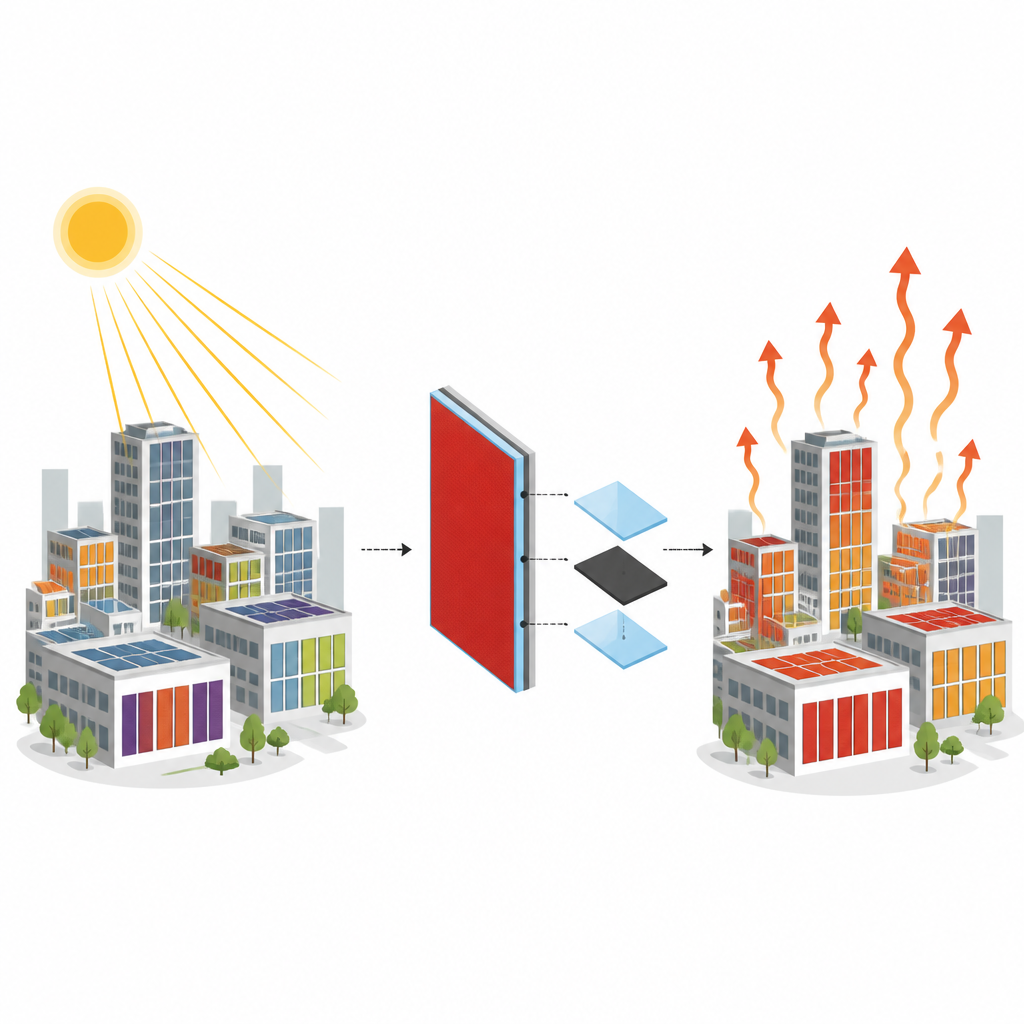
Turning sunlight into heat with style
The coatings in this work are special paint like layers made from aluminum oxide and titanium stacked in a very thin sandwich. When light hits these layers, some wavelengths are reflected as vivid colors, while the rest are absorbed as heat that can warm air or water in a building. Traditionally, designers believed that bright colors meant weaker heating performance. Using fast graphics processor calculations on more than 900 million virtual layer combinations, the researchers show that this belief is wrong. They find that when the solar absorptance sits around 87 to 90 percent, every color region on the standard color map can still appear relatively bright, with visible reflectance above 20 percent. In other words, blue, yellow, and other tones can be both eye catching and energy efficient.
What ultra large simulations reveal
To understand how color and efficiency connect, the team carried out big data style analyses of the simulated films. First, they counted how many layer stacks met different ranges of solar absorptance, reflectance, and color. As efficiency climbs above 93 percent, the number of possible layer designs shrinks, but bright colors remain possible. Next, they studied how changing each layer thickness shifts peaks and dips in the reflected light across ultraviolet, visible, and infrared regions. Thicker outer aluminum oxide layers push these features toward longer wavelengths and can increase brightness in the visible range. These trends give designers a kind of map for tuning color and performance without endless trial and error in the lab.
Roughness as a quiet design tool
Real buildings are viewed from many directions, not just straight on. Shiny mirror like coatings can look colorful only when seen from a narrow angle and appear almost black from the side. The authors show that carefully controlled surface roughness solves this problem. By lightly sanding the metal base before coating, tiny hills and valleys form under the thin films. Light then bounces around inside these micro grooves, spreading out in many directions instead of reflecting like a mirror. Experiments with laser scattering and outdoor photographs reveal that moderately rough samples keep their color and brightness over viewing angles of about plus or minus 60 degrees. At the same time, this level of roughness actually increases solar absorptance by more than 4 percent compared with a perfectly smooth base. 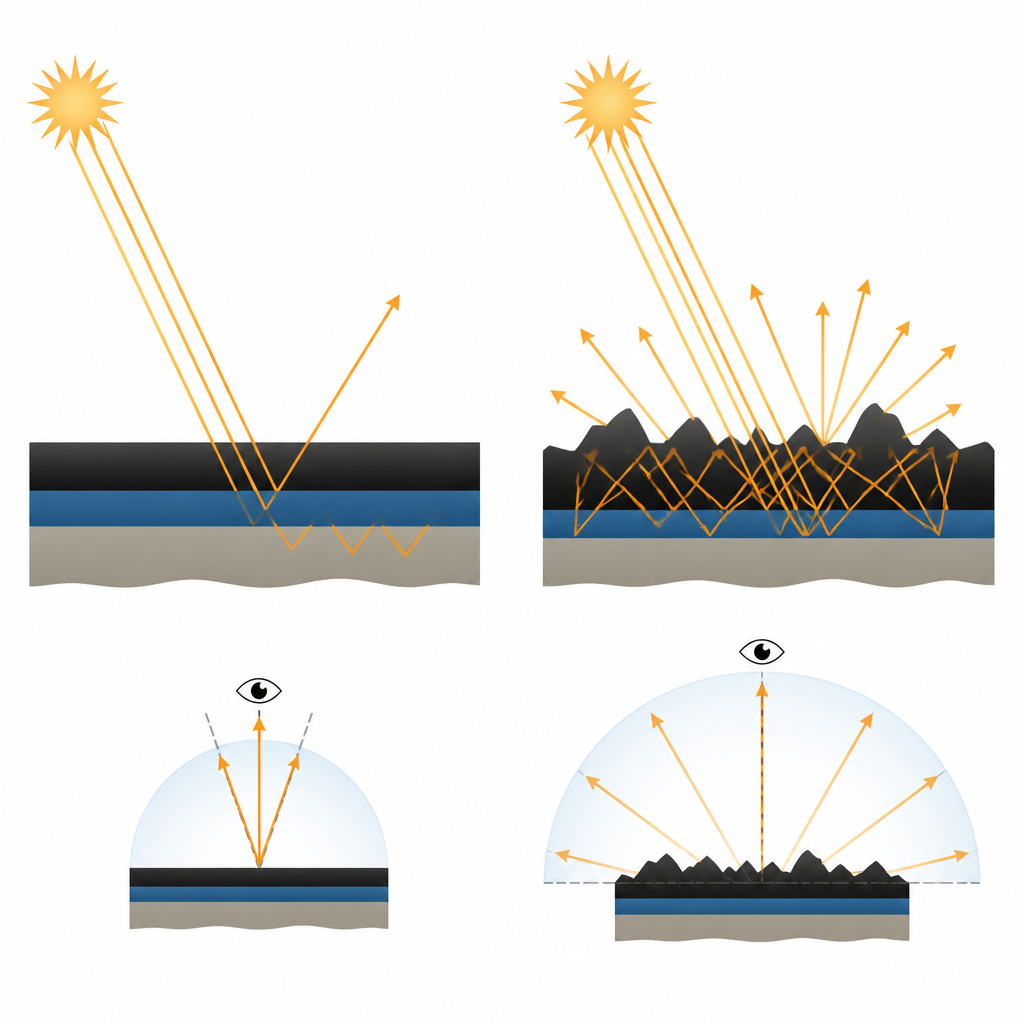
Built to last in the real world
Since building surfaces face rain, heat, dust, and salt, the team tested how roughness affects durability. Using hardness impressions, they found that coatings stick much better to roughened metal, with the best adhesion on moderately rough surfaces. Water droplet tests show that some rough textures help rain roll off, giving the surface a self cleaning effect. Corrosion tests in salty water reveal that the coated rough samples slow rusting by one to two orders of magnitude compared with bare steel. Heating experiments up to 650 degrees Celsius, along with crystal structure studies, show that the coatings keep high solar absorptance at normal operating temperatures and can have service lifetimes far longer than typical building lifespans when used below about 200 degrees Celsius.
From lab finding to city skyline
Beyond materials science, the authors discuss how these colorful, durable coatings could be marketed for green buildings. They suggest using strong color contrasts with surrounding walls, which relaxes manufacturing tolerances while still delivering striking designs. Taken together, the work demonstrates that Al2O3/Ti/Al2O3 colored solar selective absorbers can combine vivid appearance, wide viewing angles, high heat capture, strong adhesion, corrosion resistance, self cleaning potential, and long lifetime. For a layperson, the key message is that future buildings can wear bright solar skins that both save energy and enhance architectural style, rather than hiding their energy systems behind dull black panels.
Citation: Lai, YT., Lai, FD., Lin, TY. et al. Big data approaches, overcoming critical limitations, and enhanced optical and environmental stability of Al2O3/Ti/Al2O3 colored solar-selective absorber coatings. Sci Rep 16, 14864 (2026). https://doi.org/10.1038/s41598-026-39845-1
Keywords: colored solar coatings, building integrated solar, surface roughness, solar absorptance, environmental durability