Clear Sky Science · en
Molecular characterisation of the trafficking rescue of defective ABCB4 variants by roscovitine analogues
Why this liver story matters
Some children are born with a faulty liver pump that quietly damages their bile ducts and liver from the very first years of life. Many of them eventually need a liver transplant to survive. This study explores a different path: using tailor‑made small molecules to help the broken pump fold correctly, reach the right place in the cell, and work well enough to avoid or delay transplantation. It is a step toward personalized medicines for rare but devastating liver diseases.
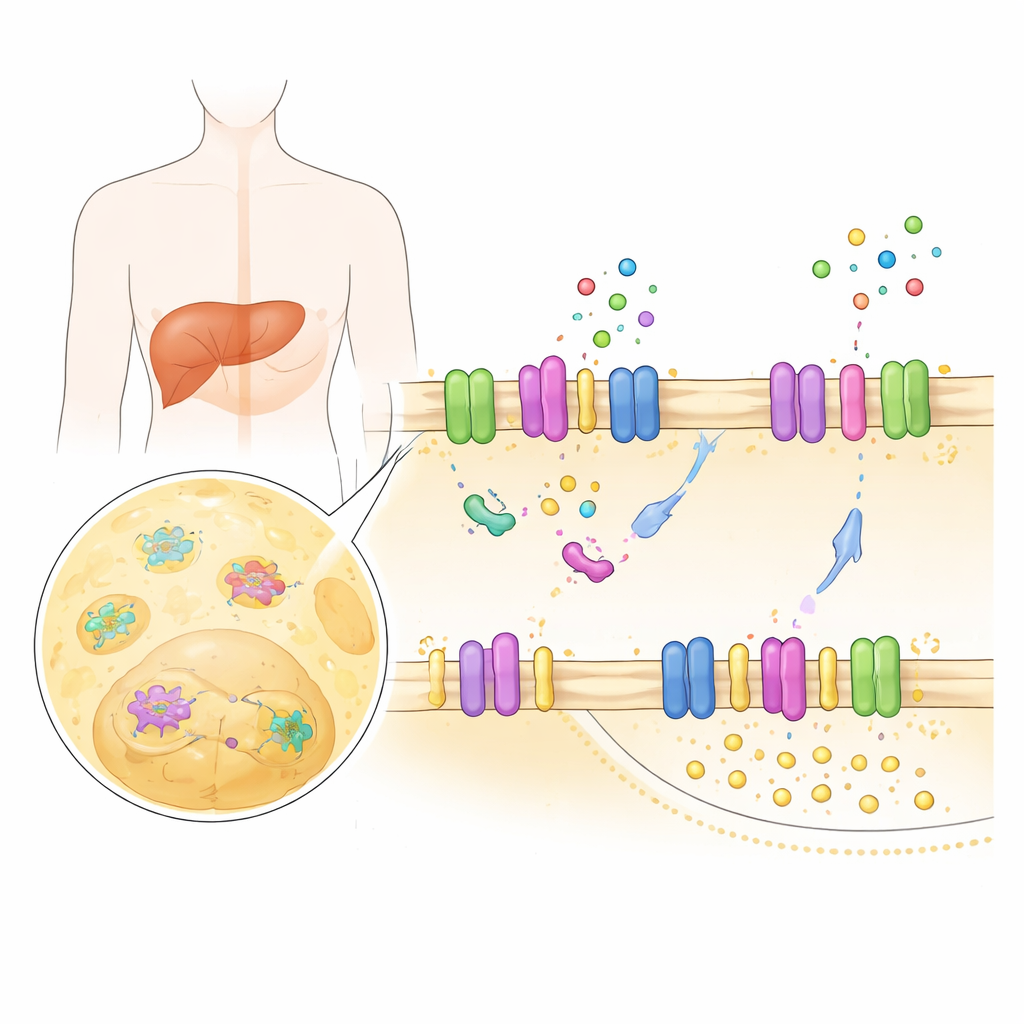
The liver’s soap‑making pump
The liver produces bile, a fluid that helps us digest fats and remove waste products. To do this safely, liver cells must ship a fat‑like substance called phosphatidylcholine into tiny channels that drain bile away. A protein called ABCB4 acts as a microscopic pump in the canalicular membrane of liver cells, flipping phosphatidylcholine from the inside to the outside of the cell so it can mix with bile salts and cholesterol. When this delicate balance is disturbed, bile becomes harsh and can form crystals and damage the bile ducts.
When a single gene disrupts bile flow
Changes in the ABCB4 gene are linked to several inherited cholestatic liver diseases. The most severe of these, progressive familial intrahepatic cholestasis type 3 (PFIC3), usually appears in infancy or early childhood and often progresses to cirrhosis and liver failure. Many patients ultimately need a liver transplant. Standard treatment with the bile acid drug ursodeoxycholic acid helps only some patients, and it rarely works in the most severe cases. More than 1500 genetic variants have been reported for ABCB4, and many interfere not with the pump’s basic chemistry but with its ability to fold properly, leave the cell’s protein factory, and reach the canalicular membrane.
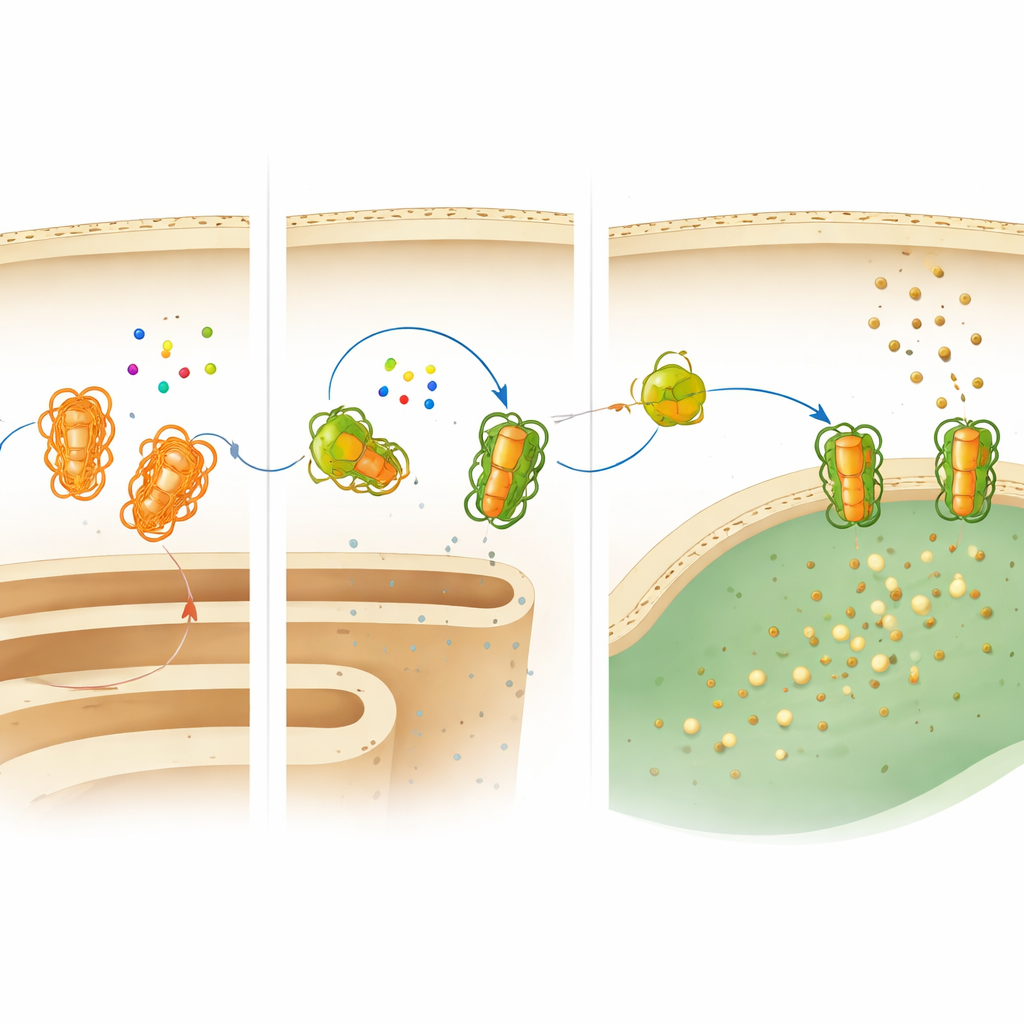
Designing chemical helpers for a misdelivered pump
The authors focused on so‑called “class II” ABCB4 variants that become stuck inside cells instead of being delivered to the membrane. Building on earlier work with a molecule called roscovitine, they synthesized 53 closely related compounds with different chemical cores and side groups. In human cell lines, they tested whether these molecules could help three common traffic‑defective ABCB4 variants mature into their fully processed form and appear at canalicular‑like regions. Through a series of protein blots and fluorescence microscopy images, they identified nine candidates that consistently improved both the maturation and canalicular targeting of all three variants, while avoiding major toxicity at the working concentration.
From better delivery to better pumping
Correct location is not enough; the repaired pumps must also move phosphatidylcholine. The team measured how much phosphatidylcholine cells secreted into their surroundings when treated with each compound. Some analogues, though good at correcting trafficking, strongly blocked the normal pump and did little to restore activity of the mutant forms. However, three molecules—named MRT13‑170, MRT14‑467, and MRT16‑467—stood out. They only moderately inhibited the normal pump and provided a partial but significant boost to the transport activity of the mutant pumps. Computer simulations suggested that these compounds can bind directly to ABCB4 in several regions, especially at interfaces between its core domains, possibly stabilizing the protein so it escapes quality‑control traps in the cell.
Looking inside the moving parts
To better understand why the three ABCB4 variants are misrouted, the researchers used large‑scale molecular simulations. These revealed that the mutations sit in a key engine‑like domain that binds and breaks down the cell’s energy molecule, ATP. The simulations suggested that the overall shape of this domain is not dramatically distorted, but its flexibility and the way it moves relative to other parts of the protein are altered. This subtle shift may be enough for the cell’s quality‑control machinery to flag the protein as defective and keep it from reaching the membrane. The same models showed that roscovitine analogues tend to dock at positions that could stabilize these moving parts, echoing how some drugs rescue the related cystic fibrosis protein.
What this could mean for patients
For children with PFIC3 and related conditions, complete restoration of ABCB4 function may not be necessary; clinical data suggest that reaching a fraction of normal activity could be enough to soften bile, protect the bile ducts, and make current treatments more effective. This study pinpoints several roscovitine‑like molecules that move traffic‑defective ABCB4 closer to that threshold while being less harmful to the normal pump than earlier candidates. Although these compounds are not yet ready for the clinic, they offer promising starting points for further chemical refinement and preclinical testing, bringing the goal of targeted, mutation‑specific therapy for rare liver diseases a little closer.
Citation: Banet, M., Crespi, V., Elie, J. et al. Molecular characterisation of the trafficking rescue of defective ABCB4 variants by roscovitine analogues. Sci Rep 16, 11031 (2026). https://doi.org/10.1038/s41598-026-39840-6
Keywords: ABCB4, cholestatic liver disease, pharmacological chaperones, bile transport, protein folding