Clear Sky Science · en
Deep mantle anomalies block early Earth melting, challenging a primordial origin
Why Earth’s Deep Interior Matters
Far beneath our feet, at depths no drill can reach, Earth’s rocky mantle moves slowly like thick taffy. These deep motions helped build the first continents and powered ancient volcanoes that shaped the planet’s surface and atmosphere. This study asks a deceptively simple question: could a hidden, dense layer of rock at the base of the mantle have blanketed the young Earth and still allowed all that early volcanic activity to happen? The answer reshapes how we think about our planet’s first two billion years.

A Hidden Layer Above the Core
Seismic waves show that two giant, continent-sized regions sit just above Earth’s core today. These regions, called large low-velocity provinces, are denser and slower for seismic waves to cross than the rest of the mantle. Many scientists have proposed that they are the surviving fragments of a once global, continuous layer that formed very early in Earth’s history, either from the crystallization of a deep magma ocean or from the debris of the giant impact that formed the Moon. If that picture were true, Earth’s mantle would once have been sandwiched between a rigid outer shell at the surface and a thick, heavy blanket of rock at the bottom.
Clues from Ancient Rocks and Crust
The rock record, however, tells us that early Earth was anything but quiet. Geologic and chemical studies indicate that at least a quarter of today’s continental crust formed during the Archean eon, between about 4.0 and 2.5 billion years ago. Abundant ancient volcanic rocks, including very hot magmas called komatiites and large igneous provinces, cluster in this time span. Their chemistry shows that large volumes of hot mantle melted and fed frequent eruptions. Any model of Earth’s deep interior must therefore allow for strong mantle upwellings and widespread melting during this period, despite the likely presence of a mostly rigid outer lid at the surface.
Testing the Deep Blanket Idea with Simulations
To see whether a global basal layer could coexist with all that early melting, the authors used high-resolution computer models of mantle convection in a “stagnant-lid” Earth, where the outer shell does not undergo modern plate tectonics. In their simulations, they added a dense, extra-sticky ring of material coating the core–mantle boundary and varied three key factors: how hot the mantle started, how hot the core–mantle boundary was, and how much radioactive heat was generated in the deep layer versus the rest of the mantle. They also calculated how much of the upper mantle would cross the melting threshold through time, a direct proxy for volcanism and crust formation.
When the Blanket Wins, the Volcanoes Lose
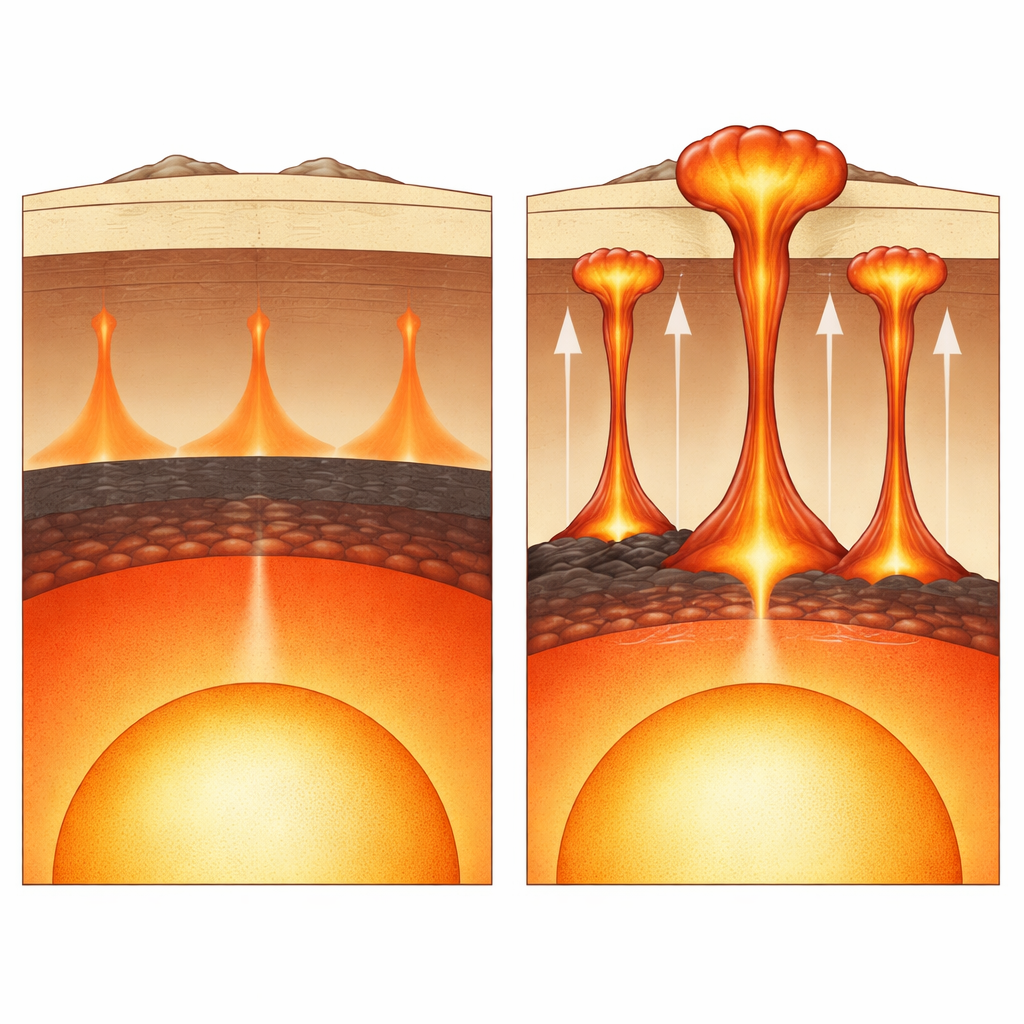
The models show that a continuous, non-mixing basal layer acts like a powerful thermal blanket. Because it barely participates in convection, it blocks heat coming out of the core, weakens the circulation of the overlying mantle, and dramatically reduces the formation of hot upwelling plumes. Even when the mantle and core start very hot, or when the deep layer is made extremely rich in radioactive elements, the effect is the same: the upper mantle stays too cool to melt significantly for most of the first two billion years. In contrast, simulations without a continuous basal layer produce vigorous plumes, substantial melting, and heat flow that match the geological evidence for Archean volcanism and rapid crust growth.
Rethinking Earth’s Deep Roots
By pitting computer models against the ancient rock record, the study concludes that a global, non-convecting dense shell above the core is incompatible with what we know about early Earth’s volcanism and crust formation. Rather than being the frozen remains of an early worldwide layer, today’s deep mantle anomalies are more likely to have formed later, or as separate piles from the start, perhaps sculpted by sinking slabs once plate tectonics began. In everyday terms, the planet’s interior could not have been wrapped in a tight insulating blanket and still built the continents and volcanic landscapes we see the traces of today. The deep structures we observe now must be younger, patchier, or both—and that insight sharpens our picture of how Earth cooled, churned, and became the habitable world we live on.
Citation: Roy, A., Mittelstaedt, E. & Cooper, C.M. Deep mantle anomalies block early Earth melting, challenging a primordial origin. Sci Rep 16, 10775 (2026). https://doi.org/10.1038/s41598-026-39827-3
Keywords: early Earth, mantle convection, deep mantle structures, Archean volcanism, core–mantle boundary