Clear Sky Science · en
Interpretable ultra-short-term photovoltaic power forecasting with multi-scale temporal modeling and variable-wise attention
Why forecasting solar power in minutes matters
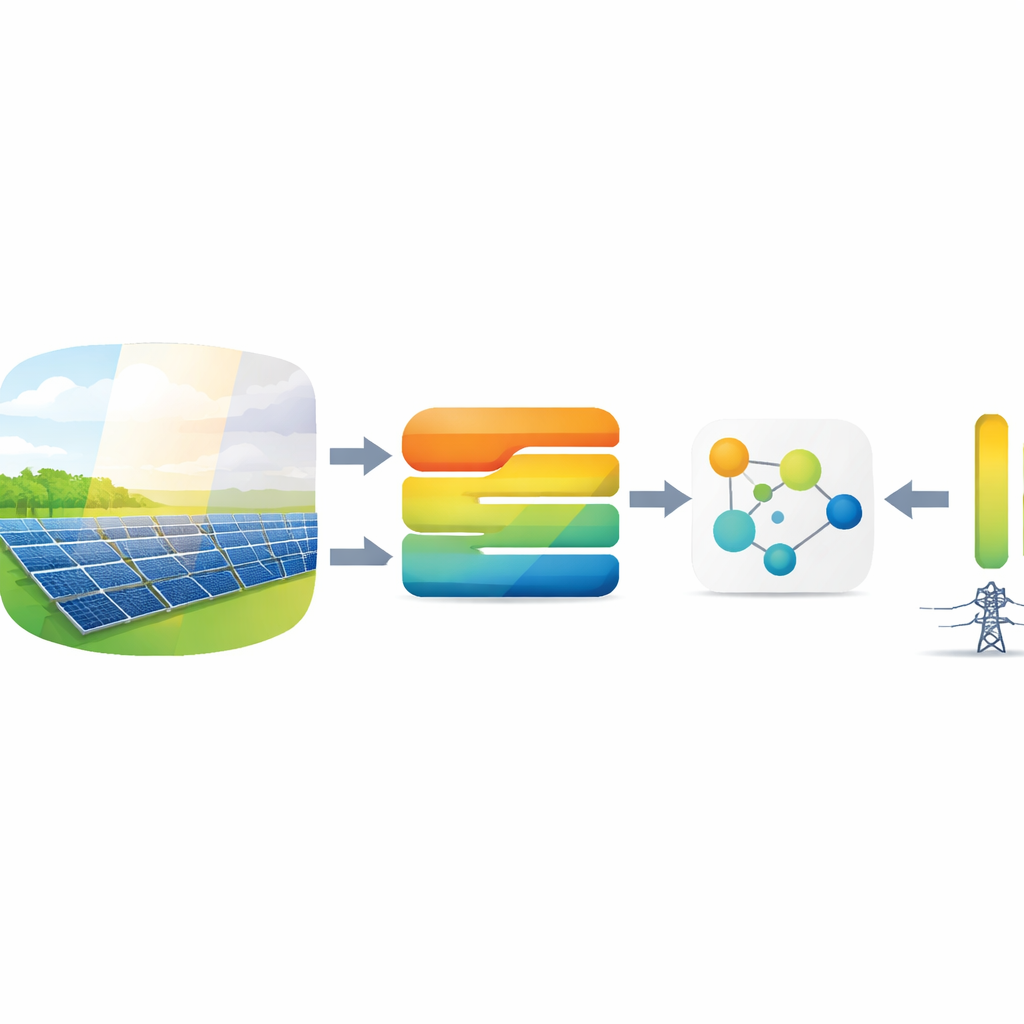
As more electricity comes from solar panels, power grid operators must constantly balance how much energy is being produced with how much people are using. Sudden clouds, seasonal shifts, and changing weather can make solar output jump up or down within minutes, threatening that balance. This paper introduces a new way to predict the power from a large solar farm just 15 minutes ahead, aiming to keep forecasts accurate across all four seasons while also making the model’s reasoning easier for humans to inspect.
Seeing patterns in sun and weather over many time scales
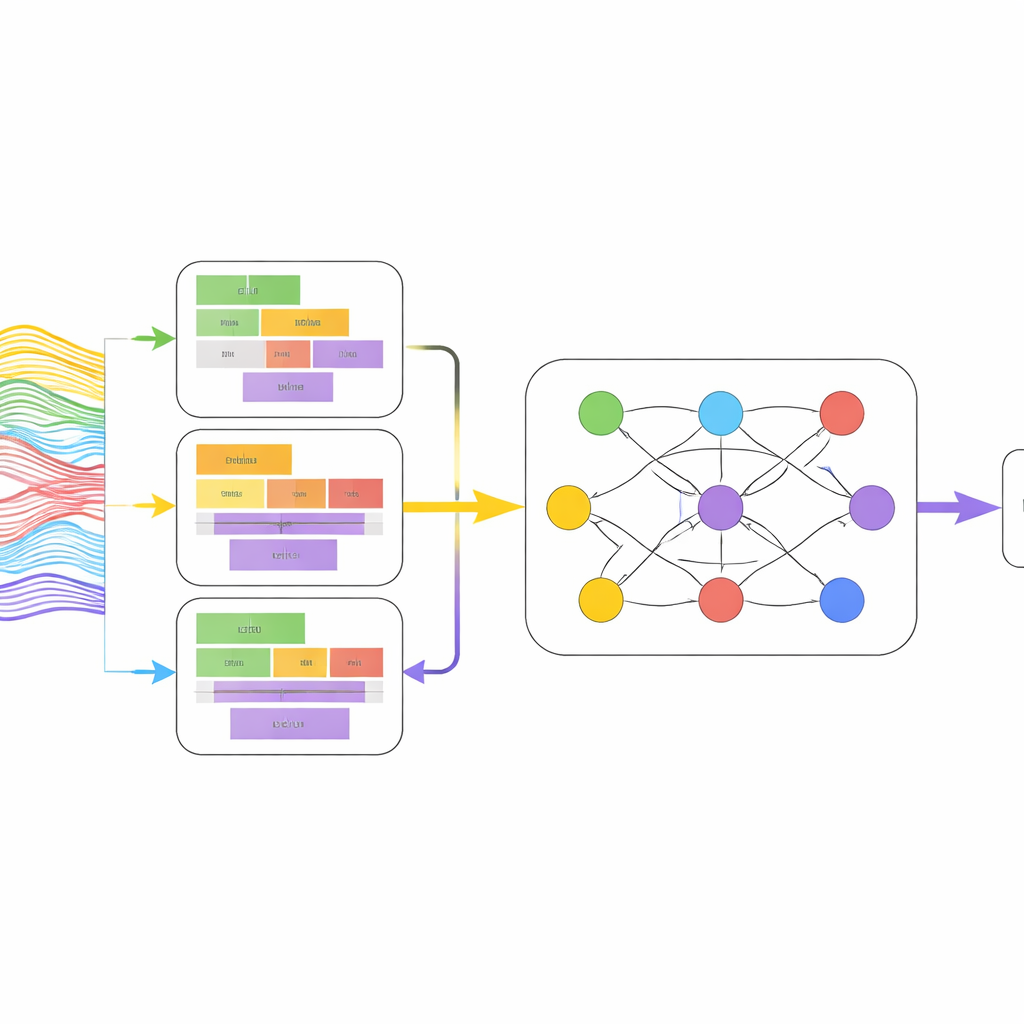
Solar power output is shaped by rhythms that unfold over minutes, hours, and months: the daily rise and fall of the sun, short bursts of cloud cover, and gradual seasonal changes. Traditional forecasting tools often focus on just one of these time scales or blur them together, which can lead to large errors when conditions change quickly. The first part of the proposed system, called the Multi-Scale Kolmogorov–Arnold Network (MKAN), tackles this by slicing past data into overlapping chunks of different lengths. Each chunk passes through a small, flexible mathematical module that learns how power responds to the recent pattern at that scale. These scale-specific views are then stitched back together into a rich summary of how the solar farm has been behaving over the recent past.
Letting weather variables "talk" to each other
Solar power does not depend on a single reading like sunlight intensity; it emerges from complex interactions among several factors, including direct and diffuse light, temperature, humidity, pressure, and the plant’s own recent output. The second part of the framework, called iTransformer, is designed to capture these interactions by treating each variable as its own "token" in a conversation. Instead of scanning time step by time step, iTransformer looks across variables and uses an attention mechanism to decide which ones should influence each other most strongly for a given forecast. This variable-wise focus makes it easier to reveal, for example, when humidity is strongly shaping the effect of sunlight, or when the model is leaning heavily on recent power output because weather is unstable.
Combining the two ideas into a single forecasting engine
The authors connect MKAN and iTransformer in sequence to form the MKAN-iTransformer model. First, MKAN transforms the raw 15-minute-resolution history of weather and power into multi-scale temporal features that separate fast flickers from smoother trends. Then iTransformer takes these features and uses its attention mechanism to weave together information from different variables, producing a final estimate of the plant’s power 15 minutes into the future. The system is trained and tested on two years of data from a 30 MW solar farm in China, using only daytime readings between 6:00 AM and 8:00 PM. The data are split chronologically for each season to mimic real deployment, and the model is compared with a wide range of alternatives, from classic recurrent networks to newer Transformer-based designs and their own KAN-enhanced variants.
How well it works across spring, summer, autumn, and winter
Across nearly all seasons and error measures, MKAN-iTransformer either matches or beats competing methods. In spring and autumn—when weather changes rapidly and power curves are shaped by irregular ramps—it delivers the lowest squared errors and the smallest average mistakes, while explaining over 94% of the variation in power. In winter, a particularly difficult regime with low sun angles and rapid swings, the model cuts some error measures by more than half compared with a standard Transformer and clearly outperforms recurrent networks. Summer is somewhat easier for most models, but MKAN-iTransformer still provides the lowest squared errors, meaning it better suppresses large, occasional misses. Careful ablation studies show that using MKAN or iTransformer alone cannot fully explain these gains; it is their combination—multi-scale timing plus cross-variable attention—that yields the most stable performance across seasons.
Opening the black box for energy operators
Beyond raw accuracy, the authors emphasize interpretability. Because MKAN builds its predictions from sums of simple learned functions, these can be visualized to reveal how the model responds to inputs at different levels, such as low or high irradiance. A multi-scale decomposition of the power signal shows how daily trends, medium-term weather shifts, and fast cloud-induced jumps are separated and processed. Meanwhile, attention maps from iTransformer display how importance shifts among variables by season: direct sunlight dominates in spring and winter, while humidity and certain irradiance measures gain prominence in summer and autumn. These visual tools help engineers understand why the model behaves as it does under different atmospheric regimes, supporting trust and diagnosis when forecasts go wrong.
What this means for the future of solar forecasting
In everyday terms, the study shows that it is possible to build a solar forecast that looks both "wide" and "deep": wide across different weather signals, and deep across multiple time scales, all while remaining partly readable to humans. For grid operators, this could translate into more reliable 15-minute-ahead predictions throughout the year, fewer surprise swings in supply, and better use of storage and backup plants. For researchers, MKAN-iTransformer offers a blueprint for combining interpretable building blocks with powerful attention mechanisms, pointing the way toward forecasting tools that are not only accurate but also explain how the sun, clouds, and atmosphere together shape the flow of renewable electricity.
Citation: Liu, L., Liu, M., Han, Z. et al. Interpretable ultra-short-term photovoltaic power forecasting with multi-scale temporal modeling and variable-wise attention. Sci Rep 16, 10336 (2026). https://doi.org/10.1038/s41598-026-39797-6
Keywords: solar power forecasting, photovoltaic grids, time series modeling, seasonal variability, interpretable AI