Clear Sky Science · en
Variable A-type lamin expression in Merkel cell carcinoma cell lines and its association with nuclear integrity
Why tiny cell shells matter in a rare skin cancer
Merkel cell carcinoma is a rare but highly aggressive skin cancer that often spreads early and is difficult to treat. Many cases are linked to a common virus that quietly lives on our skin. This study looks inside these cancer cells at the "shell" around their DNA and asks a simple question with big implications: does the way this shell is built help explain why some tumors are more dangerous than others, and how they respond when that shell cracks?
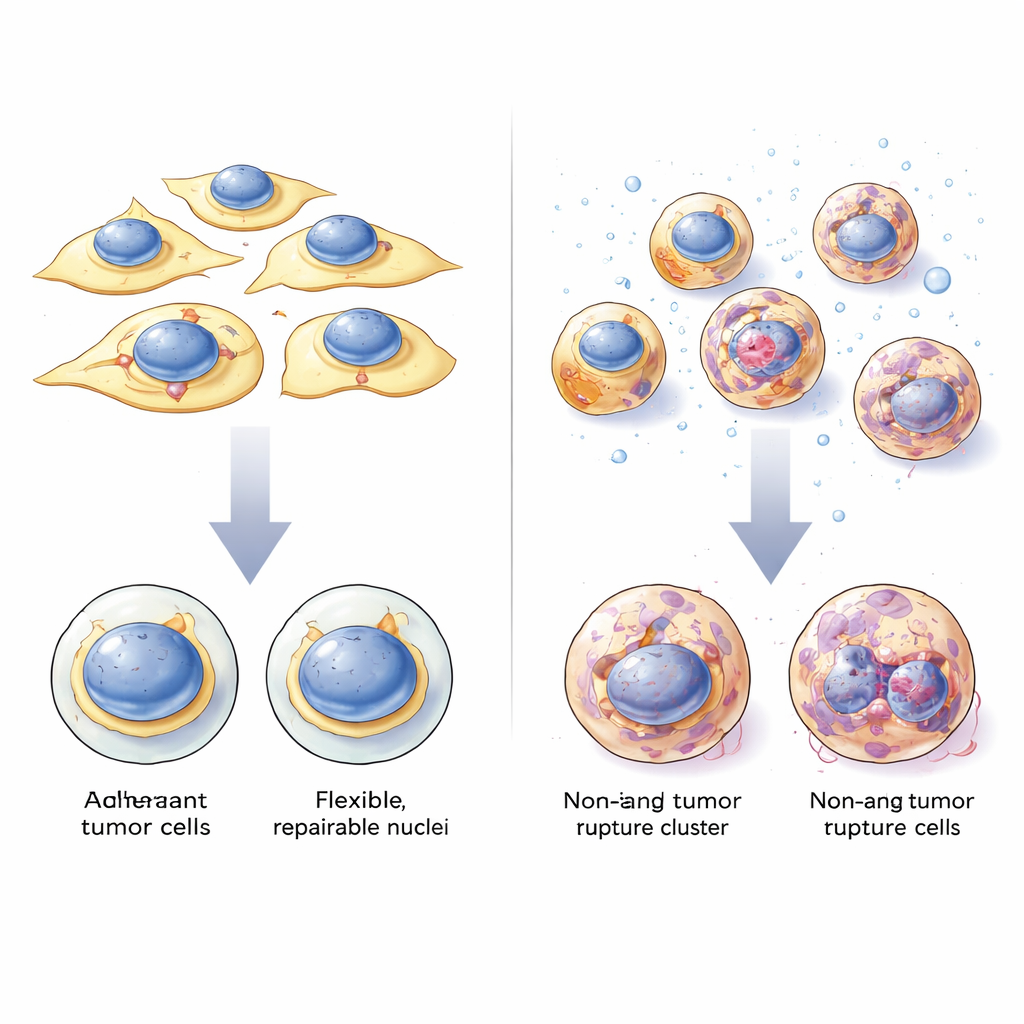
Two kinds of tumors, two ways of growing
Merkel cell carcinoma actually comes in two molecular flavors: tumors whose cells carry Merkel cell polyomavirus, and those that do not. In the lab, virus-positive cells tend to grow as loose, floating clusters, while virus-negative cells stick to the dish in a flat layer. The researchers focused on a structure called the nuclear envelope, the double membrane that surrounds DNA, and on key support proteins called lamins that form a meshwork just underneath it. They compared four well-known cell lines, two virus-positive and two virus-negative, to see how much of each lamin type they produced and how the nuclei looked.
How the inner shell of the nucleus is built
Using fluorescent microscopy, Western blotting, and RNA measurements, the team found a consistent pattern. Virus-positive, non-adherent cells had very low levels of A-type lamins and higher levels of B-type lamins. Virus-negative, adherent cells showed the opposite: strong A-type lamin signals and lower levels of B-type lamins. Another protein, emerin, which normally sits in the nuclear envelope, was mislocalized to the cytoplasm in virus-positive cells, but formed bright patches at the nuclear rim in virus-negative cells. These differences in the inner shell were seen both at the protein and mRNA level, indicating that the two tumor types truly build their nuclear scaffolds in different ways.
Cracked nuclei and how cells cope
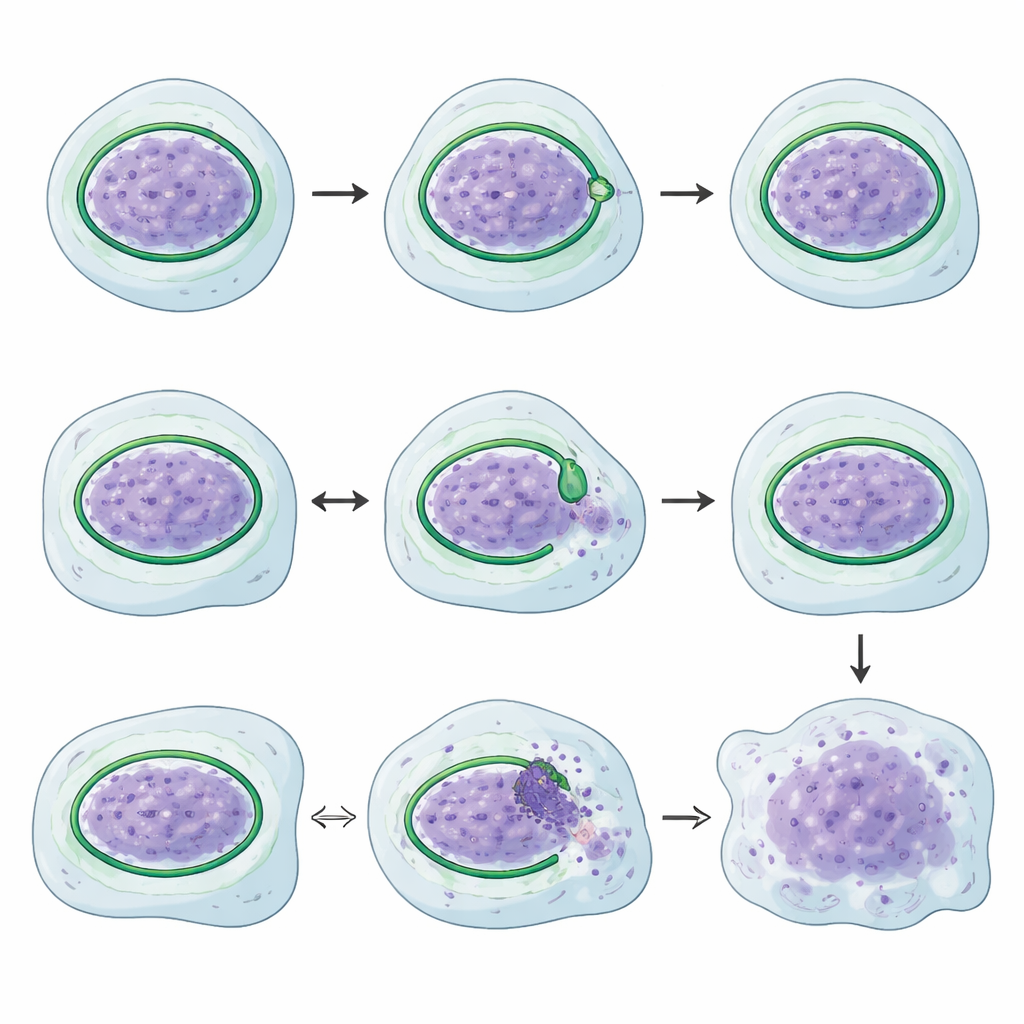
The shape and stability of the nuclei also differed strikingly. Virus-negative cells often showed distorted or damaged nuclei, including donut shapes, blebs, lobes, and tiny extra nuclei, resembling defects seen in rare inherited diseases of the nuclear envelope. The researchers then asked whether the nuclear envelope in these cells actually ruptures. By watching live cells that carried a fluorescent marker normally confined to the nucleus, they observed sudden leaks of fluorescence into the cytoplasm—direct evidence of nuclear envelope rupture. In virus-negative cells, the signal slowly re-concentrated in the nucleus, showing that these breaks could be repaired repeatedly. In virus-positive cells, however, similar ruptures were followed by complete loss of signal and swelling of the cell, consistent with cell death and failed repair.
Is the virus itself responsible?
Because virus-positive cells had low A-type lamin levels, the team tested whether viral cancer-promoting proteins could directly trigger this change. They forced a virus-negative cell line to produce the virus’s small and large tumor antigens under controlled conditions and then measured lamin levels. Despite successful production of the viral proteins, A-type lamins did not decrease and B-type lamins did not increase to match the virus-positive pattern. The abnormal nuclear shapes in these cells also remained. This suggests that simple expression of these viral proteins is not enough; factors such as how cells attach to their surroundings and mechanical tension on the nucleus may be more important in setting lamin levels.
What this means for patients and future therapies
In plain terms, the study shows that virus-positive and virus-negative Merkel cell cancers build and maintain the shell around their DNA in very different ways. Virus-negative cells have sturdier A-type lamin networks but experience frequent, repairable nuclear “cracks,” which may foster genetic instability and aggressive behavior. Virus-positive cells have fragile shells with little A-type lamin; when their nuclei rupture, they often cannot mend the damage and the cells die. These differences could help explain why virus-negative tumors tend to be more aggressive and why low A-type lamin levels, as seen in virus-positive cells, might make them more sensitive to certain chemotherapies like paclitaxel. Understanding how and when nuclear envelopes break—and whether repair can be boosted or blocked—could open new ways to slow tumor spread or selectively kill cancer cells in this rare but deadly skin cancer.
Citation: Stiekema, M., van Gorp, C., Macamo, A. et al. Variable A-type lamin expression in Merkel cell carcinoma cell lines and its association with nuclear integrity. Sci Rep 16, 11070 (2026). https://doi.org/10.1038/s41598-026-39775-y
Keywords: Merkel cell carcinoma, nuclear lamina, lamin A, polyomavirus, nuclear envelope rupture