Clear Sky Science · en
Advanced stacked modeling techniques for material porosity estimation via high-resolution computed tomography imaging
Why tiny holes in concrete matter
From bridges and skyscrapers to offshore wind farms, many of the structures we rely on are made from concrete or similar engineered materials. Hidden inside these solids is a delicate architecture of tiny voids, or pores, that quietly governs how strong, durable, and water‑tight they are. Measuring this porosity has long required slow, hands‑on lab work and careful inspection of complex X‑ray images. This study introduces a fully automated way to read those images using artificial intelligence, promising faster and more reliable checks on the health and quality of modern construction materials.
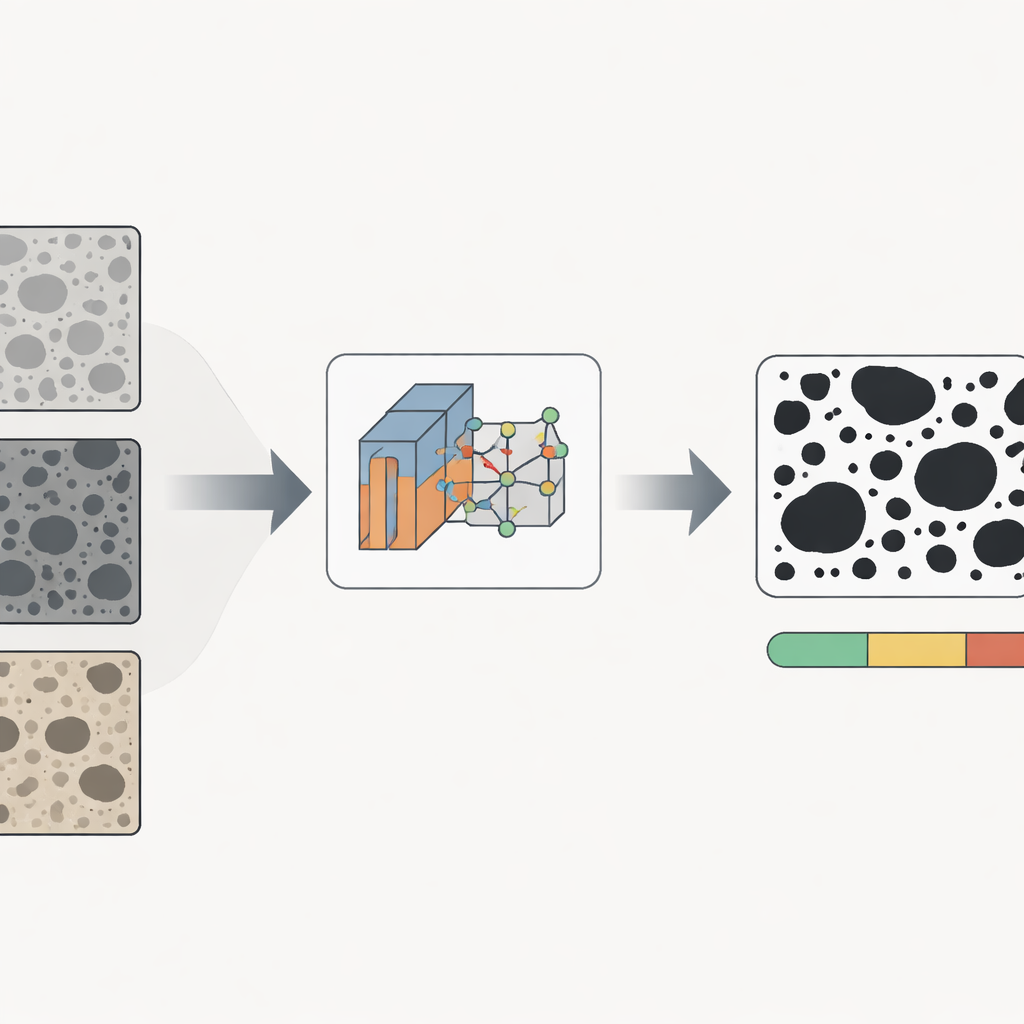
Peering inside materials with X‑rays
Porosity is essentially the share of empty space inside a solid. In concrete and related materials, it affects everything from mechanical strength and crack growth to how easily water, salts, or pollutants seep through. Engineers increasingly use micro‑computed tomography (micro‑CT) to scan samples in 3D, producing detailed grayscale images of where solid phases and voids lie. But turning these rich images into a clear pore map is not trivial. Traditional techniques rely on manually choosing brightness cutoffs and drawing regions of interest, choices that can vary from person to person and can break down when images are noisy or resolution is limited. The result is a labor‑intensive workflow that can struggle to keep pace with industrial needs.
Letting a neural network find what matters
The authors tackle these problems with a “stacked” approach that combines deep learning with carefully crafted image rules. First, a deep convolutional neural network (DeepCNN), inspired by popular object‑detection models, is trained to look at 2D slices from micro‑CT scans of different concrete‑like materials. These include several cement mortars, a geopolymer mortar, and ultra‑high‑performance concrete. Instead of segmenting every pore directly, the network has two jobs: to automatically crop out a clean, central region of interest—avoiding frame artifacts and edge distortions—and to recognize which material class the image belongs to based on subtle texture and gray‑level patterns.
From shades of gray to pore maps
Once the network has isolated and labeled the region of interest, a second module takes over to actually measure porosity. Here the authors deliberately avoid an opaque, end‑to‑end AI system in favor of a rule‑based, adaptive procedure. Pixels are first grouped into three or four intensity clusters to separate likely solid, pore, and transition zones. Depending on the material type and image characteristics, the framework then selects a suitable filtering and thresholding recipe—for example, applying median or Gaussian blurs to reduce noise, and choosing between local and global intensity cutoffs. This rule‑based adaptive thresholding converts each image into a simple black‑and‑white map, where one value represents solid and the other void. Porosity is then calculated as the fraction of pixels classified as pores within the cropped region.
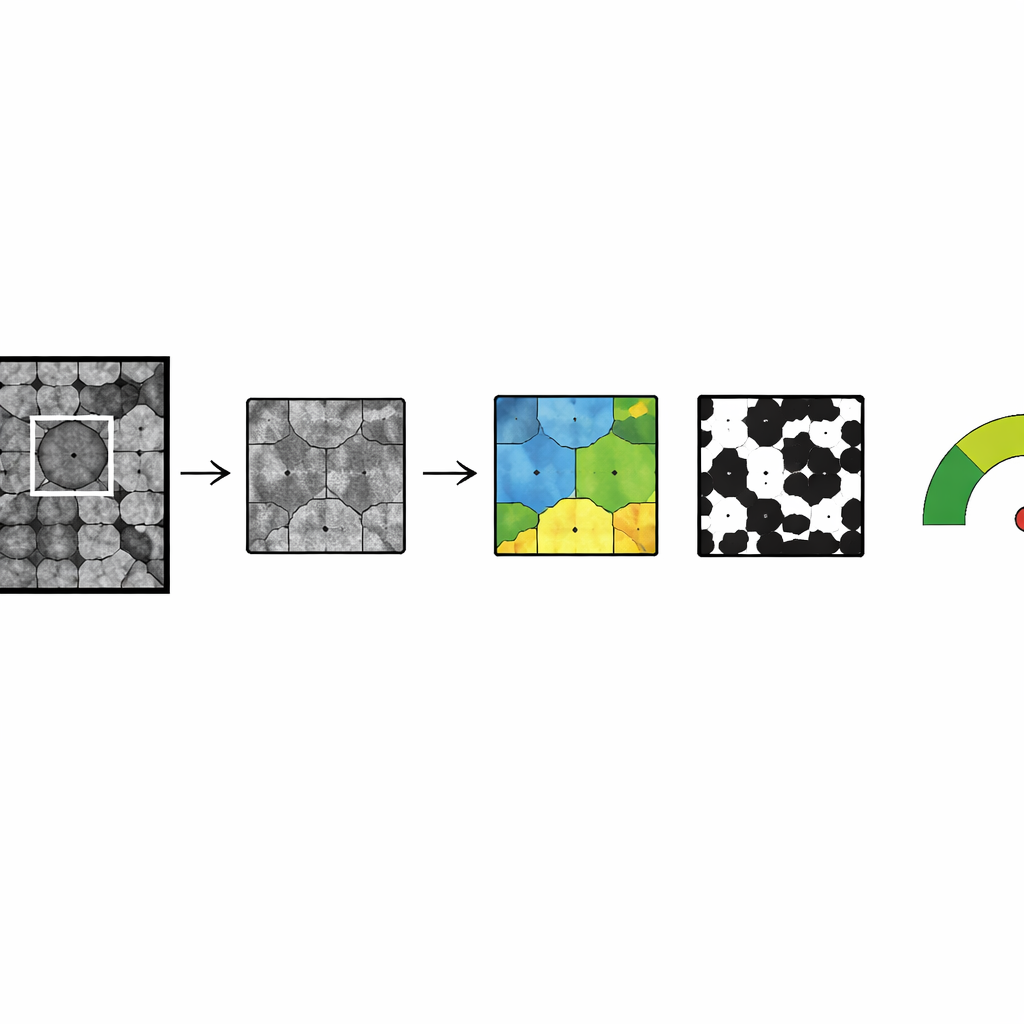
How well does the new method agree with lab tests?
To check whether the automated measurements are trustworthy, the team compares them with porosity values obtained by vacuum pycnometry, a well‑established experimental technique that infers pore volume from gas displacement. Across more than twenty thousand CT images, the estimated porosity for each material class differs from pycnometer results by typically only 2–3 percent, with especially close agreement for some mixes. The DeepCNN classifier itself performs nearly flawlessly on test data, cleanly separating the six material types. Statistical analyses show stable porosity estimates across subsets of the dataset, though the framework performs best on high‑resolution, low‑noise scans and is somewhat less consistent for ultra‑dense concretes, where pores are sparse and harder to resolve.
What this means for real‑world materials
In practical terms, the study shows that it is possible to turn raw micro‑CT images of complex cementitious materials into reliable porosity estimates with little or no human intervention. By splitting the task into a learned classification stage and a transparent, rule‑based measurement stage, the authors achieve both speed—on the order of tenths of a second per image—and interpretability. The framework is not a universal solution: it still depends on image quality, cannot see pores below the scan’s resolution, and must be retrained or adapted for completely new materials. Even so, it points toward industrial CT workflows where quality control on concrete and related materials can be performed in near real time, helping engineers design longer‑lasting structures and monitor their internal health more efficiently.
Citation: Kim, B., K.R., S., Natarajan, Y. et al. Advanced stacked modeling techniques for material porosity estimation via high-resolution computed tomography imaging. Sci Rep 16, 12714 (2026). https://doi.org/10.1038/s41598-026-39748-1
Keywords: porosity estimation, micro CT imaging, deep learning, concrete materials, image segmentation