Clear Sky Science · en
Analysis and control of gas blowout accidents in working faces beneath thick magmatic rock
Why hidden rock layers matter underground
Deep underground, coal miners are not just cutting through coal; they are working beneath huge slabs of ancient rock that can store enormous forces, gas, and water. In China’s Huaibei mining district, thick layers of hardened magma sit high above the coal seams like a giant stone bridge. When mining disturbs this delicate stack of layers, the trapped gas and water can suddenly rush out, damaging equipment and threatening lives. This study investigates how these massive rock layers behave and shows how better engineering can tame one of the most dangerous combinations in modern coal mining: deep coal, high gas, and a rigid rock roof.
The setting of a deep underground hazard
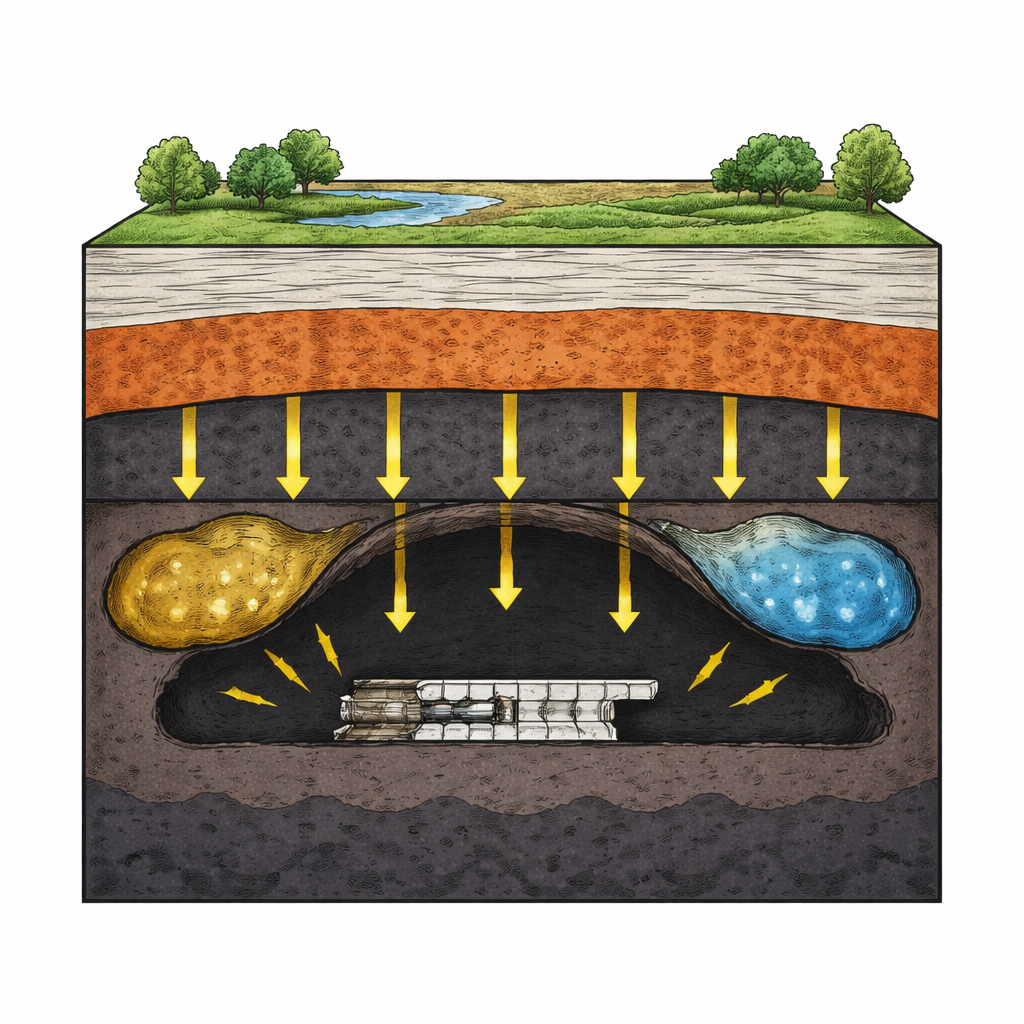
The researchers focused on the 10,414 working face in the 104 mining area of the Huaibei district, where coal lies more than 600 meters below the surface. Above the coal seam, two thick magmatic rock beds—solidified molten rock—form a stiff roof. Mining in this area has already produced a troubling record: repeated episodes of extreme roof pressure, damaged hydraulic supports, and a dramatic blowout from a surface gas extraction hole that released over 160,000 cubic meters of gas and thousands of cubic meters of water. These events suggested that the overlying magmatic rock was not a passive ceiling, but a key player in concentrating stress and driving gas and water outbursts.
Finding the key rock layers that control movement
To understand which parts of the overlying rock stack really control the behavior of the mine, the authors first analyzed detailed geological data. Using mechanical formulas, they identified “key layers” that act like the main beams in a building: if these layers bend or break, everything above and below responds. They found three such layers over the No. 10 coal seam: two thinner sandstone and siltstone beds close to the coal, and one very thick magmatic rock layer nearly 90 meters above it. Calculations showed that the lower key layers govern how the immediate roof caves and fractures, while the thick magmatic rock governs movement all the way up to the surface. Any significant shift of this magmatic slab would therefore strongly affect mine pressure and surface stability.
Scaled-down experiments and computer models
The team then built a large physical model of the rock layers using sand, powders, and binders chosen so that strength and weight scaled correctly to the real mine. They painted the coal seam and magmatic rock in contrasting colors, excavated the model step by step, and tracked how the overlying layers moved using high-resolution cameras and embedded pressure sensors. As the model coal face advanced, the lower key layers fractured in stages, forming a “ladder-like” caving structure and a growing empty space between the caved roof and the still-intact magmatic rock. Only after mining progressed far enough did the thick magmatic layer itself begin to sag as a whole block, causing its influence to reach all the way to the top of the model—mirroring how, in the real mine, this movement can extend to the ground surface.
How stress, gas, and water build toward disaster
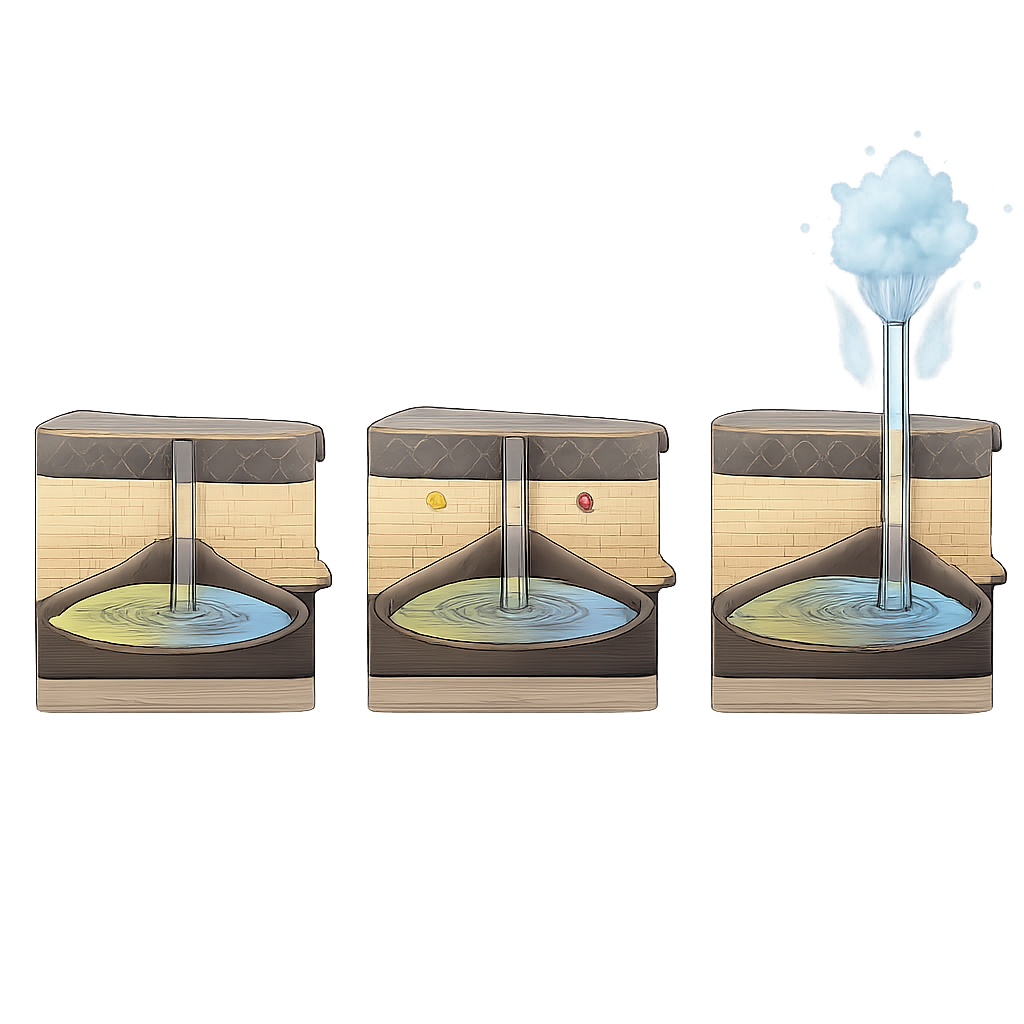
Stress measurements in the model showed that pressures in the coal and roof gradually climbed as mining approached the point where the magmatic rock would start to bend. Just before this happened, coal stresses peaked at levels much higher than in cases without a thick magmatic roof. Once the magmatic slab sagged, stress in the coal dropped but remained elevated. Numerical simulations of several neighboring working faces confirmed this pattern: with magmatic overburden, peak vertical stress in coal increased by over 20 percent compared with softer overburden, and stresses stacked up around the abandoned mined-out zones. The study’s conceptual analysis links this high-stress environment to gas and water behavior: fractures beneath the magmatic rock create a large cavity where released gas and formation water can collect. When the rigid slab suddenly settles, it squeezes these trapped fluids toward any connected drilling holes, driving violent blowouts.
Engineering ways to calm the rock and fluids
Because the thick magmatic rock lies far above the coal seam, directly breaking it in advance with blasting or hydraulic fracturing would be difficult and unreliable. Instead, the authors propose controlling the space that allows it to bend. Their plan has two parts. First, after mining, they inject grout into the separation space beneath the magmatic layer through deep boreholes, effectively filling the void that would otherwise let the slab sag and compress gas and water. Second, for future panels, they recommend paste backfill mining, in which waste rock, fly ash, cement, and water are pumped into the goaf (the mined-out area) to form a strong artificial pillar. This method both supports the roof and transfers stress more gently, lowering the chance of sudden coal bursts or fluid outbursts.
What this means for safer coal mining
Put simply, the paper shows that a thick, rigid magmatic rock layer high above a coal seam acts like a giant stiff beam that stores and focuses stress, while also helping create hidden pockets of gas and water. When that beam finally moves, the stored energy and trapped fluids can be released in dangerous bursts. By combining scaled laboratory models, computer simulations, and field data, the authors demonstrate that recognizing these key layers and deliberately filling the spaces beneath them can turn an unstable underground system into a more controlled one. For mining regions around the world where coal seams lie under similar magmatic roofs, these findings point toward practical steps to reduce catastrophic gas blowouts and keep deep coal production both safer and more efficient.
Citation: Ma, S., Su, Y., Wang, X. et al. Analysis and control of gas blowout accidents in working faces beneath thick magmatic rock. Sci Rep 16, 10198 (2026). https://doi.org/10.1038/s41598-026-39745-4
Keywords: coal mine safety, gas outburst, magmatic rock roof, rock mass stress, backfill grouting