Clear Sky Science · en
3D upper crustal structure modelling in southwestern Sicily through multiapproach onshore–offshore data: insight into Sciacca Geothermal Field
Hidden Heat Beneath a Coastal Landscape
Along the southwestern coast of Sicily, near the town of Sciacca, hot springs, steaming caves and warm seabed seeps hint at a powerful heat source deep underground. This study asks a deceptively simple question: are these onshore and offshore warm-water and gas manifestations all part of one large hidden geothermal system? By building a detailed three-dimensional picture of the rocks and faults beneath both land and sea, the authors show how deep fluids can travel upward along cracks in the Earth’s crust to feed the Sciacca Geothermal Field.
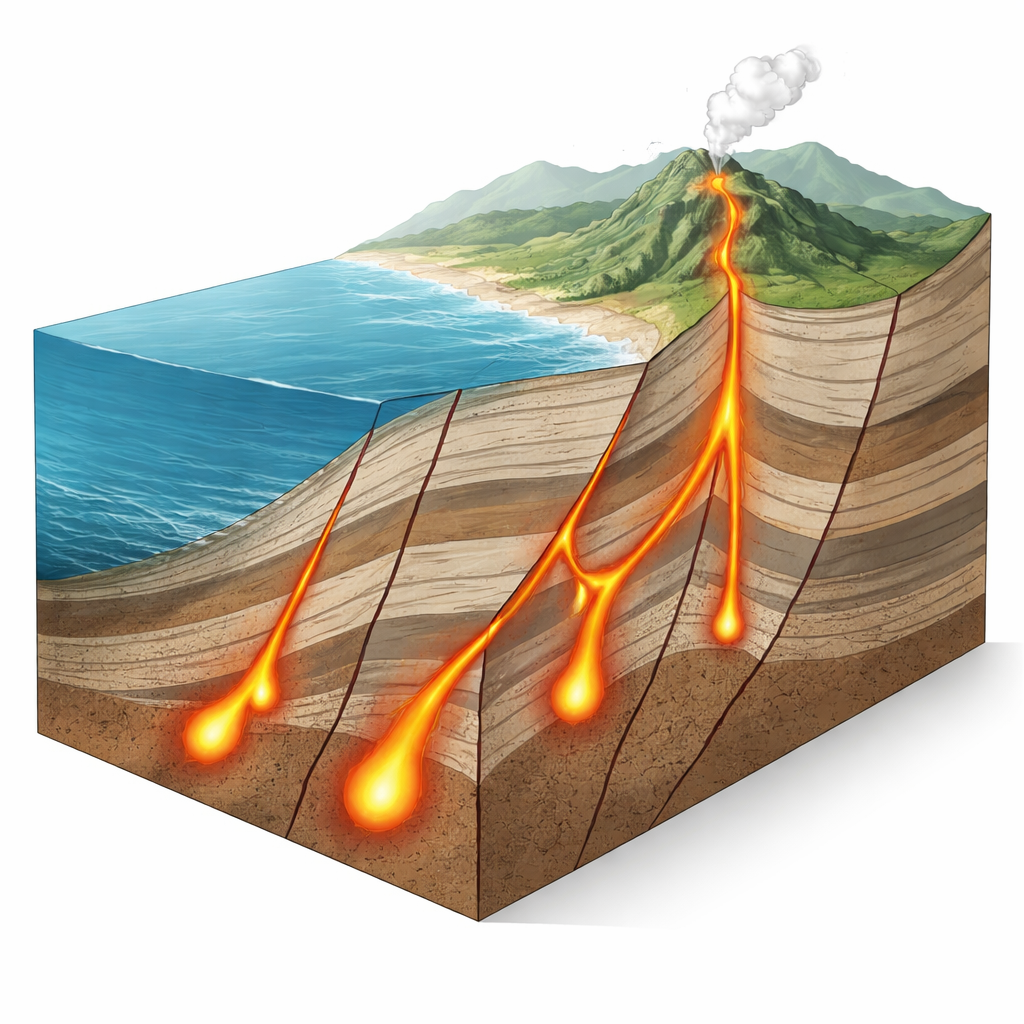
Where Land and Sea Share the Same Deep Roots
The research focuses on the Sciacca Fault System, a major fracture zone that cuts across the Sicilian margin from the open sea to the coastline near Mt. Kronio. Using marine seismic reflection profiles (which image rock layers beneath the seabed), land-based geological mapping and data from exploration wells, the team reconstructed how these faults continue from offshore into the hills onshore. They found that Mt. Kronio and a submerged structure called the Alto di Sciacca form parts of the same broad, uplifted block of carbonate rocks that has been squeezed and sheared over millions of years as Africa and Europe slowly collide.
Building a 3D Picture of a Buried Hot Reservoir
From these diverse data, the authors assembled a three-dimensional geological model extending about 22 by 18 kilometers and down to 6 kilometers below sea level. Within it, they outlined an elongated body of older carbonate rocks, from Late Triassic to Oligocene age, that acts as the main geothermal reservoir. This body is roughly 24 kilometers long, up to 6 kilometers wide and about 4 kilometers thick, with an estimated volume of around 240 cubic kilometers. Above it lie younger, more clay-rich and marl-rich layers that tend to seal fluids in place. The model shows how reverse and strike-slip faults uplift the reservoir beneath Mt. Kronio and the nearby offshore high, while other faults slice it into compartments that can either store or channel hot water and gas.
Faults as Both Barriers and Highways for Hot Fluids
The team went further than mapping geometry: they also evaluated how likely individual faults are to slip and to let fluids pass. Using information on the present-day stress field and pressures measured in wells, they calculated “slip tendency” and a “leakage factor” for 20 major fault surfaces. Many faults in the northeastern part of the model appear mechanically stable and sealing, acting as barriers that confine fluids. In contrast, central and southwestern segments, especially where faults link or bend, show high values for both slip and leakage, marking them out as preferred conduits. High-resolution seismic profiles offshore reveal vertical “chimneys” and mound-like features on the seabed—interpreted as mud volcanoes and gas escape structures—precisely where such permeable pathways intersect the shallow sediments.
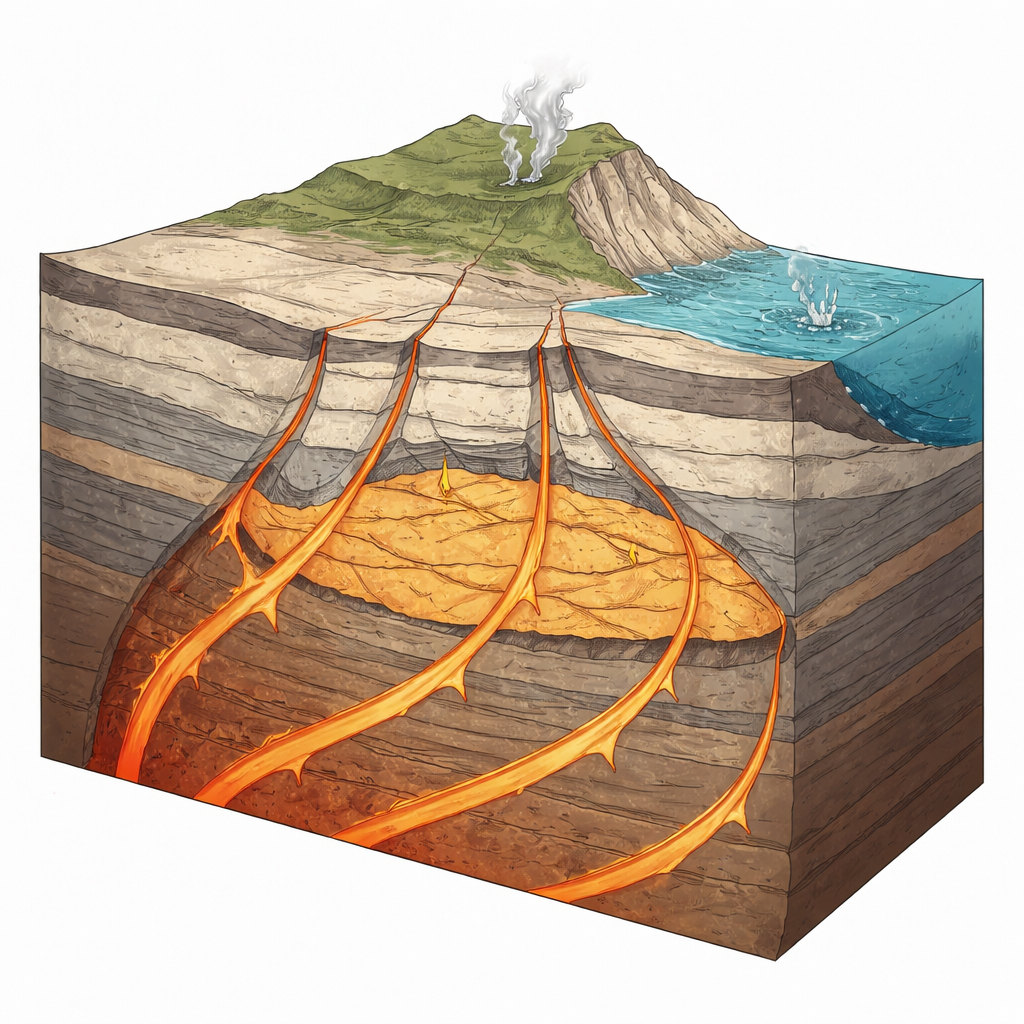
From Deep Source to Warm Springs and Seafloor Seeps
Geochemical studies of the Sciacca waters show a mixture of rainwater and modified seawater enriched in gases such as carbon dioxide and helium with a mantle signature, implying a deep, possibly magmatic heat source to the south beneath the Sicily Channel. The new 3D model helps explain how this deep heat and fluid move. The authors propose that hot, saline fluids rise northward and upward along the Sciacca Fault System from depth, enter the fractured carbonate reservoir, and are partly trapped beneath low-permeability layers. In places where the carbonate rocks reach the surface, such as Mt. Kronio, fluids can escape through karstic caves and fractures, producing warm air in caverns and hot springs on the flanks. Offshore, where the reservoir remains buried, fluids find their way up through leaky faults and weak spots in the seabed cover, forming mud volcanoes and gas seeps.
Why This Matters for Safety and Clean Energy
In plain terms, this work shows that the Sciacca area is underlain by a single, large, fault-controlled geothermal system that spans the boundary between land and sea. The same structures that deliver hot water to spas and natural vents are also active faults capable of producing earthquakes, some near populated areas. By tying together onshore geology, offshore geophysics and fluid behavior in a unified 3D model, the study sharpens our picture of both the geothermal potential and the seismic risk of southwestern Sicily. It suggests that the Mt. Kronio–Alto di Sciacca region is a promising target for carefully managed geothermal energy, provided that future development pays close attention to the complex and still-active fault network that makes this hidden heat accessible.
Citation: Rizzo, G.F., Maiorana, M., Gasparo Morticelli, M. et al. 3D upper crustal structure modelling in southwestern Sicily through multiapproach onshore–offshore data: insight into Sciacca Geothermal Field. Sci Rep 16, 9901 (2026). https://doi.org/10.1038/s41598-026-39734-7
Keywords: geothermal systems, fault-controlled fluids, Sciacca Sicily, onshore–offshore geology, 3D crustal modelling