Clear Sky Science · en
Investigation on the cutting-infiltration integrated strategy based on medical waterjet for targeted drug delivery
Gentler Cuts for Safer Surgery
Modern surgery still relies heavily on sharp metal tools and needles that can damage healthy tissue and cause pain, bruising, and slow healing. This paper explores a new approach: using a fine, high-speed water jet that can cut soft tissue while at the same time delivering pain‑relieving drugs deep into the wound. The goal is to make operations more precise, less traumatic, and potentially less painful—without adding extra steps for the surgeon.
A Knife Made of Water
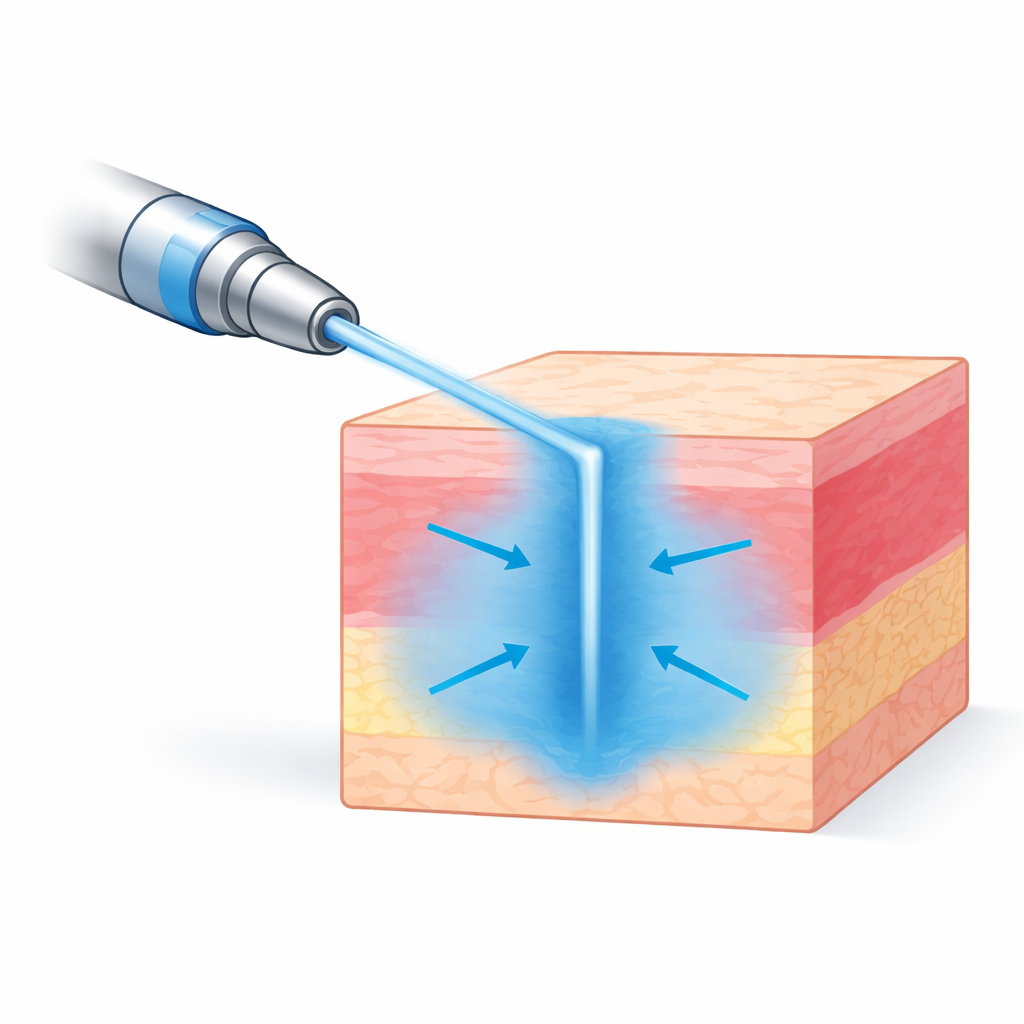
The researchers designed a specialized medical device that turns pressurized fluid into a very thin, fast jet capable of cutting soft tissues such as muscle and fat. Unlike a scalpel, this jet can also carry dissolved drugs. The core idea is that the center of the jet has enough force to slice tissue, while the surrounding fluid slows down at the cut and is pushed sideways into nearby spaces between cells. By mixing an anesthetic (or, in the experiments, dye that mimics it) into the fluid, the same motion that makes the cut also drives the drug into the tissue around it, potentially numbing the area as the surgeon works.
Testing on Real Animal Tissue
To see whether this concept works, the team built a laboratory setup using high‑pressure gas to power the water jet and tested it on freshly collected pig muscle and fat. They varied two main settings: how hard the jet hits (pressure) and how wide the nozzle is. They then measured how deep the jet cut and how far the dyed “drug” spread within the tissue. In a second series of tests, they compared the microscopic appearance of cuts made by the water jet with those made by a standard scalpel, looking for signs of tearing or crushed cells. Finally, they used advanced photoacoustic imaging—a technique that converts light absorption into ultrasound signals—to reconstruct how the dye spread in three dimensions inside muscle after cutting.
Balancing Clean Cuts and Deep Drug Spread
The results revealed a clear trade‑off between cutting and drug delivery, and how both depend on the jet settings and the type of tissue. As pressure increased, the jet cut deeper in a nonlinear way: it quickly gained cutting power at lower pressures, then leveled off at higher pressures as the flow became more turbulent and less focused. Drug spread, in contrast, kept increasing with pressure across the entire tested range. Larger nozzles tended to favor wider diffusion but also risked flooding the area with too much fluid. Muscle allowed both deeper cuts and wider spread than fat, which, because of its different structure, soaked up energy and limited diffusion. By weighing the need for sufficient cutting depth against the desire to minimize collateral damage and fluid overload, the team identified a middle‑ground setting—moderate pressure and a medium‑sized nozzle—as the safest and most effective combination for muscle and a higher pressure for fat.
Cleaner Wounds Under the Microscope
When the researchers looked closely at the cut surfaces using scanning electron microscopy, the water jet at carefully chosen low pressures produced smoother and more orderly structures than a scalpel. In muscle, fiber bundles stayed more intact, with shorter break lengths and strips of undamaged tissue preserved between them. In fat, the supporting network around fat cells remained mostly continuous, with fewer ruptured cells. Overall, low‑pressure jets reduced fiber breakage by about half and shrank the area of damaged tissue by roughly one‑third compared with standard cutting, while still achieving practical cutting depths. However, when pressures were pushed too high, the jet became overly aggressive, causing more widespread disruption than a scalpel, underscoring the importance of tight control over operating conditions.
How the Drug Spreads in Three Dimensions
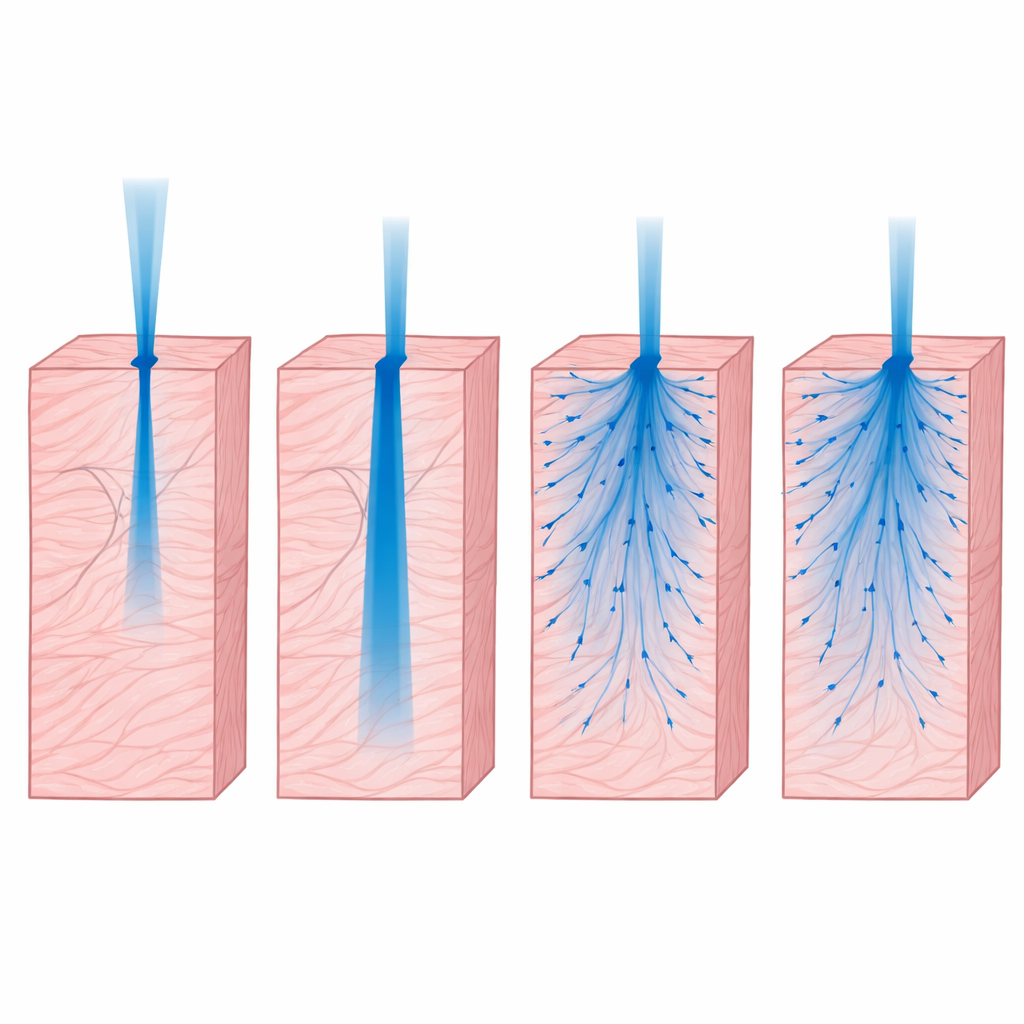
The photoacoustic images of dye‑laden cuts in muscle revealed a surprisingly complex pattern of spread. Near the surface and down to the main cutting depth, the dye fanned out along natural pathways between muscle fibers, forming branching, tree‑like shapes. The distance it reached sideways actually increased with depth up to a point close to the end of the cut, where it was greatest. Beyond that zone, the spread dropped off sharply, breaking into small, isolated patches. This behavior supports what the authors call “cutting‑guided diffusion”: the jet opens channels and loosens nearby tissue, encouraging fluid to travel outward around the tip of the cut, while deeper, untouched tissue acts as a natural barrier that limits further penetration.
What This Could Mean for Patients
Although these experiments were done in pig tissue outside the body, they suggest that a carefully tuned waterjet could simultaneously cut and numb tissue while preserving more of its delicate structure. In principle, such a tool might shorten operations, reduce the need for separate needle injections, lower the risk of overdose from concentrated drug boluses, and improve healing by avoiding crushing and tearing. Before this technology can reach the clinic, however, researchers must confirm in living animals—and eventually in people—that the drugs delivered in this way are distributed safely, last long enough to control pain, and do not have unexpected side effects. If those hurdles are cleared, a knife made of water could become a key part of future minimally invasive surgeries.
Citation: Lan, Y., Liu, W., Tang, J. et al. Investigation on the cutting-infiltration integrated strategy based on medical waterjet for targeted drug delivery. Sci Rep 16, 9886 (2026). https://doi.org/10.1038/s41598-026-39721-y
Keywords: medical waterjet, targeted drug delivery, needle-free anesthesia, minimally invasive surgery, soft tissue cutting