Clear Sky Science · en
Ecotoxicological and behavioural responses of aquatic model organisms to the MosChito raft bioinsecticide delivery system
Cleaner Backyards Without Harming the Pond
People who battle mosquitoes in flowerpots, buckets, and rain barrels often worry that the products they use might harm other creatures that share the water cycle. This study introduces and tests a new mosquito control device, the “MosChito raft,” designed to kill mosquito larvae right where they grow while leaving fish, tiny crustaceans, and other aquatic life largely untouched. The researchers asked a simple but crucial question: can we keep mosquito numbers down in everyday urban settings without poisoning the rest of the water world?
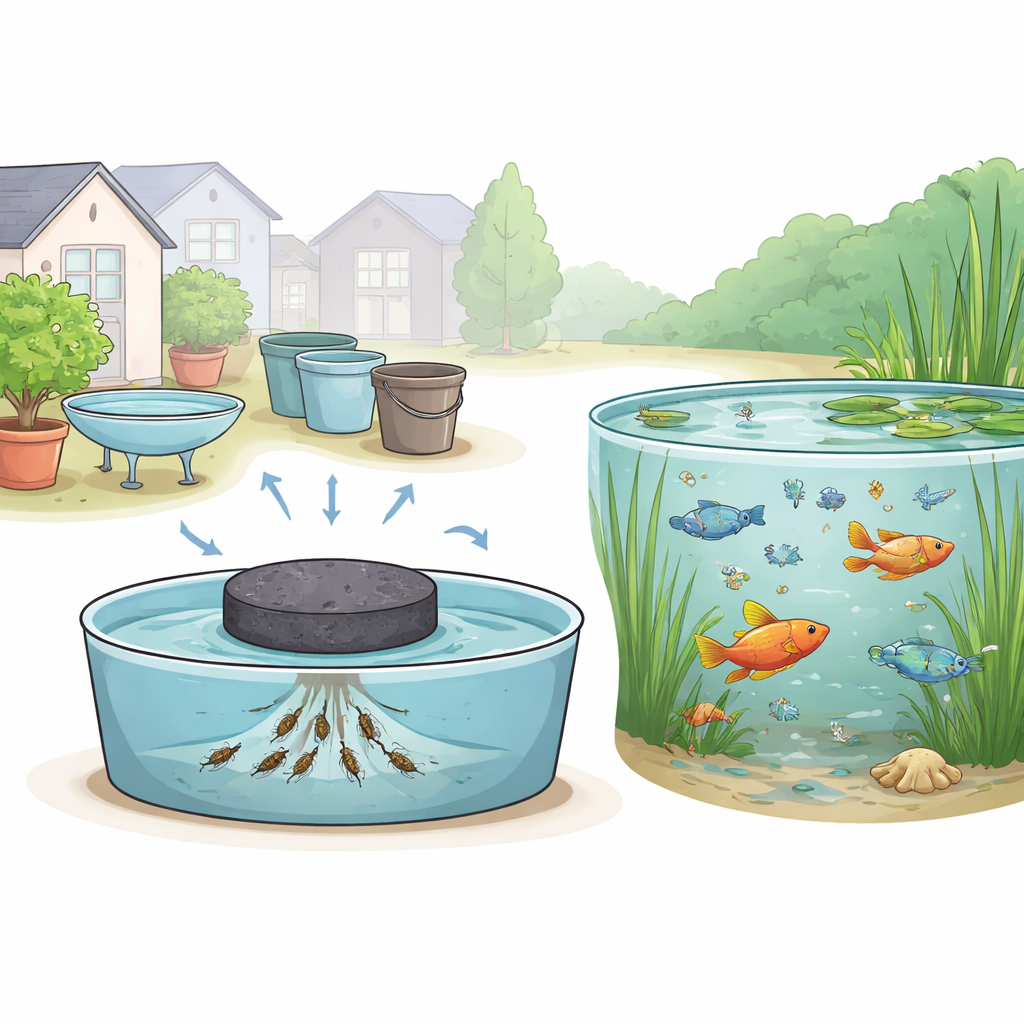
A Floating Targeted Mosquito Trap
The MosChito raft is a small floating tablet made of a biodegradable gel. It holds two main ingredients: a well-known bacterial larvicide called Bacillus thuringiensis israelensis (Bti), which is deadly to mosquito larvae, and baker’s yeast, which acts as food and a lure. Unlike standard liquid or granular products that disperse into the whole container, the active substance in this raft stays locked inside the gel and is released only when mosquito larvae scrape and eat from its surface. In theory, this “lure-and-eat” design should sharply limit how much insecticide leaks into the surrounding water, reducing exposure for other species that might share or encounter that water.
Putting the Raft to the Safety Test
To check whether the rafts are safe for other aquatic life, the team tested them on two widely used model organisms. One was the zebrafish (Danio rerio), a small tropical fish whose embryos are extremely sensitive to pollutants and often used as stand-ins for vertebrate, including human, health. The other was the water flea Daphnia magna, a tiny crustacean that plays a key role in freshwater food webs and is known to react quickly to contamination. Both species were raised for days in water containing different raft types: an empty gel, gel with yeast only, gel with Bti only, and gel with both Bti and yeast, and were compared with untreated controls.
Watching Movement, Stress, and Life Cycle
For zebrafish, the researchers tracked survival, swimming behavior, and two internal warning signals: levels of reactive molecules linked to oxidative stress and the activity of an enzyme important for nerve function. Across 120 hours, zebrafish embryos showed high survival in all groups, with no meaningful differences in movement or biochemical markers between raft-exposed and control fish. This suggests that even under conservative, “worst-case” exposure conditions in the lab, the rafts did not disturb the developing nervous system or cause measurable stress in these fish.
How Tiny Crustaceans Coped
Daphnia magna were exposed from hatching through two weeks of growth, a period that covers several reproductive cycles. As with the fish, survival stayed above 90 percent in all treatments. The animals’ swimming behavior showed only small changes: water fleas exposed to the raft containing both Bti and yeast, and to the empty gel alone, swam slightly less overall than controls, but the effect was minor. Chemical tests revealed a modest rise in oxidative stress markers in the group exposed to the combined Bti-and-yeast raft, yet there were no signs of nerve disruption. Importantly, the total number of offspring produced and the timing of births were virtually unchanged across all treatments, indicating that population growth was not impaired.
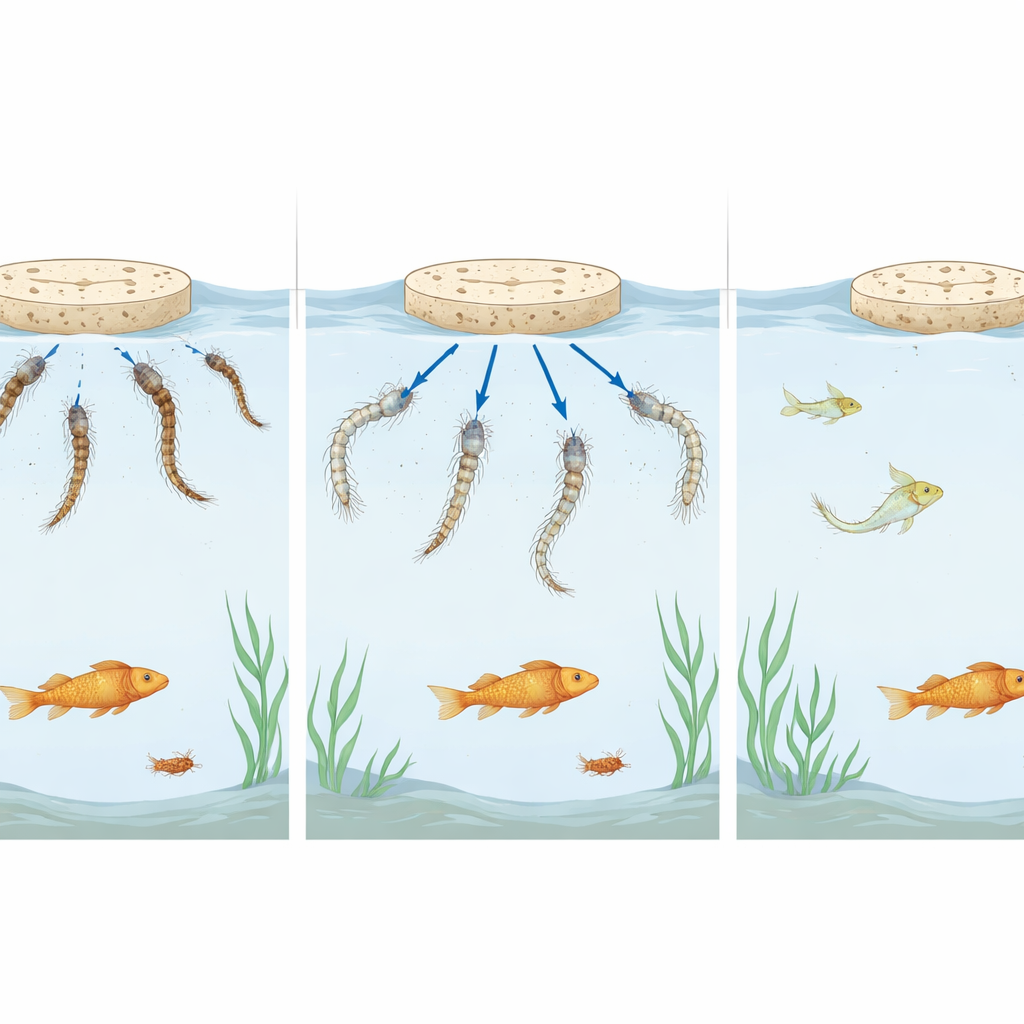
What This Means for Everyday Use
Taken together, these experiments show that the MosChito raft achieves its goal of focusing its punch on mosquito larvae while leaving common non-target aquatic organisms largely unharmed. The raft’s design keeps the insecticide confined within a floating, edible matrix, so that meaningful doses reach only the larvae that feed on it, not the broader water environment. For household and urban mosquito control, this approach offers a path toward quieter, more selective pest management: fewer bites and less disease risk without sacrificing the health of fish, water fleas, and the many other small creatures that keep our ponds and waterways alive.
Citation: Negri, A., Nigro, L., Signorini, S.G. et al. Ecotoxicological and behavioural responses of aquatic model organisms to the MosChito raft bioinsecticide delivery system. Sci Rep 16, 10115 (2026). https://doi.org/10.1038/s41598-026-39702-1
Keywords: mosquito control, biopesticides, aquatic ecotoxicology, Bacillus thuringiensis israelensis, non-target species