Clear Sky Science · en
Process and forces of tight-sandstone gas charging in the Shihezi formation (P2x1) Dongsheng gas field, northern Ordos Basin China
Why This Underground Story Matters
Far below the grasslands of north-central China, a huge natural gas field lies locked inside rocks that barely let fluids pass. These tight-sandstone rocks hold enough gas to power cities, but only if we understand how the gas got in and where it ended up. This study dissects the hidden history of the Dongsheng Gas Field in the Ordos Basin and shows how pressure deep in the Earth has acted against the resistance of tiny rock pores to fill some zones with gas while leaving others mostly with water. The work offers a new way to forecast which parts of a tight reservoir are likely to pay off and which will disappoint.
Locked Gas in Tight Rocks
The Dongsheng Gas Field is one of China’s major tight-gas resources. Its main gas-bearing layer, part of the Lower Permian Shihezi Formation, lies between about two and four kilometers underground. The sandstone here has an average pore space of only 8.6 percent and extremely low ability to transmit fluids, meaning gas will not flow freely without engineering help. By examining more than two thousand core samples, the researchers show that most of this formation now qualifies as tight sandstone, especially south of a major fault called the Poerjianghaizi Fault. Only in the shallower northern zone does the rock preserve somewhat better pore space and flow capacity.
How the Rock Tightened Over Time
To understand why the rock is so tight, the team reconstructed the burial and heating history of the basin. They found that as sediments piled up over hundreds of millions of years, the sand grains in the Shihezi layer were squeezed closer together, while chemical processes caused quartz and clay minerals to grow and weld grains into a rigid framework. Thin-section images reveal grains pressed into each other with curved contacts and most open space converted into small secondary pores or partially filled by solid bitumen. Modeling shows that the original porosity of roughly one-third of the rock volume shrank to less than 10 percent in many zones before the most important gas influx occurred.
Three Waves of Gas Filling
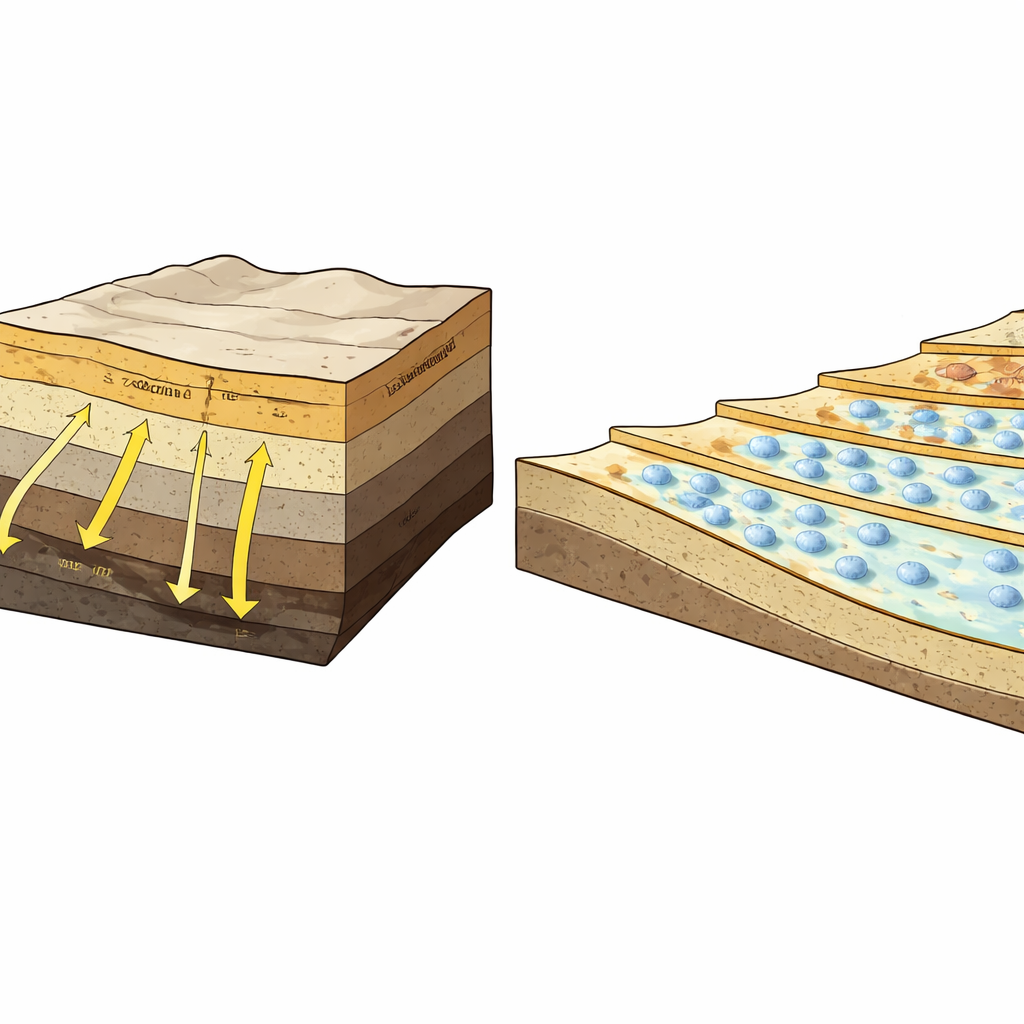
The researchers then turned to tiny fluid-filled bubbles trapped in minerals—fluid inclusions—to time when oil and gas entered the reservoir. Combined with computer models of how the source rocks were buried, heated, and generated hydrocarbons, these inclusions reveal three distinct charging episodes. An early phase from about 230 to 180 million years ago brought both oil and gas when the organic-rich coal layers beneath first began to break down. Two later phases, from 180 to 120 million years ago and from 120 to 80 million years ago, were dominated by gas only, as the source rocks reached higher maturity. The last of these gas pulses coincided with peak gas generation and turned out to be the key period for building the large gas accumulation seen today.
Pressure Versus Pore Resistance
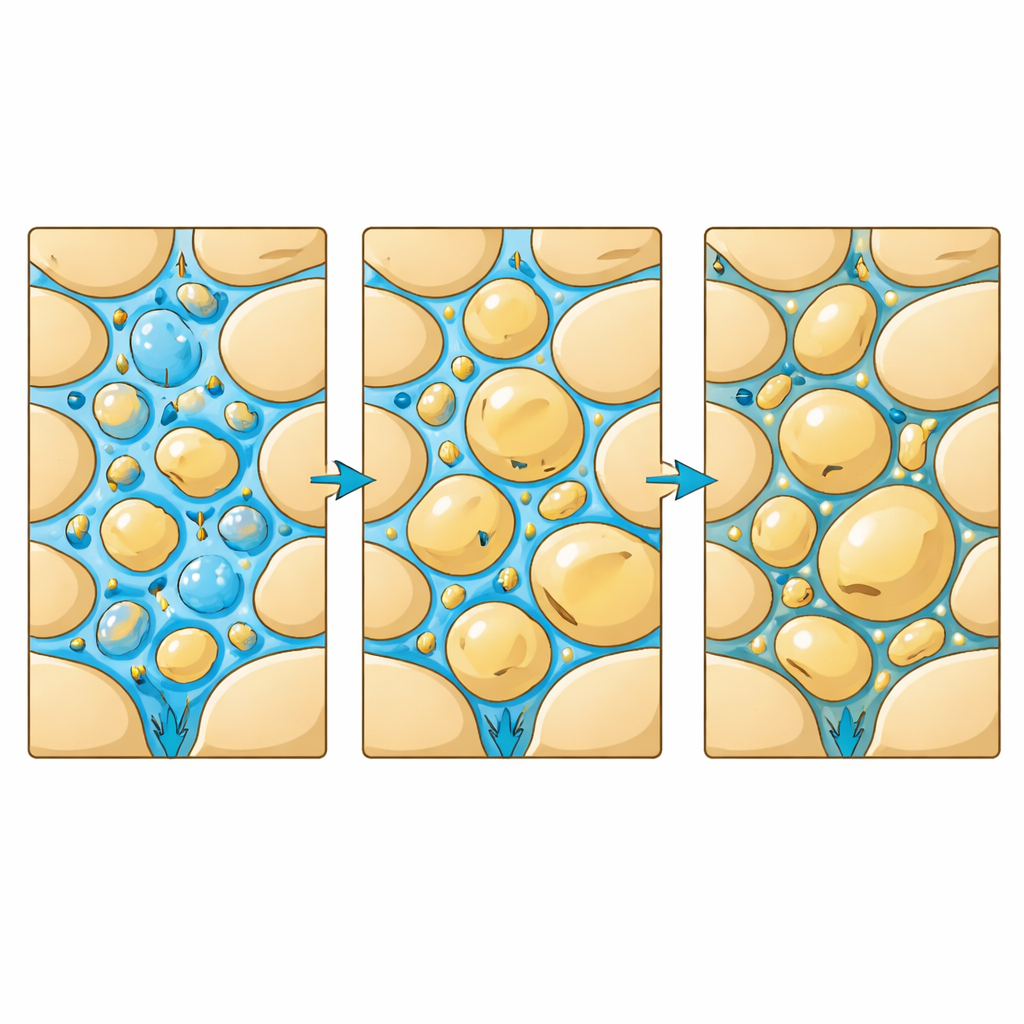
A central contribution of the study is a simple but powerful way to describe what drives gas into such stubborn rocks. The authors define a “net force” as the difference between the excess pressure in the gas-generating source rocks and the capillary resistance of the tight sandstone pores at a representative gas saturation. Using basin models, they tracked how overpressure in the deep coal layers built up during the peak gas generation stage. In parallel, digital rock simulations—based on three-dimensional scans of real rock samples—show how much pressure is needed for gas to first break into water-filled pores, then rapidly fill them, and finally reach a near-steady saturation. From these simulations they extracted the pressure needed to reach 50 percent gas saturation, treating it as a measure of resistance.
Predicting Where the Gas Ends Up
By comparing the modeled driving pressure with the simulated resistance, the team calculated net force values across different wells and zones. They found three regimes that line up closely with actual well tests. Where the net force was low and still in the breakthrough stage, wells tended to be dry or held only small amounts of gas. Where it rose into the rapid charging range and exceeded the capillary resistance threshold, wells produced commercial gas layers. In between lay marginal, gas-bearing intervals. The analysis also shows that by the time of the most important gas pulse, much of the reservoir south of the Poerjianghaizi Fault had already tightened, making it harder for gas to enter, while the northern zone remained slightly more open to charging.
What This Means for Future Gas Exploration
For non-specialists, the key message is that the size of a tight-gas resource is not controlled only by how much organic matter the basin once held. It also depends on a tug-of-war between pressure that pushes gas out of source rocks and the fine-scale structure of the surrounding sandstones that resists entry. This study shows that by reconstructing that tug-of-war through time and expressing it as a net force, geologists can better predict which tight zones are likely to be gas-rich and which are not. Such insight can guide drilling toward the most promising parts of the Dongsheng Gas Field and similar deep, tight reservoirs around the world, improving efficiency while reducing unnecessary wells.
Citation: Cao, Q., He, F., Zhang, W. et al. Process and forces of tight-sandstone gas charging in the Shihezi formation (P2x1) Dongsheng gas field, northern Ordos Basin China. Sci Rep 16, 11818 (2026). https://doi.org/10.1038/s41598-026-39614-0
Keywords: tight sandstone gas, Ordos Basin, gas charging history, reservoir pressure, capillary forces