Clear Sky Science · en
Role of oxygen vacancies on the structural, electronic, optical, and photocatalytic properties of Ba2CeMO6 (M = Bi, Sb) double perovskites: a DFT study
Why tiny gaps in crystals matter
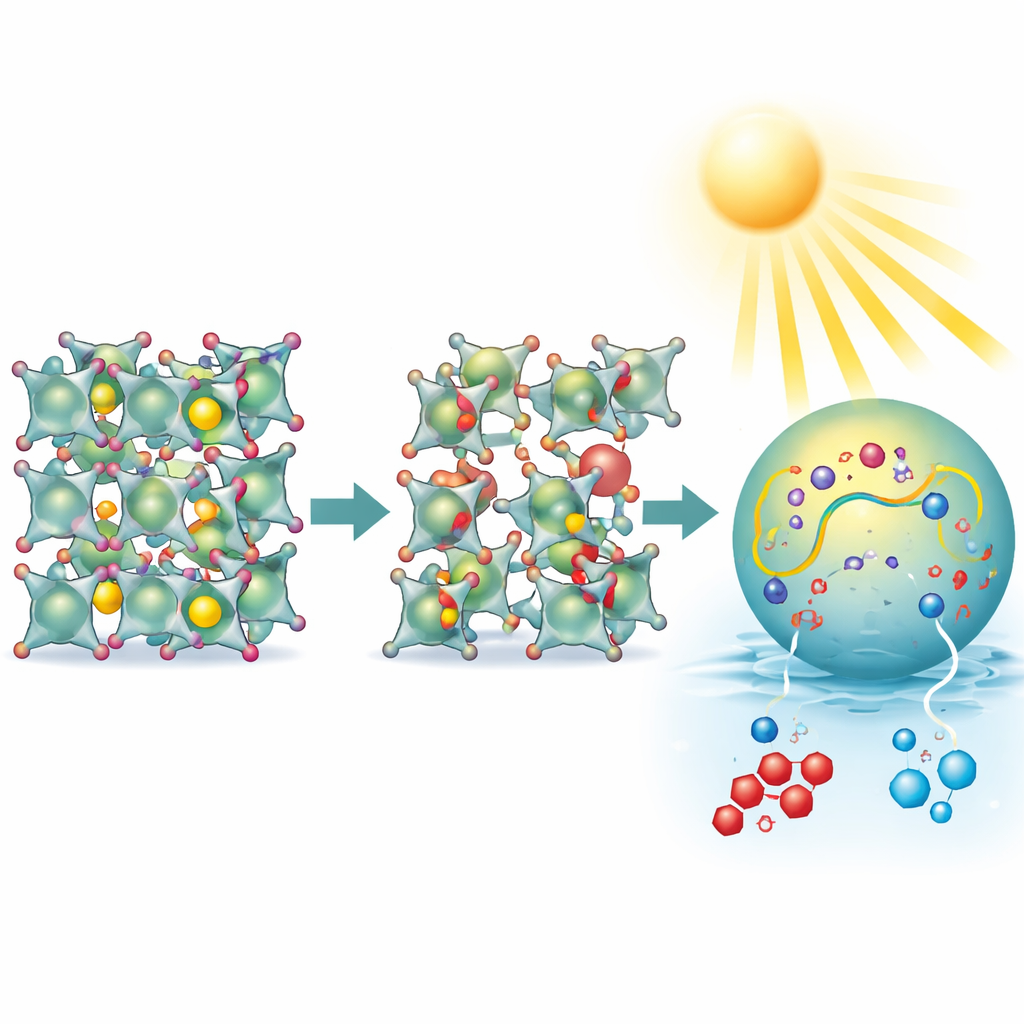
Cleaning polluted water and making green hydrogen from sunlight both rely on materials that can harness light and drive chemical reactions efficiently. This study looks at a promising family of such materials—barium–cerium double perovskites—and asks a deceptively simple question: what happens when a few oxygen atoms go missing from their crystal structure? Using advanced computer simulations, the authors show that these tiny "vacancies" can dramatically reshape the material’s behavior, sometimes turning it from a poor performer into an excellent light-driven catalyst.
The special building blocks of these crystals
The materials examined, written chemically as Ba2CeMO6 (where M is either bismuth or antimony), belong to the perovskite family, a class of crystals famous for their flexible structure and rich set of properties. In these double perovskites, barium atoms occupy one set of sites, while cerium and either bismuth or antimony share another, all tied together by a framework of oxygen atoms. The authors first confirmed that their calculated crystal structures match experimental measurements, showing that the lattices are mechanically stable and can withstand compression and shear without falling apart. They also developed an improved "tolerance factor"—a simple geometric measure based on ion sizes that predicts whether the crystal prefers a more symmetric cubic form or a distorted monoclinic one—by explicitly including the effect of missing oxygen atoms.
How missing oxygen reshapes structure and electrons
To explore defects, the team systematically removed one or two oxygen atoms from a simulated chunk of the crystal and let the structure relax. They found that regions around the vacancies distort: metal–oxygen bond lengths change, octahedral units tilt, and the overall lattice becomes slightly less regular. More importantly, these vacancies alter the charge state of cerium and its neighbors, promoting a mix of valence states. This, in turn, changes the electronic band structure—the energy landscape that electrons and holes must cross to participate in electrical and chemical processes. In oxygen-rich crystals, Ba2CeBiO6 has a relatively small band gap and Ba2CeSbO6 a much larger one. When oxygen is removed, new electronic states appear inside the gap, narrowing it; for bismuth-based material, enough vacancies can even collapse the gap completely, turning a semiconductor into a metal, consistent with puzzling experimental reports of a “zero band gap.”
Light absorption and photocatalytic strength
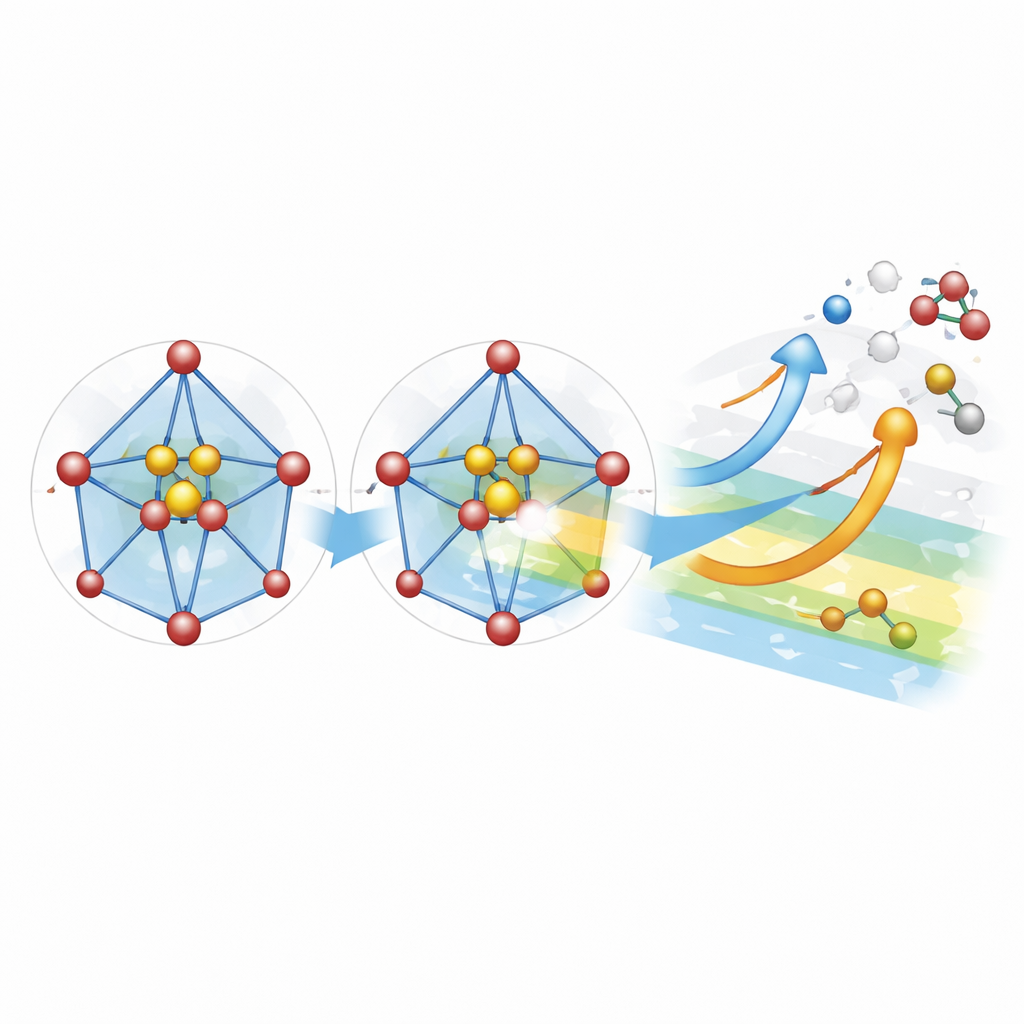
The authors then connected these electronic changes to how the materials interact with light and drive reactions. They calculated how strongly the crystals absorb photons over a wide energy range and how easily light-generated electrons and holes move, quantified by their effective mass. Both pristine materials behave as semiconductors that absorb from the visible into the ultraviolet, but oxygen vacancies shift absorption toward lower energies. For Ba2CeSbO6 in particular, a single oxygen vacancy creates shallow extra states near the conduction band rather than deep traps. These act as temporary waystations that slow down the recombination of electrons and holes, while a reversible Ce3+/Ce4+ redox couple helps keep charges separated long enough to react with nearby molecules. Band-edge positions, referenced to the normal hydrogen electrode, show that both oxidation and reduction reactions become energetically favorable, especially in the Sb-based compound, which retains a useful band gap in the visible range even with defects.
Strength, heat, and practical robustness
Beyond light-driven chemistry, the study evaluates how robust these materials are. From the elastic constants, the authors deduce that both bismuth- and antimony-based crystals are mechanically stable and somewhat ductile: they resist breaking under stress and can deform slightly without cracking. Calculations of sound speeds in the lattice lead to Debye temperatures around 370–400 K, indicators of relatively stiff atomic bonding. At the same time, the predicted minimum thermal conductivities are very low, meaning heat flows sluggishly through the crystal—a desirable trait for some energy applications. High melting temperatures near 1800 K suggest that these perovskites can survive harsh thermal environments while continuing to function as photocatalysts.
What this means for future clean technologies
In plain terms, the work shows that carefully controlling missing oxygen atoms can turn Ba2CeMO6 crystals into tunable light-activated engines for chemical reactions. Too many vacancies can ruin performance by making the material metallic or overly defective, but the right amount, especially in the antimony-based version, narrows the band gap into the visible range, enhances charge separation, and boosts photocatalytic power. By linking crystal structure, electronic behavior, optical response, and catalytic ability through first-principles calculations, the study provides a design roadmap: engineer oxygen vacancies and mixed cerium charge states to build more efficient, thermally robust materials for solar-driven water splitting, pollutant degradation, and other next-generation clean-energy technologies.
Citation: Karim, M., Saha, A., Hossain, M. et al. Role of oxygen vacancies on the structural, electronic, optical, and photocatalytic properties of Ba2CeMO6 (M = Bi, Sb) double perovskites: a DFT study. Sci Rep 16, 11973 (2026). https://doi.org/10.1038/s41598-026-39601-5
Keywords: photocatalysis, oxygen vacancies, double perovskites, cerium oxides, density functional theory