Clear Sky Science · en
Anger impacts face memory and face – object memory differently in children and adults
Why Angry Faces Linger in Our Minds
Imagine witnessing an argument in a playground: a furious face, a raised tennis racket, and a scattered jumble of bystanders and objects. Later, what sticks with you more clearly—the angry face, or the details around it? This study asks that question for both children and adults, revealing that anger changes what we remember about people and situations in surprisingly age‑specific ways. Understanding these differences helps explain how emotionally intense moments are stored in memory and why some aspects of threatening events may be especially vivid—or strangely disconnected—later on.
What the Researchers Wanted to Find Out
The authors focused on two kinds of memory. One is memory for single things, such as a person’s face or a lone object on a table. The other is memory for links between things, such as which object went with which face. These “who‑was‑with‑what” links are crucial for recalling episodes as coherent stories. Earlier work in adults showed that emotional events often sharpen memory for key items but blur the surrounding details and connections. Other studies in young people exposed to violence hinted that angry faces might particularly disrupt memory for how people and objects are tied together. But no one had clearly tested how angry faces shape these different types of memory in typically developing children compared with adults.
How the Study Was Done
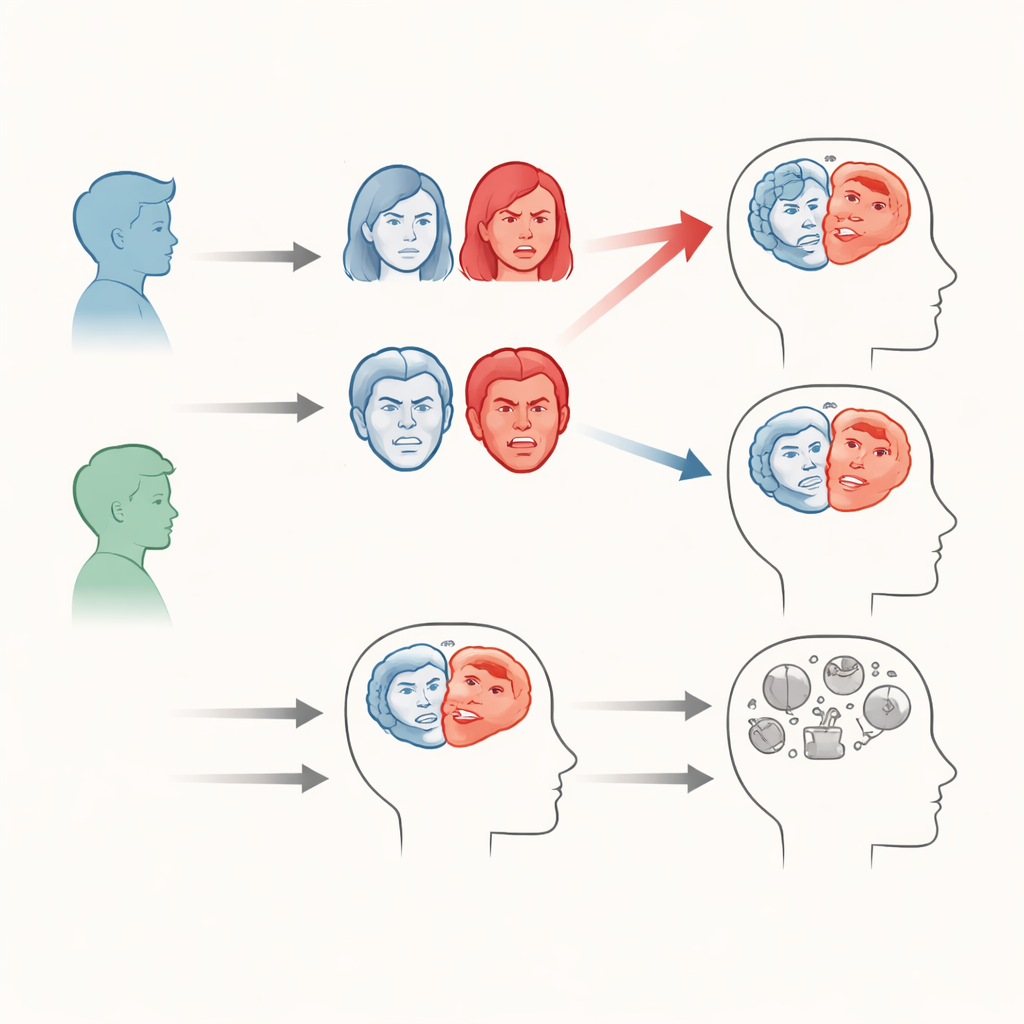
Thirty‑three children aged 9 to 11 and thirty young adults participated. During a learning phase, they saw many pairs of a human face and a neutral object, such as everyday tools or toys. Half of the faces looked neutral; half looked angry. Participants were asked to form a mental picture that combined the person and the object into a little scene, encouraging them to bind the two together. Later, their memory was tested in three ways. First, they were shown faces alone and had to decide whether each one was old or new. Second, they did the same for objects alone. Third, in an association test, a previously seen face or object appeared as a cue, and participants had to pick, from four options, the specific partner it had been paired with before.
What Children and Adults Remembered
Adults were generally better than children at recognizing faces and at remembering which faces went with which objects. In contrast, children and adults remembered objects themselves equally well. Emotion made a striking difference. Children were more accurate at recognizing angry faces than neutral ones, suggesting that threatening expressions stand out especially strongly in their memories. Adults, however, showed no such advantage: angry and neutral faces were remembered to a similar degree when considered on their own. Importantly, for both age groups, memory for objects did not depend on whether the objects had been seen with an angry or a neutral face—objects were remembered just as well in both emotional settings.
When Angry Faces Break the Story
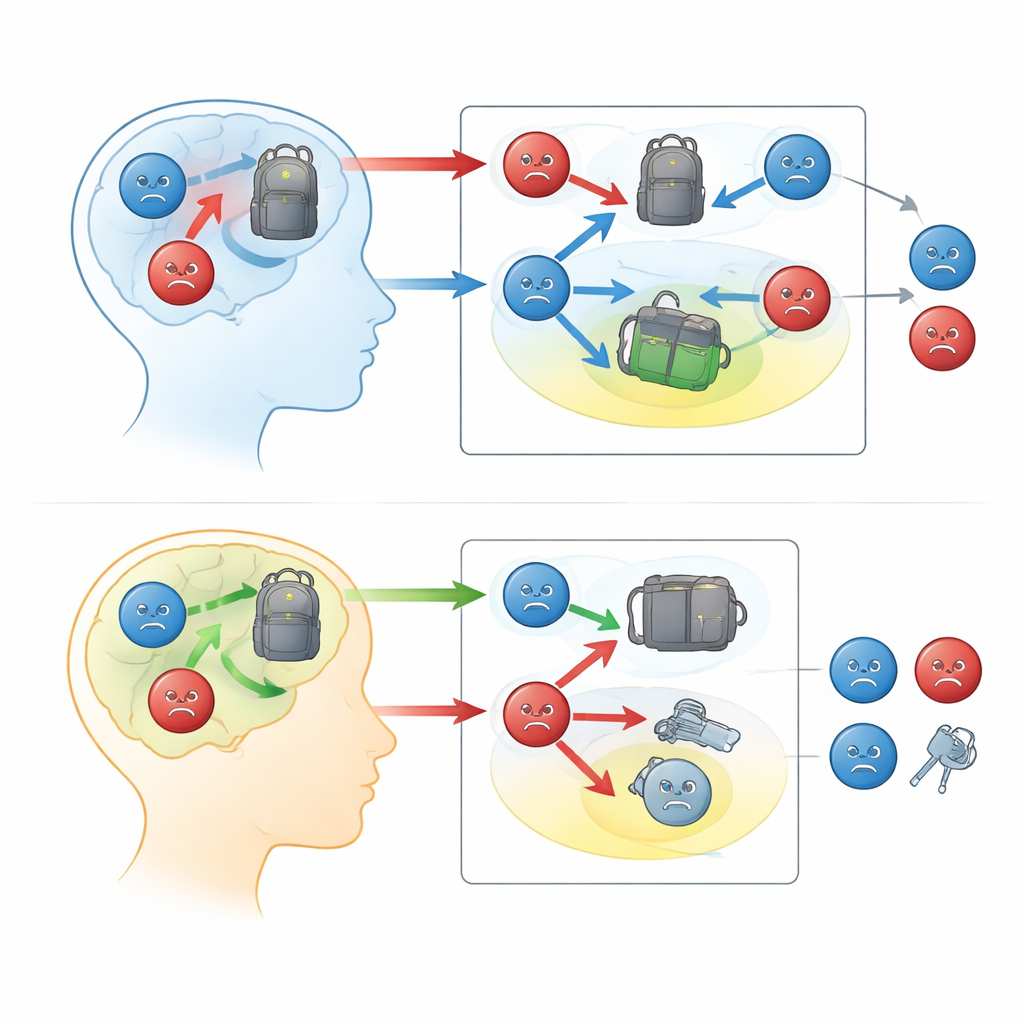
The picture changed when the researchers looked at memory for the links between faces and objects. Here, adults showed a cost of anger: they were worse at remembering which object went with which face when that face had been angry. This was true whether they were cued with the face and asked for the object, or cued with the object and asked for the face. In other words, anger seemed to weaken the glue that binds people and things together in adults’ memories, even though it did not harm their memory for the individual faces or objects. Children, by contrast, showed no reliable difference in association memory between angry and neutral pairs. For them, anger boosted memory for faces themselves without measurably breaking the link to the associated object.
Why These Findings Matter
Put simply, the study suggests that anger reshapes memories in different ways across development. In late childhood, angry faces become especially memorable, but children still hold onto the basic “who‑was‑with‑what” connections. In adulthood, angry faces no longer gain a clear edge as stand‑alone items, yet they do seem to pull attention or processing away from the surrounding scene, weakening the ties between people and objects. Because real‑life threats and conflicts often involve angry faces, these patterns may help explain why some adults recall disturbing images vividly but with gaps or confusion about the wider context. The work also offers a baseline for understanding how early adversity and clinical conditions like post‑traumatic stress might further skew what we keep—and what we lose—when emotions run high.
Citation: Onay Forthomme, N., Rimmele, U. Anger impacts face memory and face – object memory differently in children and adults. Sci Rep 16, 13361 (2026). https://doi.org/10.1038/s41598-026-39566-5
Keywords: emotion and memory, angry faces, child development, associative memory, threat processing