Clear Sky Science · en
Intonation and timing in singing early music is unrelated to respiration synchronization
Why shared breathing in choirs matters
Anyone who has sung in a choir knows the strange feeling of "breathing as one." It can seem as if the group becomes a single living organism, rising and falling together on each phrase. Many scientists have wondered whether this hidden bodily synchrony is part of what makes great ensemble singing sound so tight and polished. This study puts that assumption to the test by asking a simple question: when professional early‑music singers’ breathing lines up, does their tuning and timing actually get better?
Singing together as a human network
Musical ensembles are more than just people standing side by side; they are dense networks of signals flowing between brains and bodies. Earlier research using "hyperscanning"—recording several people’s physiology at once—has shown that heartbeats and breathing patterns can become synchronized when musicians perform together. Choirs, guitar duos, piano duets, and saxophone groups have all been shown to display such physiological coupling. In previous work with the same vocal ensemble, the authors found that when singers lightly touched their neighbors during Renaissance pieces, their breathing rhythms became more closely aligned across the group.
A natural experiment with touch and distance
Building on that earlier study, the researchers now examined whether this shared breathing has any clear payoff for musical precision. Eight highly trained singers performed complex Renaissance works in three different stage setups: a modern semicircle with each singer at a separate stand, a tight double row sharing a big stand while touching shoulders and hands, and the same tight formation without touch. The music was recorded with individual microphones, and every sung note—over 64,000 in total—was carefully annotated for when it began and what pitch it reached. Because each musical line was doubled by two singers, the team could measure how closely each pair matched in timing and in pitch, note by note.
Measuring accuracy note by note
To turn art into data, the team focused on two basic ingredients of ensemble quality: when notes start, and how accurately they hit the intended pitch. For timing, they calculated the average difference in onset between the two singers on the same line; for tuning, they calculated how far apart their pitches were, measured in tiny fractions of a semitone. They then compared these measures across the different body arrangements, and related them directly to breathing synchrony, which had been quantified in several ways in the earlier physiological analysis. This two‑step approach let them ask both an indirect question (does touch, which boosts shared breathing, also boost precision?) and a direct one (does more synchronized respiration predict better timing or tuning?). 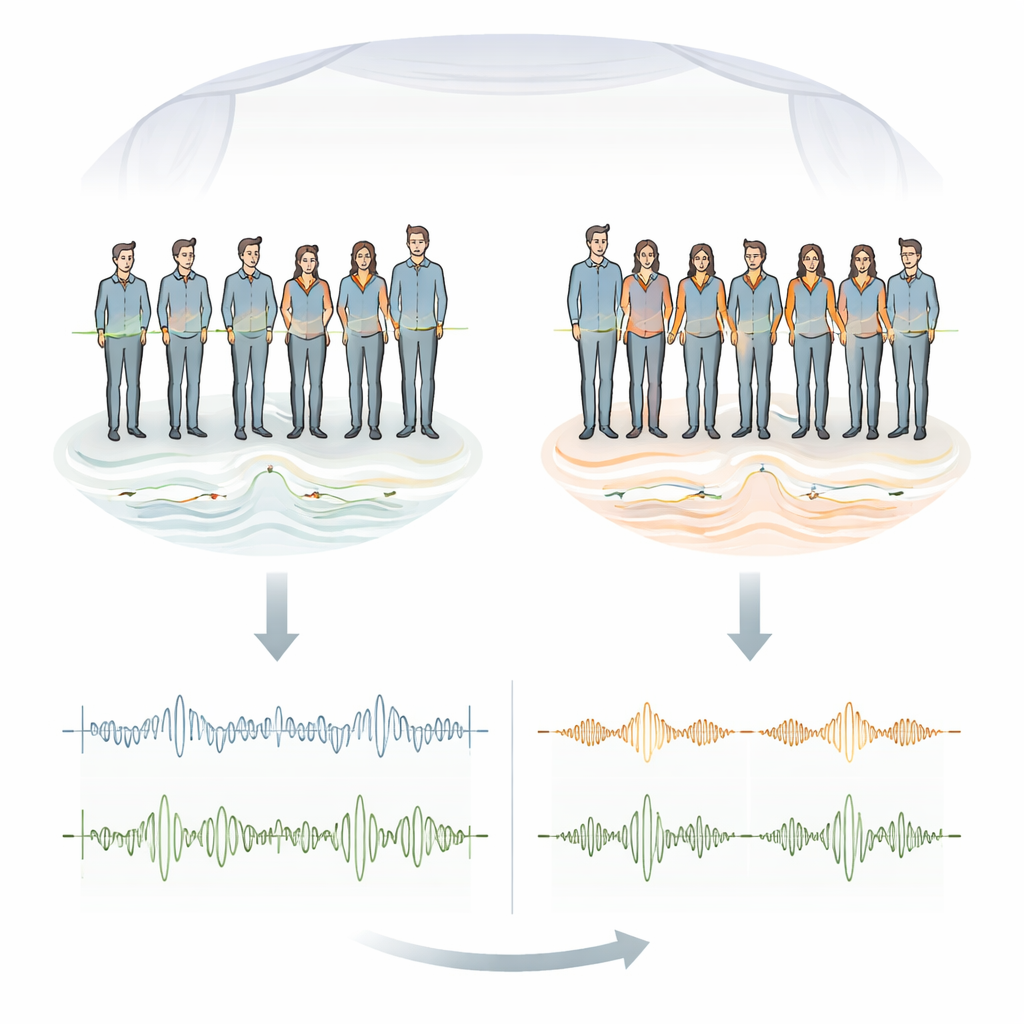
When shared breathing does not sharpen the sound
The results were striking in their simplicity: for these professionals, breathing together did not mean singing more precisely together. Performances with touch were no better in timing or pitch than those without touch, despite showing stronger respiratory coupling. When the authors used statistical models to predict note accuracy directly from breathing synchrony, the picture barely changed. Across most models, there was no reliable link between how aligned the singers’ respiration was and how closely they matched in onset or pitch. In one analysis, stronger coupling was even associated with very slightly poorer tuning, though the authors treat this as puzzling rather than proof of a harmful effect. Overall, the singers were already extremely accurate, and changes in shared breathing did not move the needle.
What shared breathing might really be doing
These findings suggest that the near‑mystical sense of breathing as one may be more about social connection than about technical perfection. Earlier studies in other group tasks, such as drumming and joint decision‑making, have linked physiological synchrony not to better performance, but to stronger feelings of togetherness. The authors propose that something similar may happen in choirs: bodies fall into step, not to improve microscopic timing or tuning, but to support empathy, cohesion, and the shared experience of making music. For listeners, this means that the magic of a great ensemble likely rests on many layers of coordination—ears, eyes, habits, and long practice—while shared breathing hums along in the background as a subtle sign of being in sync as humans, rather than a direct cause of cleaner notes. 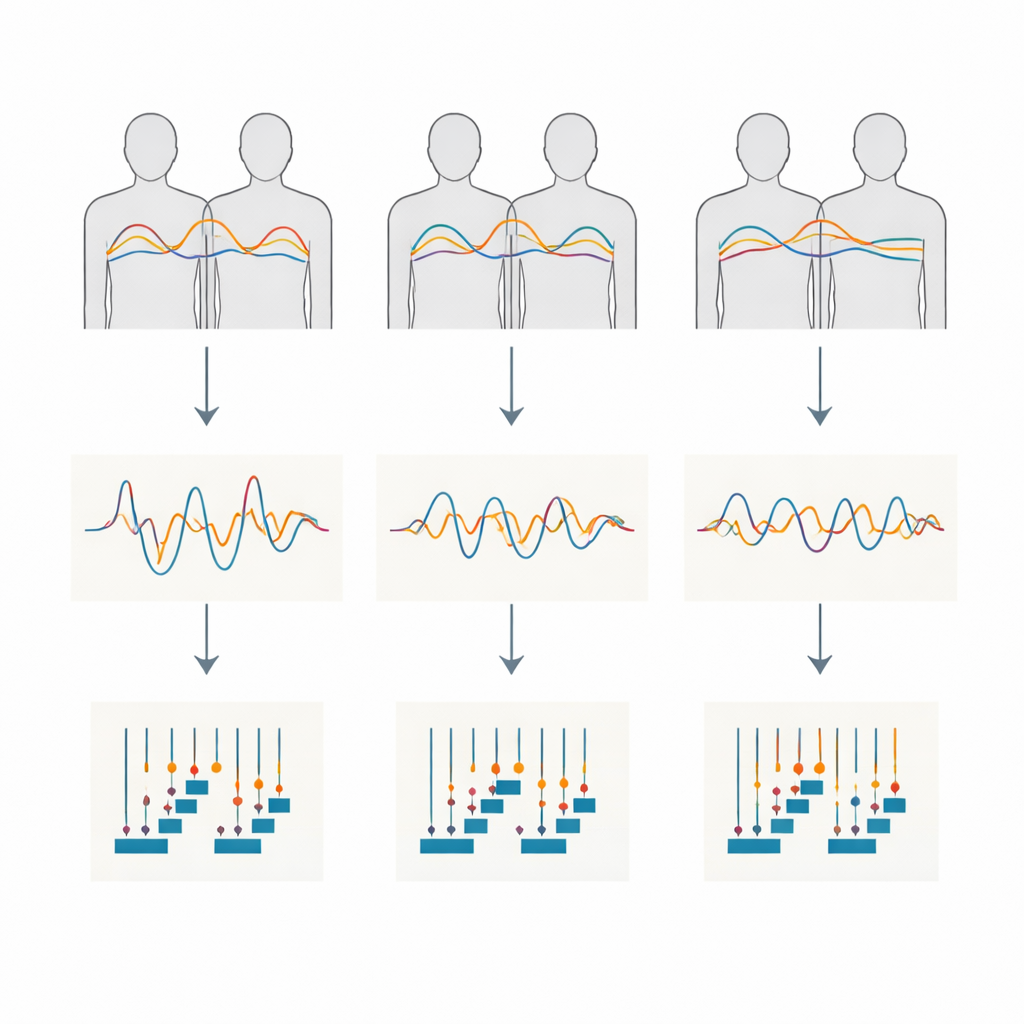
Citation: Schreiber, A., Frieler, K. & Lange, E.B. Intonation and timing in singing early music is unrelated to respiration synchronization. Sci Rep 16, 7834 (2026). https://doi.org/10.1038/s41598-026-39565-6
Keywords: ensemble singing, physiological synchrony, breathing and music, choral performance, Renaissance vocal music