Clear Sky Science · en
CFD-driven neural network and SVM models for airfoil aerodynamic enhancement with bio-inspired riblets and plasma actuation
Smarter Wings for Greener Flight
Modern airplanes and cars owe much of their efficiency to the quiet work of aerodynamics—the way air flows around wings and bodies. This study explores how to squeeze more lift and less drag from a common wing shape by blending three cutting-edge ideas: tiny shark-skin–inspired surface grooves, invisible electrical “winds” from plasma devices, and artificial intelligence models that learn from computer simulations. The goal is simple but powerful: help future aircraft and wind turbines fly farther on less fuel while keeping designs practical to manufacture.
Borrowing Tricks from Sharks and Lightning
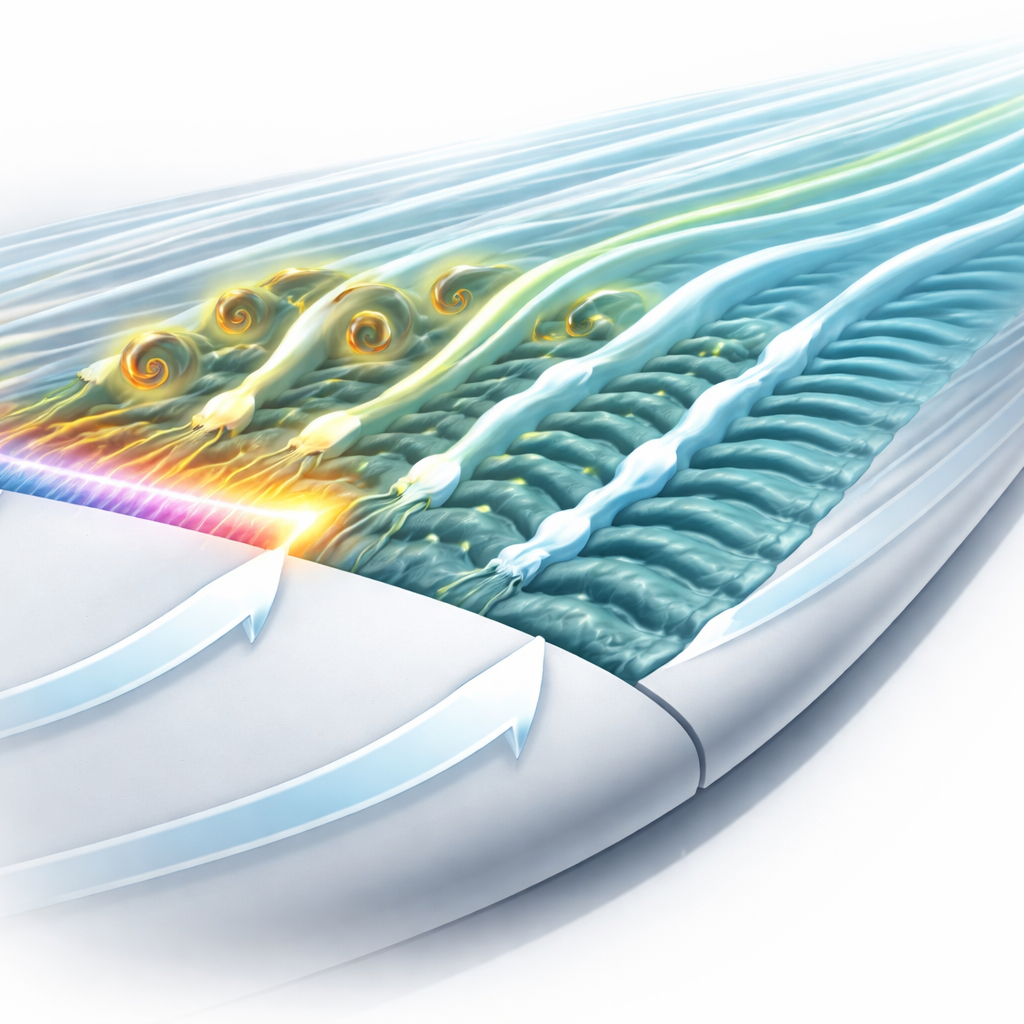
The researchers focus on a widely used wing profile called NACA4412, a workhorse shape in aviation and wind energy. To improve its performance, they first add microscopic grooves called riblets to the upper surface, inspired by the texture of shark skin. These riblets, only a few millimeters wide and deep, run along the direction of the flow and are known to reduce friction by calming turbulent swirls that scrape along a surface. The team tests three riblet shapes—semi-circular, sharp triangular, and a smoother “fillet” design—at a demanding operating condition where the airflow is fast and highly turbulent.
Using Electric Forces to Push the Air Along
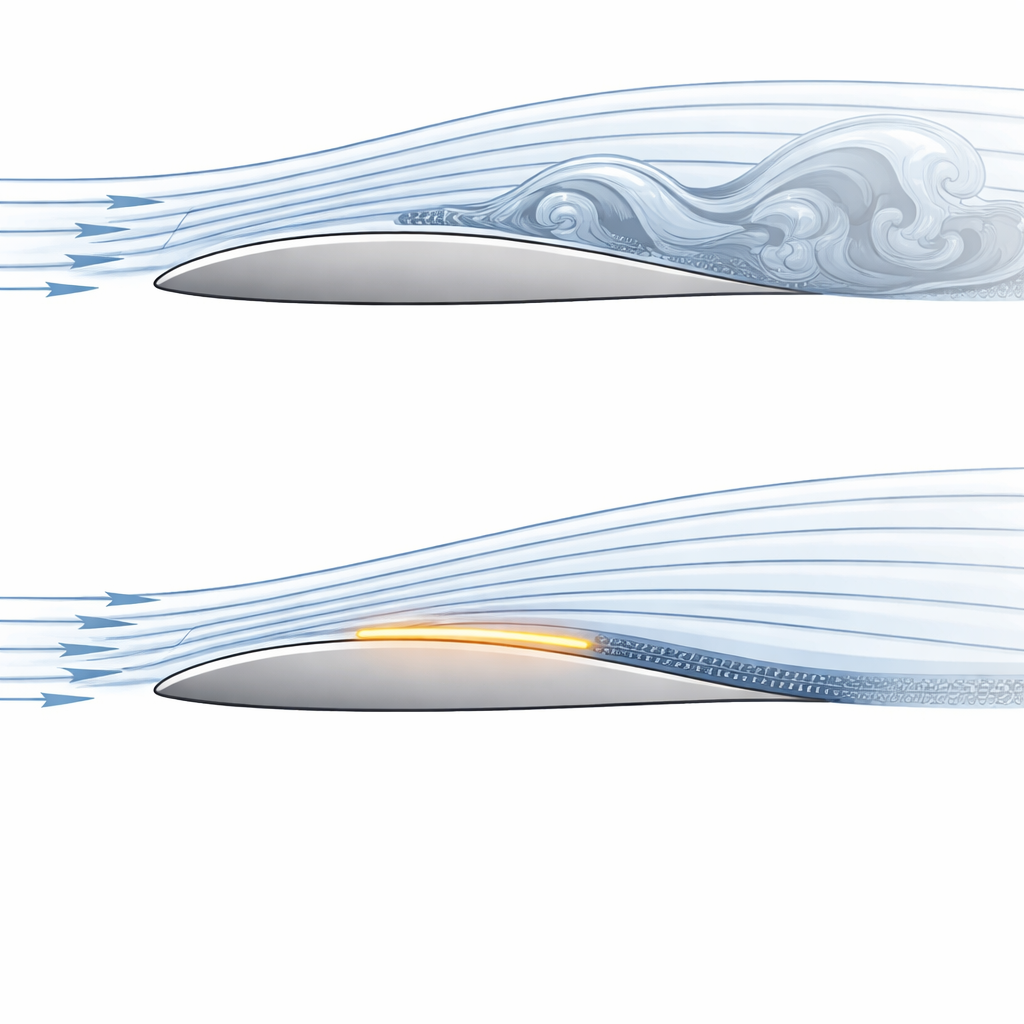
Riblets alone mostly chip away at drag but do not dramatically boost lift, especially when the wing is at steeper angles where flow tends to peel away and stall. To address this, the researchers add an active device called a plasma actuator near the leading edge of the wing. When energized at several thousand volts and high frequency, this thin strip creates a tiny region of ionized air that exerts a body force on the surrounding flow, effectively blowing the air downstream without any moving parts. Positioned just a few percent of the chord from the front, the actuator energizes the boundary layer—the thin layer of air hugging the surface—delaying the onset of separation and helping the flow stay attached longer.
Seeing the Air with High-Powered Simulations
To understand how these features interact, the team performs detailed three-dimensional computer simulations of airflow over the wing for angles from gentle cruise to near-stall conditions. They use a well-established turbulence model to capture vortices, wake shapes, and how the boundary layer grows and detaches. The riblets are placed where the flow is fully turbulent, and the numerical mesh is refined enough that further sharpening it does not change the results. The pictures emerging from the simulations show that riblets thin the near-wall turbulence and narrow the wake, while the plasma actuator shrinks or even removes large recirculation bubbles that would otherwise sap lift and add drag.
Letting Artificial Intelligence Learn the Aerodynamic Rules
Because these simulations are expensive to run, the authors train machine learning models to serve as fast stand-ins. They feed data on angle of attack, flow speed, riblet width, and actuator settings into two types of AI: an artificial neural network and a support vector machine. Both learn to predict the wing’s lift and drag coefficients with high precision, matching the simulation results while using only a fraction of the computing time. The models capture subtle effects of geometry and control settings, suggesting that once trained, they could help engineers quickly explore design options or tune flow-control devices in real time without rerunning full simulations.
Finding the Best Combo for Lift and Drag
Among all tested designs, the clear standout is the bio-inspired fillet riblet combined with plasma actuation. This pairing delivers the largest boost in lift and the strongest cut in drag compared with a smooth, uncontrolled wing. At its best operating range, lift rises by more than one-fifth and the lift-to-drag ratio—a key measure of aerodynamic efficiency—improves by nearly half. Other riblet shapes and the plasma actuator alone also help, but not as much as this hybrid arrangement. Flow visualizations show smoother, more stable patterns over the treated region and a thinner wake, confirming that the wing is working harder to generate lift while wasting less energy in turbulence.
What This Means for Everyday Flight
For a general reader, the takeaway is that small, smart changes to a wing’s surface and invisible electric nudges to the airflow can add up to substantial savings in fuel or battery power. By pairing physics-based simulations with AI models, the study lays out a practical roadmap: use heavy-duty computing just once to map how new textures and plasma devices affect flow, then rely on trained models to guide design and operation. If translated into real aircraft and turbines, this approach could help make transportation quieter, cleaner, and more efficient without radical changes to familiar shapes.
Citation: Karthikeyan, K.V., Raju, A., Jain, J. et al. CFD-driven neural network and SVM models for airfoil aerodynamic enhancement with bio-inspired riblets and plasma actuation. Sci Rep 16, 14197 (2026). https://doi.org/10.1038/s41598-026-39525-0
Keywords: airfoil flow control, bio-inspired riblets, plasma actuators, aerodynamic optimization, CFD and machine learning