Clear Sky Science · en
Biologically inspired neuromorphic-XAI synergy for transparent and low-carbon healthcare intelligence
Smarter hospital tech for people and the planet
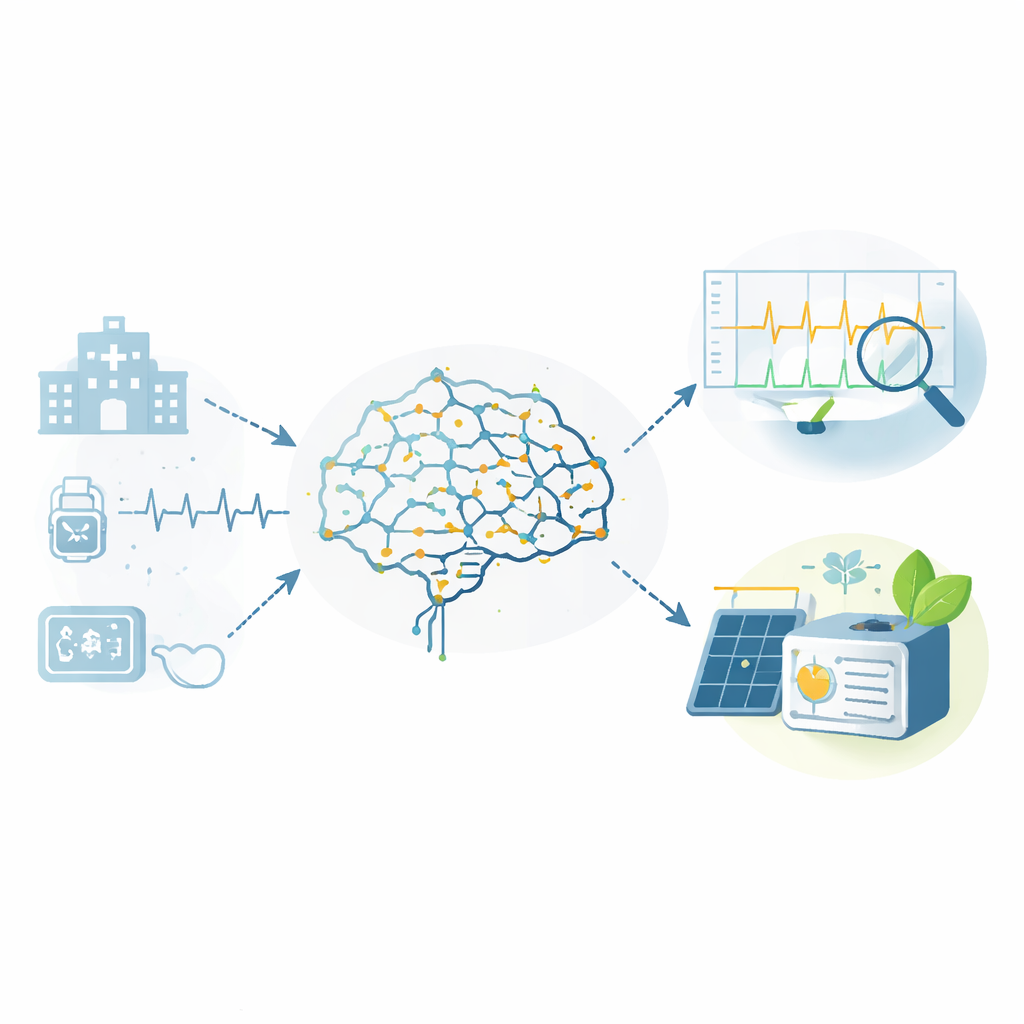
Hospitals are turning to artificial intelligence to read heart signals, spot dangerous rhythms, and support doctors’ decisions. But today’s powerful algorithms often behave like black boxes and demand energy-hungry graphics processors, which clashes with climate goals and strains clinics with limited electricity. This paper proposes a new kind of heart‑monitoring system that aims to be both understandable to clinicians and far more energy‑efficient, offering a path toward safer, lower‑carbon digital healthcare.
Why current medical AI falls short
Modern medical AI can match or even exceed expert performance in tasks such as reading X‑rays or detecting abnormal heartbeats. Yet many models run on large data centers or high‑end GPUs that draw hundreds of watts continuously. In an intensive care unit, a single GPU‑based system running around the clock can consume over 2,000 kilowatt‑hours per year. At the same time, these models usually provide little insight into how they reach their conclusions, making it hard for doctors and regulators to trust them. Existing explanation tools can help, but they themselves often require heavy extra computation, further increasing energy use and latency.
A brain‑inspired route to gentler computing
The authors explore neuromorphic computing, a style of hardware and algorithms that mimics how biological neurons communicate using brief electrical spikes instead of continuous signals. In their NEXAI‑Health framework, incoming electrocardiogram (ECG) heart signals are converted into sparse streams of spikes, where information is carried mainly by when spikes occur rather than by dense numerical values. This event‑driven design means that computation happens only when needed, potentially slashing energy use compared with conventional chips that churn through every time step whether the signal changes or not.
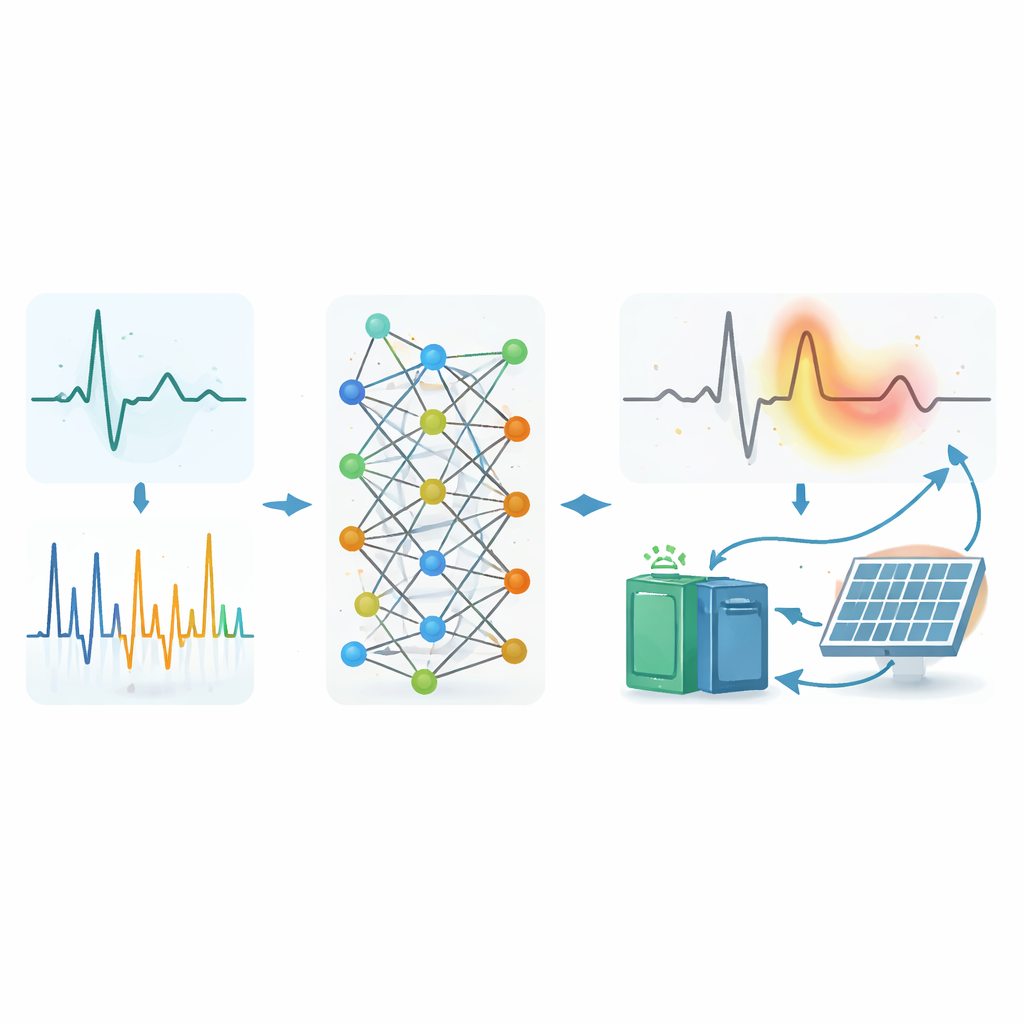
Within this framework, the team builds spiking neural networks tailored for classifying heartbeats from the well‑known MIT‑BIH Arrhythmia Database. They design the encoding so that only about 16 percent of possible spike events actually fire, striking a balance between preserving medically important features—such as the shape of the main heartbeat peak and the timing between beats—and avoiding wasted activity. Simulations suggest that this sparse, spike‑based representation can maintain high diagnostic information while greatly reducing the number of operations the hardware would need to perform.
Making machine decisions easier to trust
To address the black‑box problem, the authors adapt an explanation technique called integrated gradients to work on spike trains rather than standard numeric inputs. In practice, this produces heatmaps over each heartbeat that highlight which time points most strongly influenced the system’s decision. Crucially, they weave explanation directly into the model’s operation instead of bolting it on afterward, and they modulate how detailed the explanation is based on an energy budget. When plenty of power is available, the system uses many intermediate steps for high‑fidelity explanations; when energy is tight, it falls back to coarser but still informative summaries. In tests, these explanations aligned well with clinically important regions of the ECG, such as the sharp central peak and recovery wave, and reached high scores on quantitative measures of faithfulness.
Designing around real‑world energy limits
Beyond the model itself, the paper sketches a larger ecosystem for sustainable deployment. It couples the neuromorphic engine to a simple solar‑power model and a battery, then uses a scheduling algorithm that decides which patient monitoring tasks to run based on both clinical urgency and available energy. In simulations using over 100,000 labeled heartbeats, the framework reached about 95 percent diagnostic accuracy—slightly better than strong deep‑learning baselines—while also cutting simulated latency and memory use enough to fit on modest, edge‑class devices. The authors estimate large energy savings compared with GPU‑based systems, though they emphasize that these numbers are projections grounded in published neuromorphic chip specifications, not actual measurements.
What this means for future healthcare
For non‑specialists, the key takeaway is that this work is a blueprint rather than a finished product. The study shows that, at least in software simulations, a brain‑inspired model can read heart signals accurately, provide doctor‑friendly visual explanations of its reasoning, and theoretically run on a fraction of the energy consumed by today’s mainstream AI. However, the authors are clear that they have not yet built or tested a physical neuromorphic device, nor conducted clinical trials. To truly deliver transparent, low‑carbon healthcare AI, future work must port these designs onto real neuromorphic chips, validate the actual power draw, and demonstrate safe, reliable performance at the bedside.
Citation: Sungheetha, A., R., R.S., Balusamy, B. et al. Biologically inspired neuromorphic-XAI synergy for transparent and low-carbon healthcare intelligence. Sci Rep 16, 10049 (2026). https://doi.org/10.1038/s41598-026-39515-2
Keywords: neuromorphic computing, explainable AI, ECG arrhythmia, energy efficient healthcare, low carbon diagnostics