Clear Sky Science · en
Small eye movements during convergence and divergence in individuals with intermittent exotropia
Why tiny eye movements matter
Our eyes constantly adjust as we look from our phone to the road or from a book to a clock on the wall. For most people, these shifts are smooth and automatic. But in people with intermittent exotropia—a condition where one eye sometimes drifts outward—these everyday refocusing movements can become jerky and inefficient. This study used a high-speed eye tracker to zoom in on those tiny eye adjustments, revealing how subtle glitches in eye coordination may explain problems with reading, depth perception, and visual comfort, and how surgery can help.
Looking between near and far
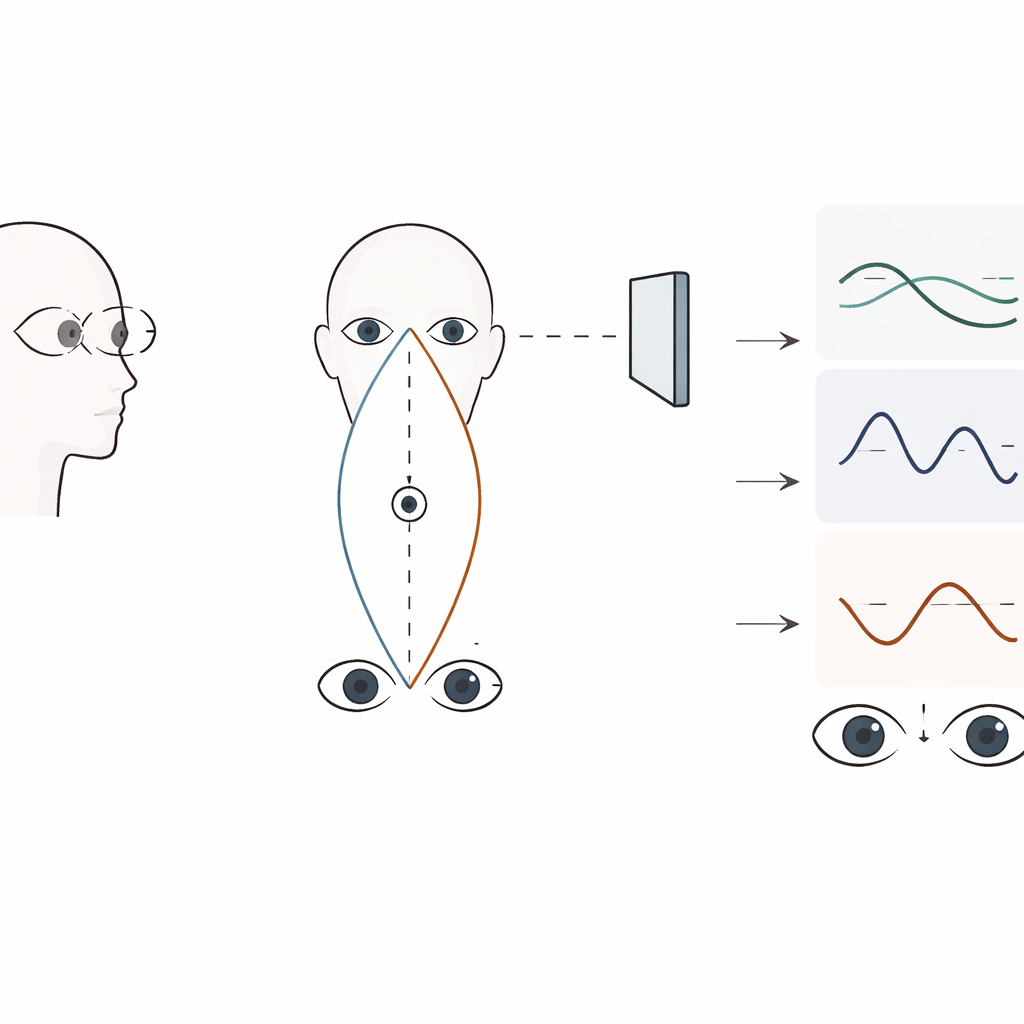
The researchers studied 20 young adults with intermittent exotropia and 20 people with normal eye alignment. Participants repeatedly shifted their gaze between a near target 30 centimeters away and a screen 60 centimeters away, mimicking common tasks like glancing between a book and a computer. A 300-Hz eye-tracking system precisely measured how both eyes moved together as they converged (turned inward for near) and diverged (turned outward for far). Instead of just tracking where the target was, the team calculated the actual point in space where the two lines of sight met, giving a detailed, moment-by-moment picture of how the eyes lined up in three dimensions.
When eye movements hesitate and wobble
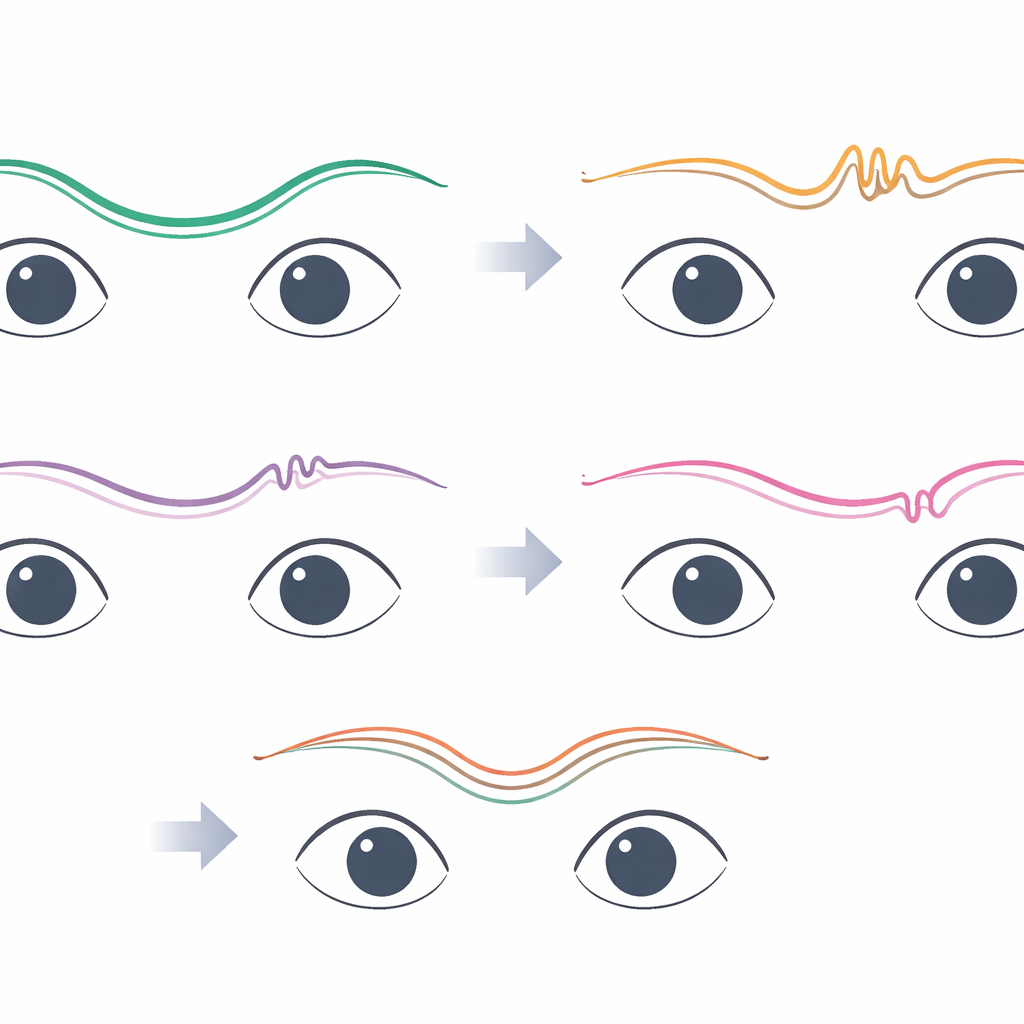
In people with intermittent exotropia, turning the eyes inward to look at the near target took about half again as long as in the control group, suggesting that near focusing demands extra effort. When the researchers looked more closely at the movement traces, they found three recurring patterns of tiny irregular eye motions that showed up far more often in the exotropia group. "Notch" events were brief back-and-forth wiggles during a shift in focus. "Static notch" events were small, momentary wrong-way movements that occurred just before the eyes should have started moving toward the new target. "Overshoot" events happened when the eyes went too far at the end of a movement and then had to pull back. These were not random jitters: notch and static notch were mostly seen when changing focus, while overshoot especially appeared at the end of looking farther away.
How these glitches affect daily life
People with intermittent exotropia showed many more of these small glitches than those with normal eye alignment. Static notch events during inward focusing were present in 70% of the exotropia group but only 30% of controls, and divergence-related notches and overshoots were also clearly more common. Interestingly, these abnormal patterns did not simply scale with how far the eye could drift outward; they reflected how the brain was controlling focus rather than the raw size of the misalignment. When patients filled out a quality-of-life questionnaire, those with more static notches and overshoots were more likely to report trouble reading, needing frequent breaks, or stopping tasks because their eyes made it hard to concentrate. The data suggest that these tiny missteps in eye coordination can add up to a real burden in school, work, and driving.
What changes after surgery
All patients with intermittent exotropia underwent standard eye muscle surgery to improve alignment and were tested again three months later. The overall speed of their eye movements did not change much, but the fine-grained patterns did. Static notch events during inward focusing were cut roughly in half, and overshoot events during outward focusing became less common. At the same time, patients reported better depth perception, less eye strain, and easier reading on the questionnaire. Reductions in specific abnormal movement types were linked to improvements in particular complaints, such as no longer needing to close one eye to see better or finding reading less exhausting. Together, these results hint that surgery may help the brain control focus more efficiently, not just straighten the eyes.
What this means for people with drifting eyes
For someone with intermittent exotropia, the problem is not only that an eye sometimes turns outward—it is also that the tiny steering adjustments needed to keep both eyes working together may be unstable. This study shows that people with the condition often have extra hesitations, reversals, and overshoots when shifting focus between near and far, and that these small errors are tied to real-world difficulties like reading fatigue. After surgery to better align the eyes, many of these abnormal movements become less frequent, and patients feel that seeing and reading take less effort. In simple terms, straightening the eyes appears to help smooth out the fine control system behind where we look, improving not just appearance but everyday visual comfort.
Citation: Mochizuki, Y., Kimura, A., Okita, Y. et al. Small eye movements during convergence and divergence in individuals with intermittent exotropia. Sci Rep 16, 10301 (2026). https://doi.org/10.1038/s41598-026-39497-1
Keywords: intermittent exotropia, eye tracking, vergence, reading difficulty, strabismus surgery