Clear Sky Science · en
Agentic AI-driven autonomous decision support system for smart agriculture
Smarter Choices for Fields and Farmers
For many farmers, knowing what to plant, how to care for the soil, and which fertilizers to use is still a mix of experience, guesswork, and delayed lab tests. This paper presents a way to turn that guesswork into guided decisions using artificial intelligence. By teaching computers to “see” soil, read local weather, and weigh past harvest data, the researchers build an assistant that suggests which crops to grow, which fertilizers to apply, and what yields to expect—helping farmers get more from each field while wasting less water and chemicals.
Why Soil, Weather, and Crops Must Work Together
Farming success depends on a delicate balance: the minerals locked in the soil, the timing of rain and heat, and the needs of each crop. Traditional methods rely on physical soil sampling, chemical tests, and expert advice that can be slow, costly, and hard to scale to thousands of small farms. The authors argue that, as climate shifts and input costs rise, farmers need tools that can respond in near real time. Their solution is to treat the farm as an information problem: soil color and texture become images, nutrients and weather become numbers, and smart algorithms turn all of that into concrete advice tailored to a specific plot of land.
How the Digital Farm Assistant Works
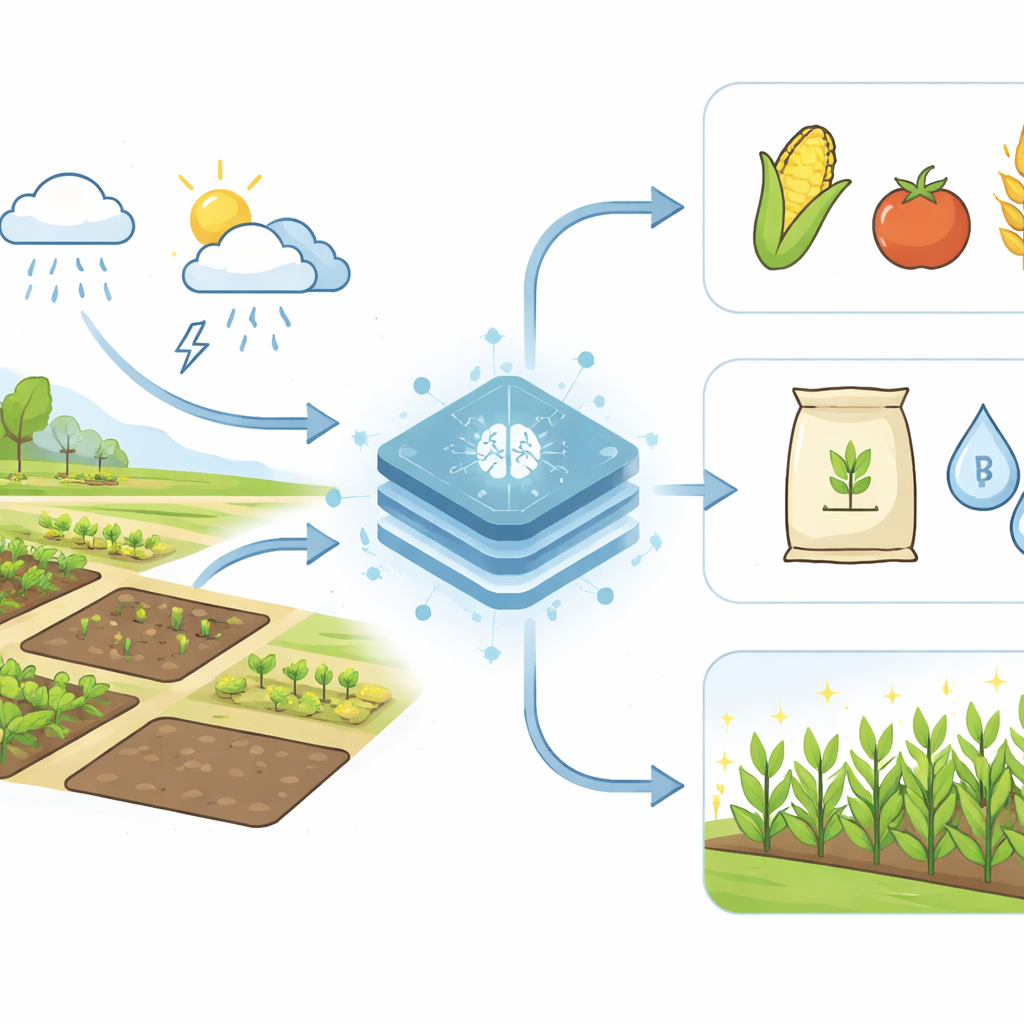
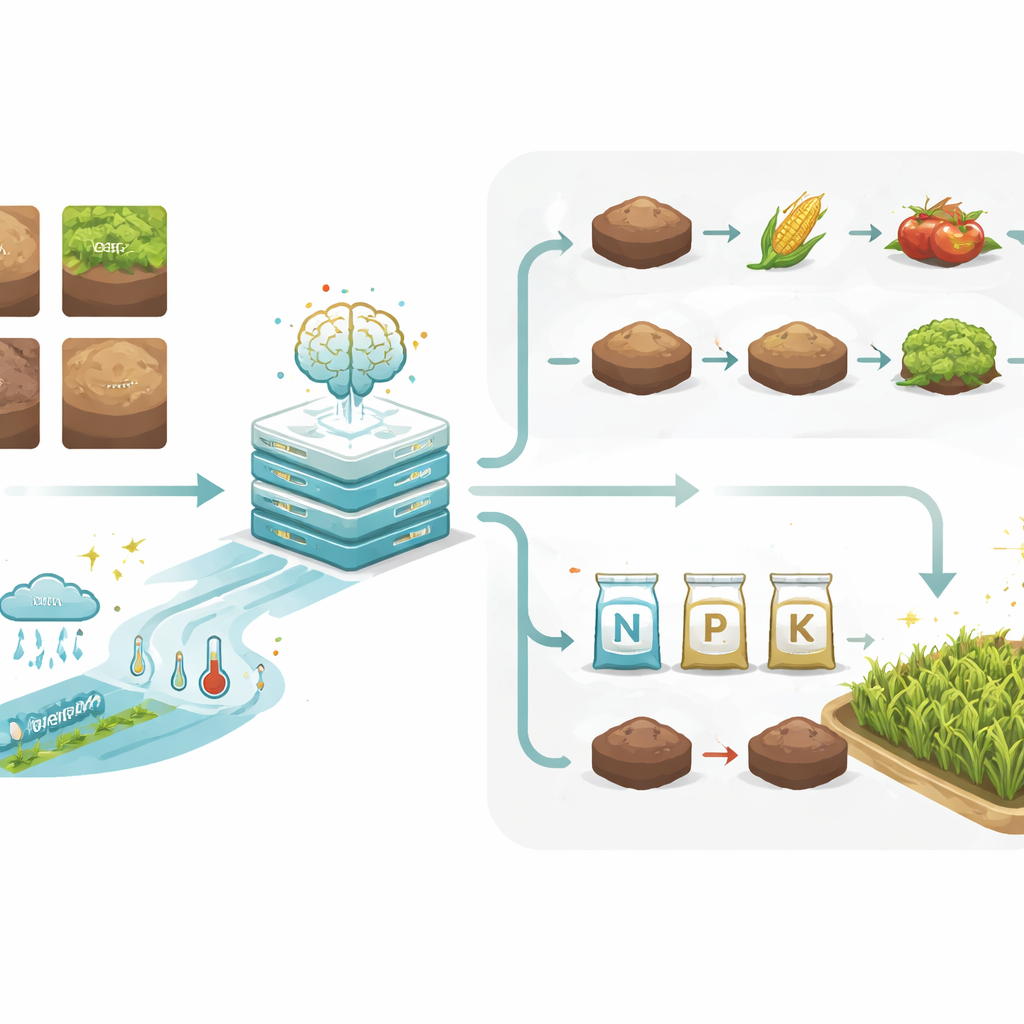
The proposed system, called Soil2Harvest-AI, is built from several cooperating “agents,” each handling one part of the decision chain. First, a soil agent looks at photos taken from the field and classifies them into four broad soil types—black, red, clay, or alluvial—based on texture and color. A second agent estimates key soil properties such as acidity (pH) and the levels of nitrogen, phosphorus, and potassium, which are crucial for plant growth. At the same time, a weather module pulls live data on temperature, rainfall, and humidity from online services, so that any recommendation reflects current and forecasted conditions rather than long-term averages.
From Raw Data to Crop and Fertilizer Advice
Once soil and climate are understood, a crop agent consults a large dataset of past conditions and outcomes—2,200 examples that link nutrient levels, weather, and pH with successful crops like rice, maize, wheat, and vegetables. Using an approach called Random Forest, which effectively combines many simple decision trees, this agent suggests which crops are most likely to thrive in the present conditions with over 92% accuracy. Next, a fertilizer agent checks for nutrient gaps and, using another advanced model called XGBoost, recommends specific fertilizer types and blends, including organic options like compost. This module achieved close to 95% accuracy in tests, indicating that it can distinguish subtle differences in soil and crop needs.
Opening the Black Box of AI for Farmers
Because farmers and agronomists need to trust and question the system’s suggestions, the authors add an explainability layer rather than leaving decisions as mysterious outputs. Tools known as SHAP and LIME highlight which factors—such as low phosphorus, high humidity, or a certain soil texture—pushed the system toward a given crop or fertilizer choice. For soil images, they can even show which parts of the photograph mattered most, revealing that the models focus on meaningful patterns like cracks, color gradients, or clumping, not random noise. A web interface and chatbot named CroPiBot wrap all this into a simple dashboard that displays soil type, likely yield, weather alerts, and plain-language guidance.
What the Results Mean for the Future of Farming
Tests across thousands of soil images and field records show that this multi-agent assistant can make reliable, well-explained suggestions under a range of conditions, including noisy measurements and unusual weather. While it does not reach the near-perfect accuracy sometimes reported in small, controlled studies, it performs strongly in more realistic, connected scenarios where soil, climate, and fertilizer choices all influence one another. For a layperson, the takeaway is clear: by combining farm data, live weather, and transparent AI, systems like Soil2Harvest-AI could help growers choose smarter crops, apply just enough fertilizer, and protect soil health—supporting better harvests today without exhausting the land for tomorrow.
Citation: Swati, N.L.P., Gupta, S.V., Duddela, N.S. et al. Agentic AI-driven autonomous decision support system for smart agriculture. Sci Rep 16, 9972 (2026). https://doi.org/10.1038/s41598-026-39472-w
Keywords: smart agriculture, soil analysis, crop recommendation, fertilizer optimization, explainable AI