Clear Sky Science · en
Experimental validation of metaheuristic-optimized control for standalone DFIG dynamic performance enhancement
Keeping the Lights On in Remote Wind-Powered Communities
As more villages, farms, and small islands turn to wind turbines instead of diesel generators, they face a subtle but serious problem: keeping the electricity steady and clean when the wind and the local demand are anything but steady. This paper explores a new way to make a popular wind-turbine generator behave more calmly and reliably, so that lights do not flicker, appliances do not suffer, and sensitive electronics can run safely even at the end of a long, lonely power line.
Why This Kind of Wind Generator Matters
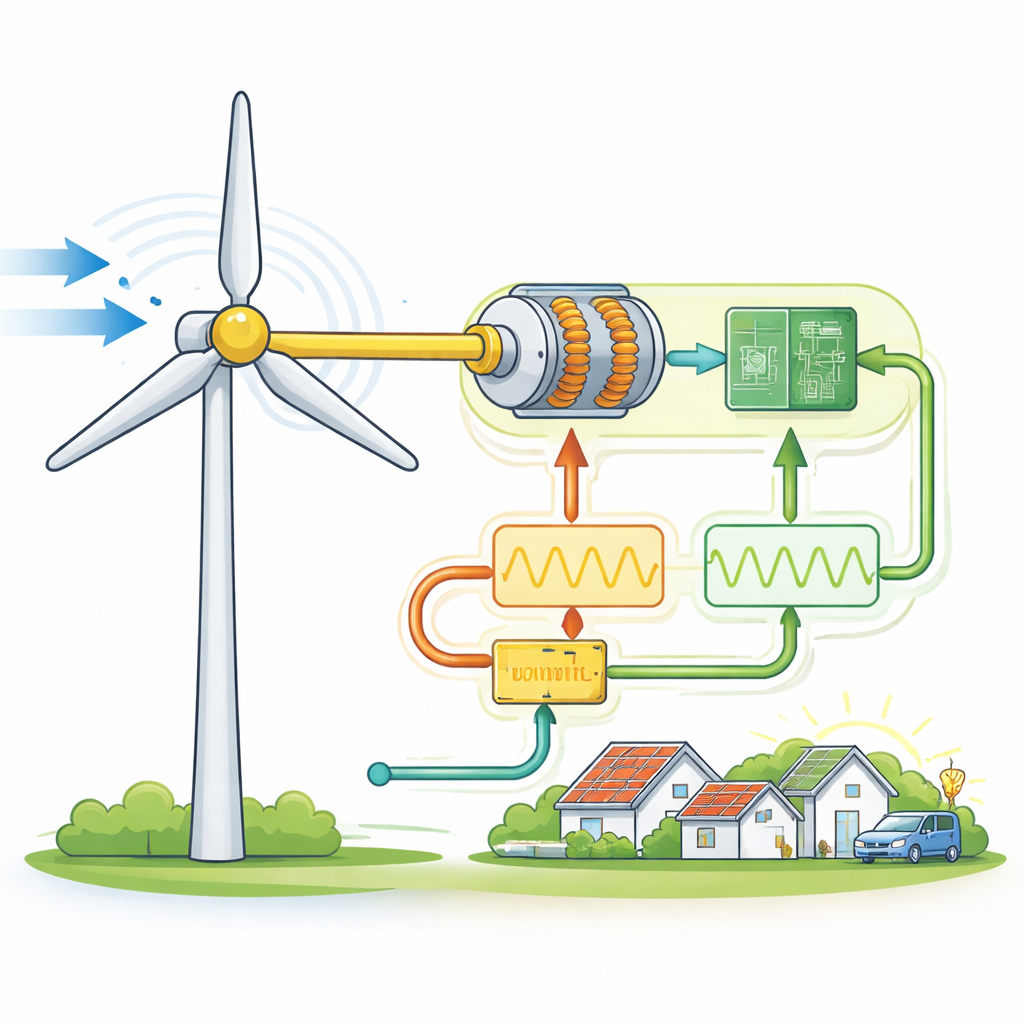
Many modern wind turbines use what is called a doubly fed induction generator, or DFIG. Unlike a simple generator that spins at one fixed speed, a DFIG can adjust to changing wind while still delivering electricity at the right frequency. It does this with the help of power electronics that let engineers separately steer how much real power and reactive power the turbine sends out. That flexibility makes DFIGs efficient and economical, especially for medium-size wind projects. But the same complexity also makes them sensitive: changes in wind, uneven household loads, and quirks in the equipment can all cause voltage spikes, slow recovery after a disturbance, and distorted waveforms that reduce power quality.
Smarter Tuning Instead of Trial and Error
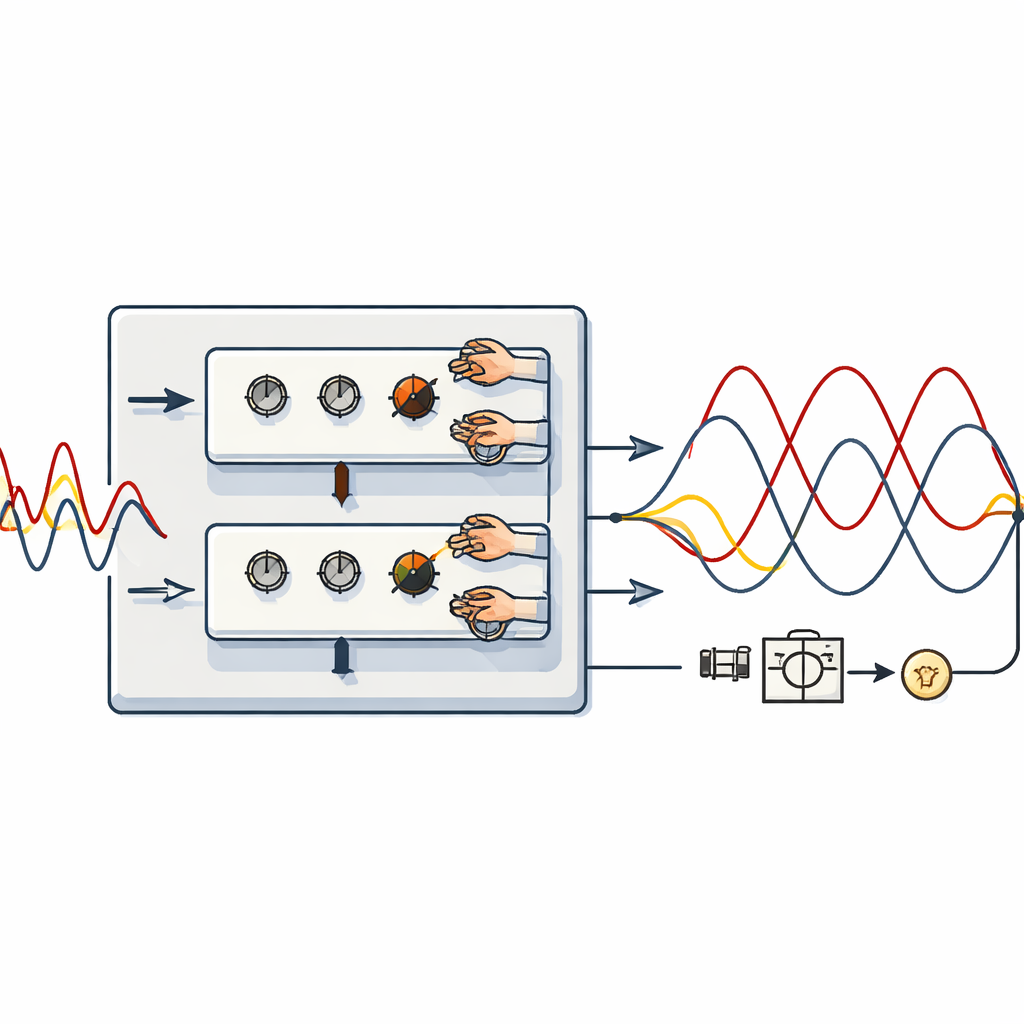
At the heart of the problem is how to tune the simple but powerful proportional–integral (PI) controllers that sit inside the DFIG’s electronics. These controllers decide, moment by moment, how to adjust currents in the generator so that the output voltage stays at the desired level. Traditionally, engineers pick their PI settings using textbook rules or long trial-and-error sessions. In a system as nonlinear and changeable as a standalone wind turbine, those methods often lead to sluggish responses, large overshoots, and high levels of unwanted harmonics. The authors instead turn to two nature-inspired search strategies: the cuckoo search algorithm, based on how certain birds lay their eggs in others’ nests, and the whale optimization algorithm, modeled on how humpback whales herd prey with spiral bubble nets. These methods automatically search through many possible PI settings to find combinations that give fast, well-behaved responses.
How the New Control Strategy Was Put to the Test
The study focuses on a standalone DFIG that must power local loads directly, without the stabilizing help of a large grid. The researchers keep the mechanical side of the turbine simple and fixed, then concentrate on the electrical control loops that shape the stator voltage. They design a direct-voltage control scheme for the rotor-side converter and let the two search algorithms tune six key gains: one pair for the stator voltage regulator and two pairs for the rotor current loops. The tuning goal is expressed in a single measure that punishes both large errors and errors that last too long, encouraging quick, clean corrections. First, they explore performance in detailed computer models; then they port the same control code to a dSPACE DS1104 hardware platform operating a real 3 kW wound-rotor machine, converters, and programmable loads, so that simulations and experiments can be compared fairly.
What Happens During Sudden Changes
To see how well the new tuning works, the team subjects the system to harsh but realistic tests. In one set of experiments, a sizeable load is abruptly connected and then removed while the turbine speed is held constant. With conventional PI settings, the stator voltage shoots far above its target and takes several seconds to settle, and the voltage waveform shows a high level of distortion. With PI gains chosen by the cuckoo search or whale algorithms, the same disturbances produce much smaller spikes and smoother recovery. In the most striking case, the overshoot is cut by up to 88 percent and the rise time improves by 99 percent, dropping from about two-tenths of a second to just a few thousandths. Another set of tests steps the desired stator voltage up and down by 40 percent, mimicking intentional adjustments or internal disturbances. Again, the optimized controllers keep the voltage close to target with only modest overshoot and quick stabilization.
Cleaning Up the Shape of the Electricity
Voltage that looks smooth at first glance can still hide problems in its fine details. The authors therefore also measure total harmonic distortion, a standard indicator of how much the waveform deviates from a pure sine wave. Under both moderate and higher rotor speeds, the conventional controller allows the stator voltage distortion to hover around 30 percent, a level that can stress motors, transformers, and electronic devices. With the new tuning, that distortion falls dramatically, to below about 8 percent in all cases and down to roughly 6 percent in the best configuration. The current waveforms in both rotor and stator windings show similar improvements, confirming that the overall power quality delivered to the loads is much closer to what one would expect from a well-behaved utility grid.
What This Means for Real-World Wind Power
For readers imagining a remote farm, mine, or island powered mainly by wind, the message is straightforward: smarter tuning of existing controllers can make standalone wind systems far more reliable without redesigning the hardware. By letting search algorithms inspired by birds and whales choose how the DFIG’s control knobs are set, the authors achieve faster, gentler reactions to sudden changes and sharply cleaner voltage waveforms. That means fewer flickering lights, better protection for equipment, and more confidence that wind can serve as a primary energy source even when no large grid is present.
Citation: Soued, S., Boureguig, K., Chabani, M.S. et al. Experimental validation of metaheuristic-optimized control for standalone DFIG dynamic performance enhancement. Sci Rep 16, 10432 (2026). https://doi.org/10.1038/s41598-026-39460-0
Keywords: wind energy, doubly fed induction generator, power quality, metaheuristic control, standalone microgrid