Clear Sky Science · en
Thermo-hydraulic performance optimization of different louvered strip inserts inside a heated tube employing Al2O3 and CuO water-based nanofluids
Why smarter heat pipes matter
From power plants and refrigerators to electric cars and data centers, countless technologies depend on devices called heat exchangers to move heat from one place to another. Making these devices more efficient means using less fuel, shrinking equipment size, and cutting costs and emissions. This study explores a promising way to boost the performance of a simple heated tube—the building block of many heat exchangers—by adding small metal inserts shaped like louvers and by using specially engineered liquids filled with tiny metal-oxide particles.
Shaping the flow inside a tube
In a plain tube, fluid tends to slide smoothly along the walls, forming a thin insulating layer that slows heat transfer. The researchers focus on louvered strip inserts: thin, leaf-like metal pieces mounted on a central rod and angled to the flow. These strips act like tiny turbulence generators inside the tube. As the fluid weaves around them, the smooth layers of flow are disrupted, and swirling patterns form. This stronger internal motion helps bring cooler fluid from the tube’s core into contact with the hot wall and carries warmed fluid away, allowing heat to move more quickly from the wall into the flowing liquid. 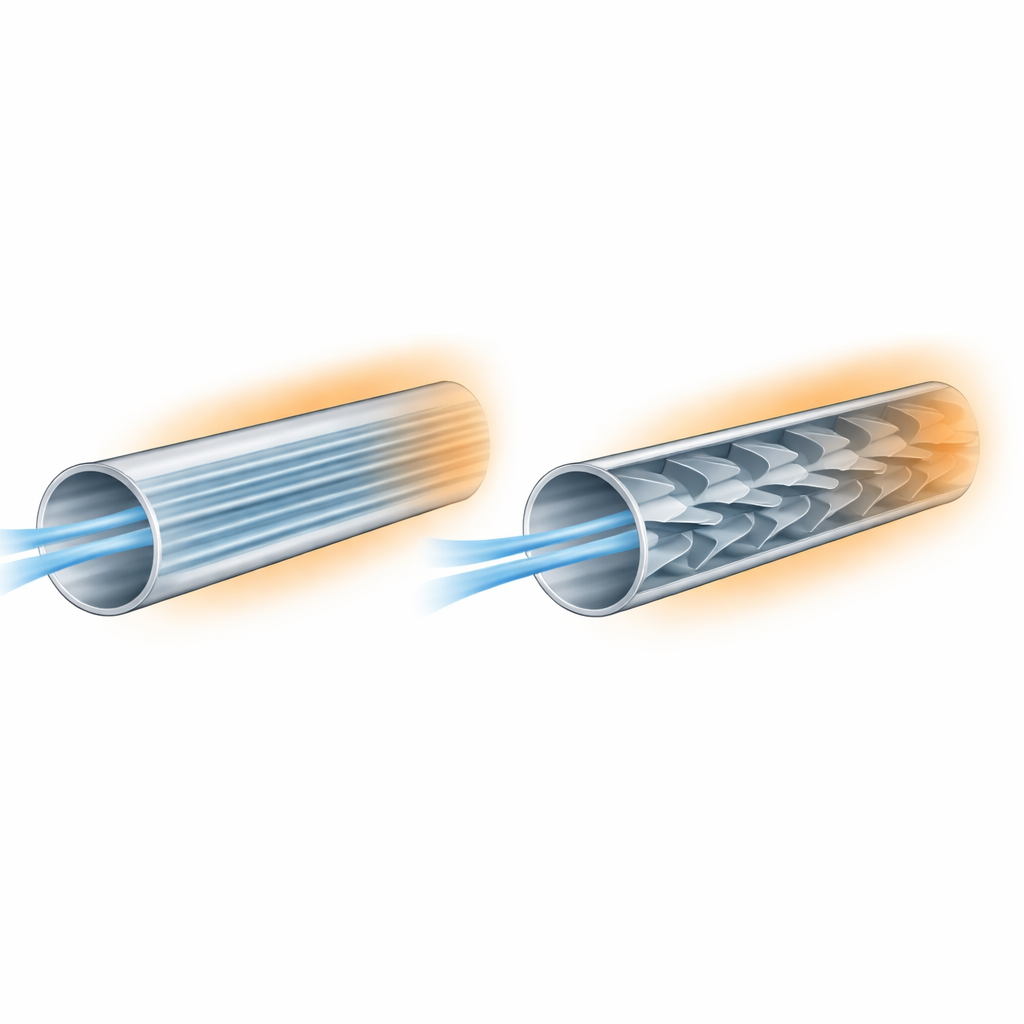
Using designer liquids to carry more heat
Beyond reshaping the flow, the team also looks at changing the fluid itself. Instead of plain water, they study nanofluids—water mixed with a small amount of ultra-fine solid particles. Here they test aluminum oxide (Al2O3) and copper oxide (CuO) particles, with concentrations up to 2 percent by volume. These particles have better heat-conducting properties than water, so even a modest amount can help the liquid absorb and transport heat more effectively. The work compares how these different nanofluids behave in the same louvered-tube setup, asking which combination of particle type and amount delivers the biggest gain in heat transfer without causing too much resistance to flow.
Virtual experiments and smart search
Physically testing every possible combination of tube geometry, flow rate, and nanofluid mixture would be slow and expensive. Instead, the authors build a detailed three-dimensional computer model of the tube and inserts, then simulate the fluid motion and heat transfer for many different scenarios. They vary four key knobs at once: how fast the fluid moves through the tube, how steeply the louvered strips are slanted, how far apart they are spaced along the rod, and how concentrated the nanoparticles are. To explore this large design space efficiently, they first select 91 carefully distributed cases and run full simulations for each one. They then train a machine-learning model called a radial basis function neural network to mimic the simulator’s behavior, so that it can very quickly predict performance for new designs. 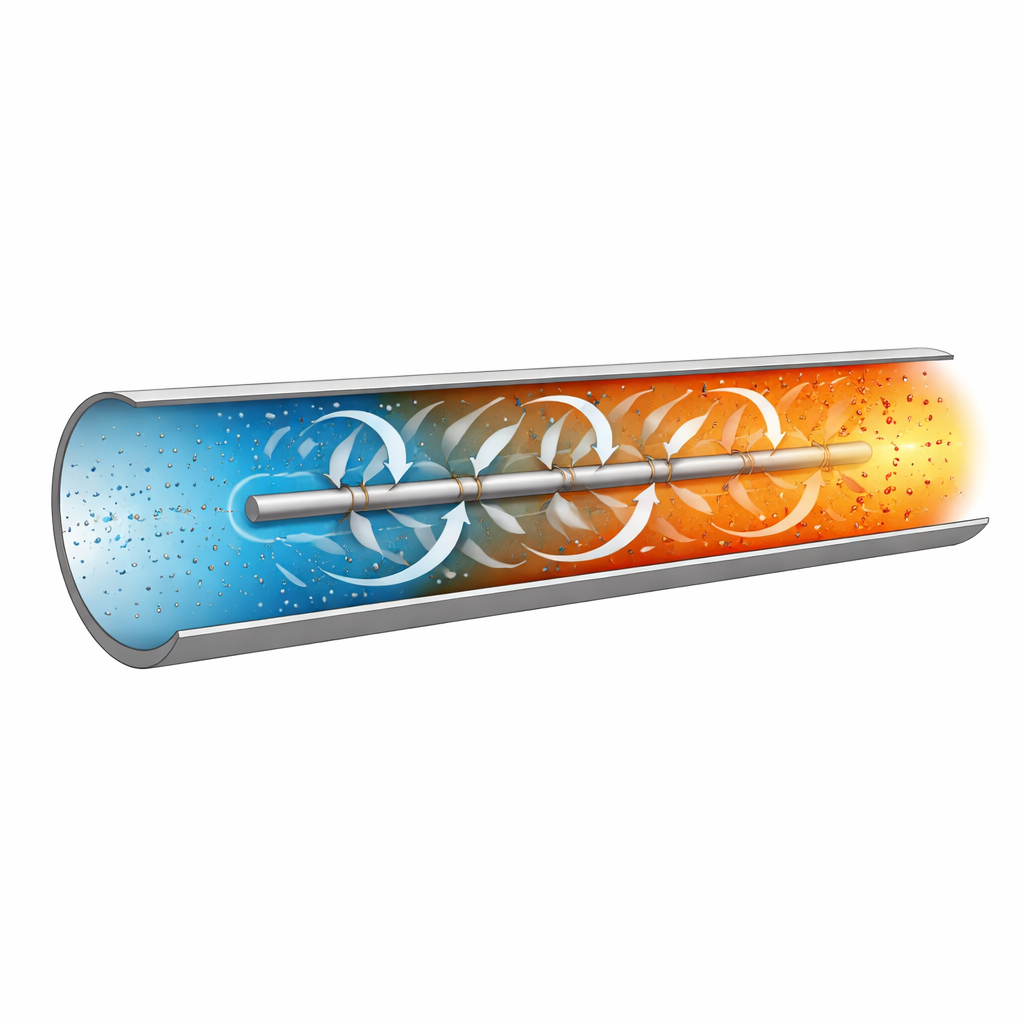
Balancing more heat against higher resistance
Adding inserts and particles has a trade-off: while they boost heat transfer, they also make it harder for the fluid to move, increasing the pressure needed to pump it through the tube. The study therefore evaluates performance with several combined measures that compare heat gained against the extra resistance. Using the surrogate model together with genetic algorithms—search strategies inspired by evolution—the authors hunt for designs that maximize these measures. They find that copper-oxide nanofluid consistently outperforms both aluminum-oxide nanofluid and plain water. The best overall setting uses relatively slow flow, a moderate particle loading of about 0.8 percent, a fairly steep strip angle of 35 degrees, and a slightly longer spacing between strips. Under these conditions, the tube’s combined heat-transfer-and-friction performance is more than two and a half times better than a plain water-filled tube without inserts.
What this means for real-world devices
In simple terms, the study shows that carefully arranged internal fins plus a small dose of engineered particles can make a basic heat-carrying tube dramatically more effective, especially at lower flow speeds where smooth, laminar motion would otherwise limit performance. By using computer simulations, machine learning, and optimization algorithms together, the authors map out how design choices interact and pinpoint combinations that deliver much more heat transfer for only a modest pumping penalty. These insights can guide engineers in designing more compact and energy-efficient heat exchangers for many applications, from industrial processes to climate control and thermal management in electronics.
Citation: Almohammadi, B.A., Refaey, H.A., Alsharif, A.M. et al. Thermo-hydraulic performance optimization of different louvered strip inserts inside a heated tube employing Al2O3 and CuO water-based nanofluids. Sci Rep 16, 12054 (2026). https://doi.org/10.1038/s41598-026-39448-w
Keywords: heat exchangers, nanofluids, louvered inserts, thermal optimization, turbulent flow