Clear Sky Science · en
Artificial intelligence versus traditional approaches in multicomponent spectral analysis
Why this matters for everyday medicines
Many skin creams contain several drugs blended together to fight infection and inflammation at once. Testing whether each ingredient is present at the right dose is essential for safety, but their chemical “fingerprints” often overlap, making them hard to tell apart. This study shows how free, widely available artificial intelligence (AI) tools can work alongside traditional lab instruments to untangle these signals more quickly, cheaply, and sustainably—especially in laboratories that lack expensive software and equipment.
Untangling a crowded chemical picture
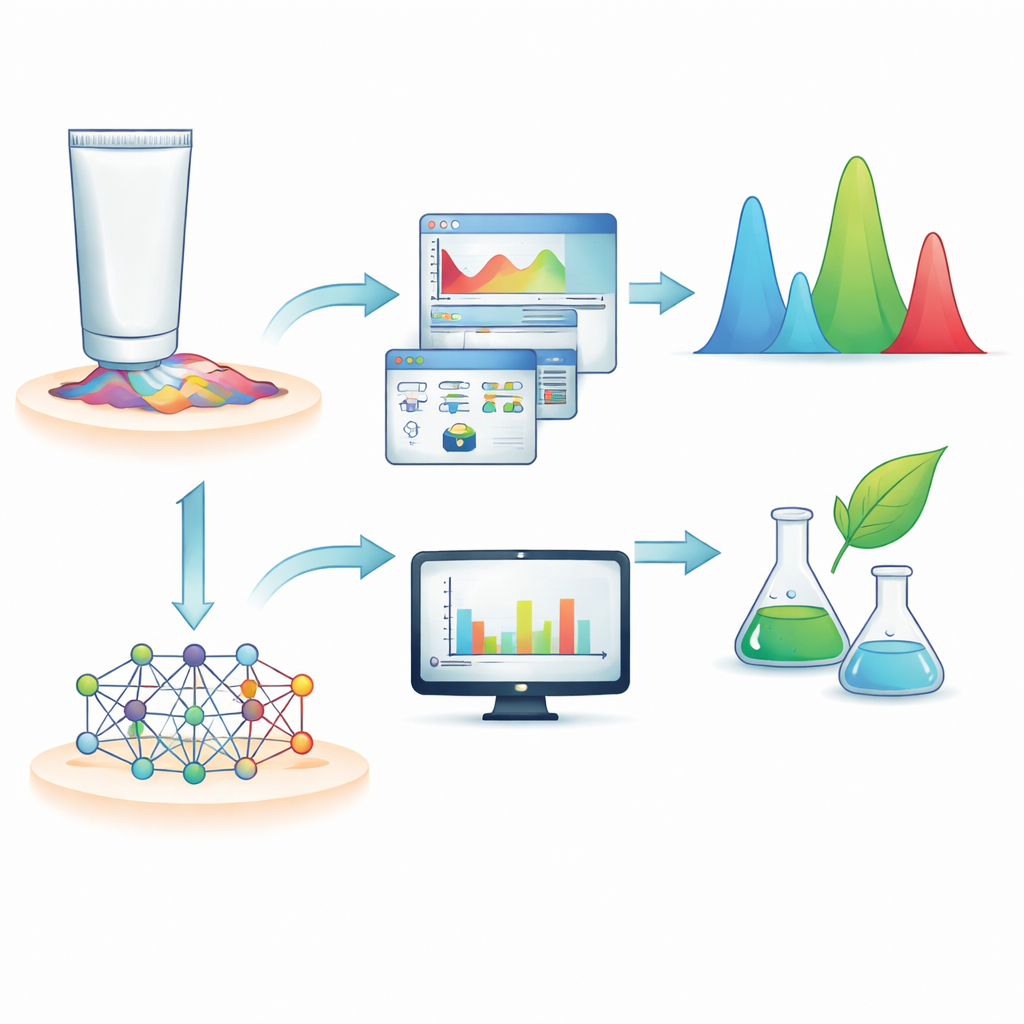
The researchers focused on a common prescription cream that combines four active drugs—an antifungal, an anti-inflammatory steroid, and two antibiotics—plus a preservative. When this mixture is tested with a standard ultraviolet–visible (UV–Vis) spectrophotometer, the resulting curves overlap so strongly that it is difficult to measure each ingredient separately. Earlier work from the same group had already worked out how to deal with two of the components. Here, they tackled the toughest remaining trio, which formed a heavily crowded, three-drug signal that stands in for many complex pharmaceutical mixtures.
Old tools versus smart helpers
Traditionally, chemists rely on proprietary instrument software to chip away at these overlaps through a sequence of manual steps—choosing wavelengths, transforming spectra, and building calibration graphs one operation at a time. This is slow, can vary from one operator to another, and usually requires licensed programs. In this study, the team compared that classic path with an AI-assisted route that uses freely accessible tools such as ChatGPT and Microsoft Copilot. The raw spectral data are exported as simple spreadsheet files, and the chemist guides the AI with structured prompts to perform the same mathematical tricks: dividing spectra, taking derivatives, finding clean regions with minimal interference, and generating regression equations that relate signal size to concentration.
New ways to see through the noise
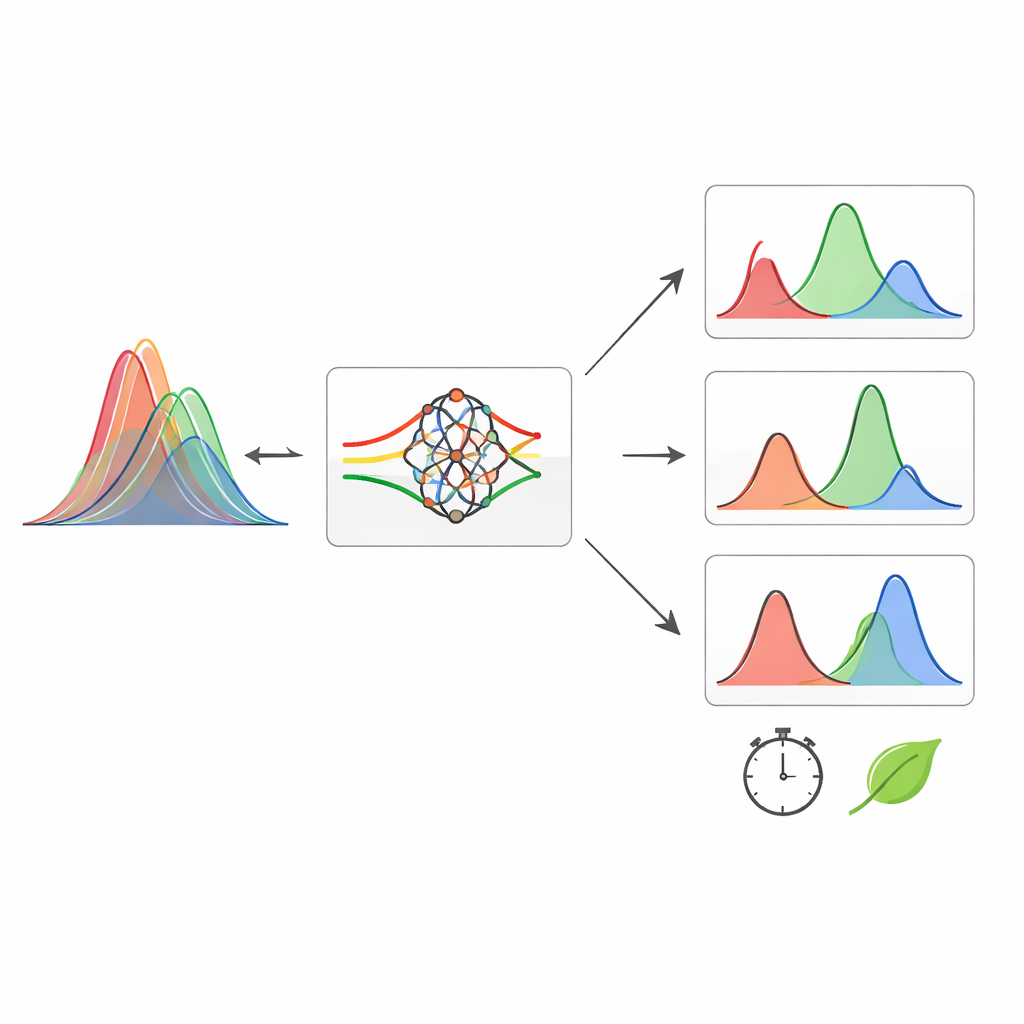
To sharpen the view of the three overlapping drugs, the authors refined a mathematical technique in two flavors: a carefully tuned manual version and an AI-driven version. Both rely on clever combinations of spectra that effectively cancel out the unwanted parts, leaving behind a clearer signal for each ingredient. The fully manual method introduces a “factorized” spectrum that boosts sensitivity at the best peaks. The automated method asks the AI to carry out the same steps and even to suggest which wavelengths give the most reliable straight-line relationship between signal and amount. After some back-and-forth, including teaching the AI by showing it screenshots of the traditional workflow, the automated approach produced virtually the same numerical results as the trusted software—matching accuracy, precision, and detection limits while greatly reducing hands-on effort.
Checking reliability and environmental impact
To ensure these shortcuts did not compromise quality, the researchers rigorously validated both manual and AI-assisted methods according to international guidelines. They confirmed that the readings were linear over the needed concentration ranges, that repeated measurements were consistent, and that the new procedures agreed statistically with official pharmacopoeial methods and earlier published techniques. Beyond performance, they also examined sustainability using a modern “white analytical chemistry” scoring system that blends environmental impact, practicality, and innovation into a single “Whiteness Score.” With help from Copilot to speed up the 51-item checklist, they obtained a score of about 61%, highlighting good practicality but also pointing to sample preparation as the main environmental burden and a key target for future improvement.
What this means going forward
In plain terms, this work shows that free AI assistants can help ordinary UV–Vis instruments tackle complex drug mixtures with the kind of finesse usually associated with more expensive techniques. Under the watchful eye of an experienced chemist, AI can quickly sort through dense spectral data, pick out cleaner signals, and generate reliable numbers, all while documenting and scoring the method’s environmental footprint. For patients, this supports accurate quality control of multi-ingredient creams. For laboratories, especially in resource-limited settings, it offers a path to faster, greener, and more accessible testing without sacrificing scientific rigor.
Citation: Fahmy, N.M., Obaydo, R.H. & Lotfy, H.M. Artificial intelligence versus traditional approaches in multicomponent spectral analysis. Sci Rep 16, 7835 (2026). https://doi.org/10.1038/s41598-026-39433-3
Keywords: spectrophotometry, pharmaceutical analysis, artificial intelligence, multicomponent mixtures, green analytical chemistry