Clear Sky Science · en
Porous structure analysis of coconut shell–derived activated carbons prepared under different conditions
Turning Coconut Shells into Climate Helpers
As the world searches for ways to slow climate change, one promising tactic is to pull carbon dioxide (CO₂) directly out of the air or from industrial exhaust. This study shows how something as ordinary as discarded coconut shells can be transformed into highly efficient “sponges” for CO₂, and how fine-tuning their production makes a big difference in how well they work.
Why Pores Matter for Trapping Gas
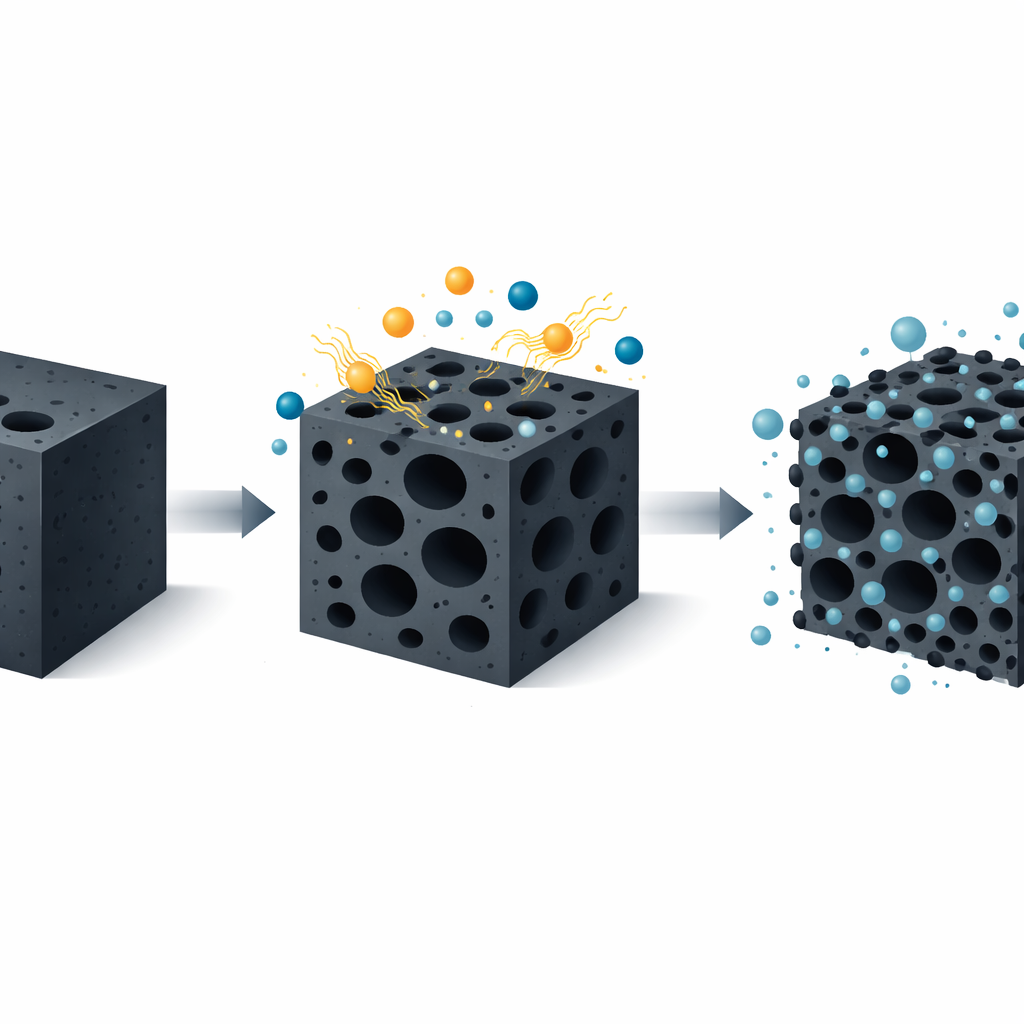
CO₂-capturing solids work a bit like ultrafine sponges: the more tiny holes, or pores, they contain, the more gas they can hold. Activated carbon is already widely used because it has an enormous internal surface area hidden inside these pores. The authors focused on improving such carbons for CO₂ capture by adding nitrogen atoms to their surface. Nitrogen groups tend to attract acidic gases like CO₂, so combining the right chemistry with an optimised pore network can greatly boost performance.
From Coconut Shell to High-Tech Material
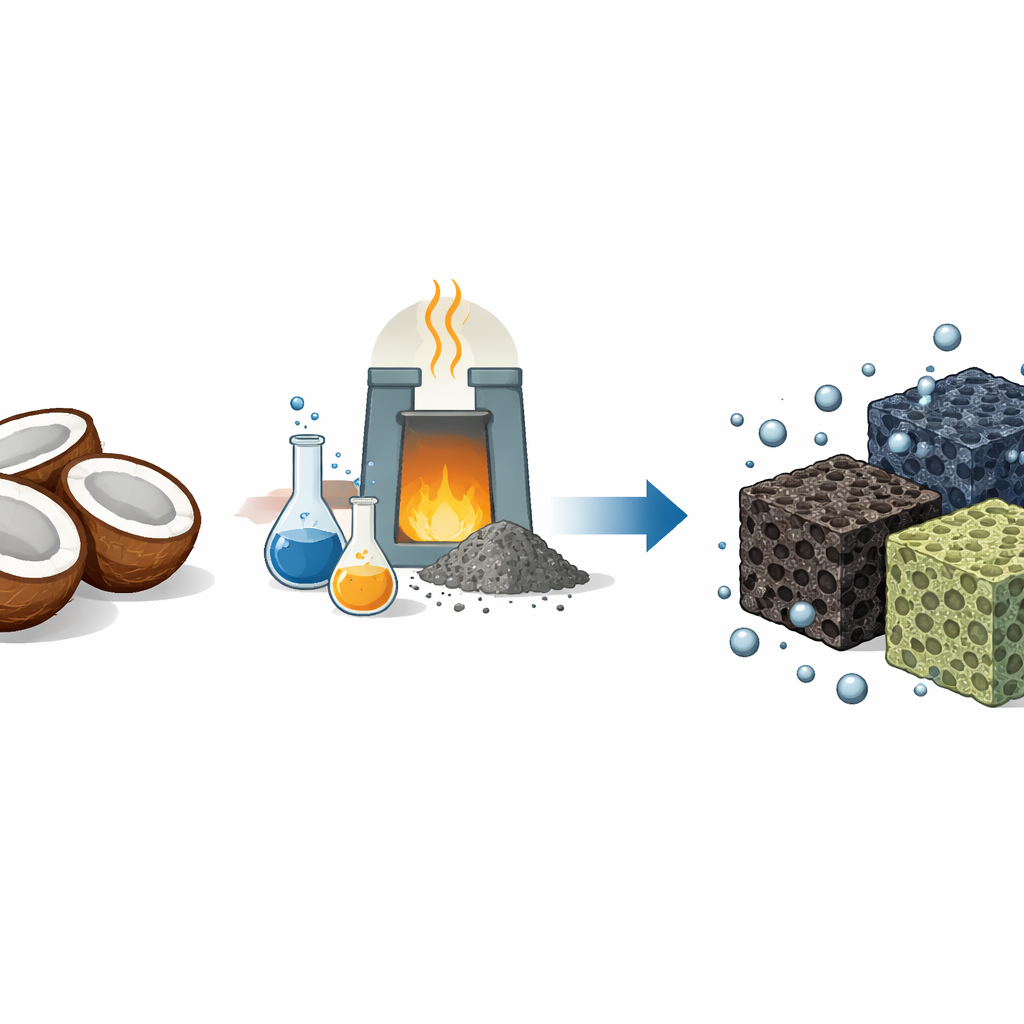
The starting point in this work is coconut shell, a cheap and abundant agricultural waste. The shells were cleaned, ground, and first heated in nitrogen to form a basic carbon material. Next came an "ammoxidation" step, where the carbon was treated with a mixture of ammonia and air so that nitrogen-bearing groups formed on its surface. Finally, the material was activated with potassium hydroxide (KOH) at high temperature, which etches out a labyrinth of pores. By changing the activation temperature (600, 650, or 700 °C) and the mass ratio between the carbon and KOH, the researchers created a family of carbons with subtly different pore structures and surface properties.
Looking Inside the Invisible Pore Network
Because these pores are far too small to see directly, the team used gas adsorption measurements: they recorded how much nitrogen gas the carbons could hold at very low temperatures and different pressures. From these curves, they applied three advanced analysis tools that go beyond older, oversimplified methods. One, called LBET, interprets how layers and clusters of gas molecules build up inside pores and provides an index of how uniform, or heterogeneous, the surface is. The other two, QSDFT and NLDFT, use modern statistical physics to reconstruct how many pores of each size are present. QSDFT is designed to cope better with the rough, chemically varied surfaces typical of real carbons, avoiding artefacts that can mislead designers.
Finding the Sweet Spot in Preparation Conditions
By comparing all samples, the study showed that both the activation temperature and the amount of KOH strongly shaped the final pore network. Carbons made at lower temperature or with too little activator had fewer and less accessible micropores, limiting how much gas they could take up. As the treatment temperature and KOH ratio were increased, the internal surface area and micropore volume rose sharply. The standout performers were materials activated at 700 °C with intermediate KOH ratios (labelled NC-700-3 and NC-700-4). These had extremely high internal surface areas, large volumes of the smallest pores that are most effective for CO₂ capture, and—crucially—very uniform surfaces, meaning gas molecules encounter similar conditions wherever they land.
What This Means for Future CO₂ Capture
For non-specialists, the key message is that not all “activated carbons” are equal. By carefully tuning how coconut shells are treated—especially the activation temperature and chemical ratio—and by using more realistic analytical tools, the authors identified conditions that create a finely tuned pore network ideal for trapping CO₂. Their best materials combine dense populations of tiny pores with evenly behaved surfaces, making them strong candidates for affordable, bio-based filters in future carbon capture systems.
Citation: Kwiatkowski, M., Hu, X. Porous structure analysis of coconut shell–derived activated carbons prepared under different conditions. Sci Rep 16, 10220 (2026). https://doi.org/10.1038/s41598-026-39432-4
Keywords: CO2 capture, activated carbon, coconut shell, porous materials, nitrogen doping