Clear Sky Science · en
Investigation of direct welding of organza textile and PET mesh for designing free-form lighting
Bringing Light and Fabric Together
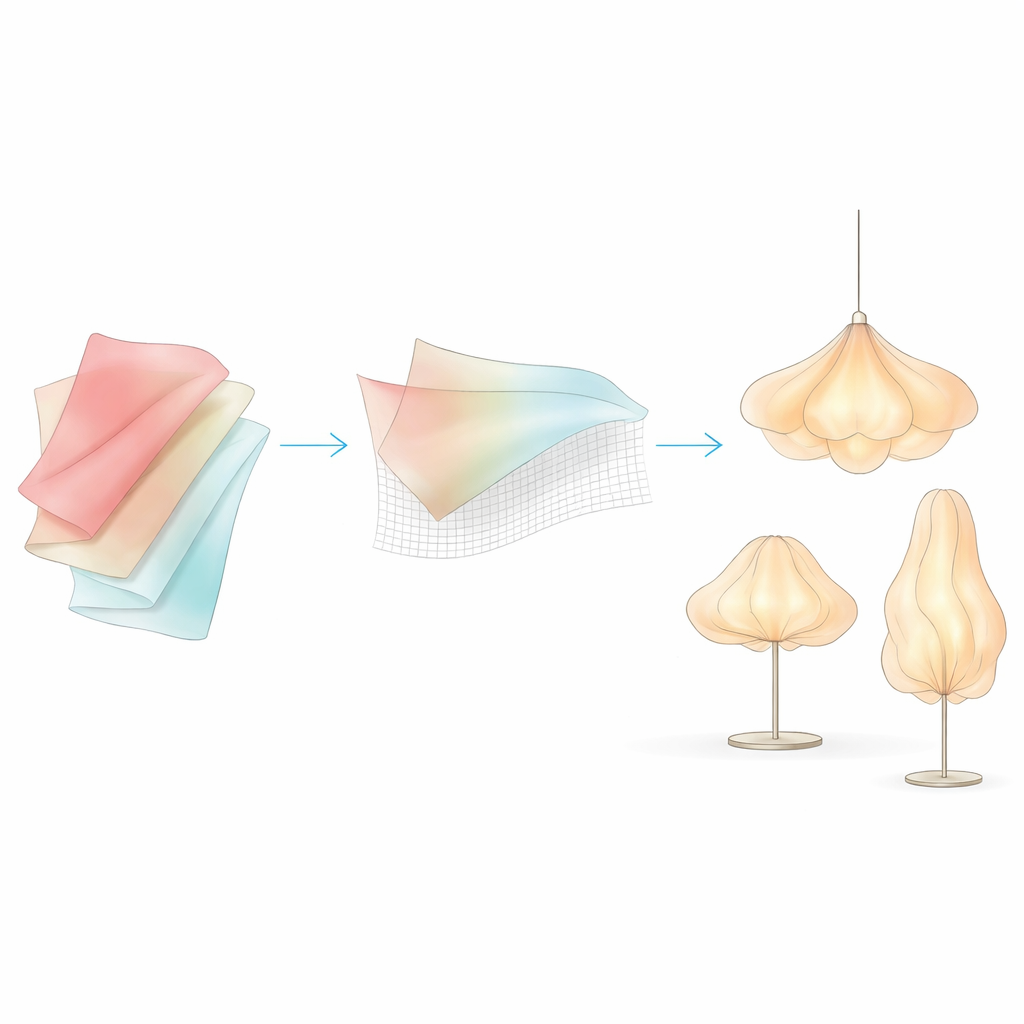
Most of us don’t think twice about the fixtures that brighten our homes and offices, but their shape, color, and softness quietly shape how we feel in a space. This study explores a new way to turn a delicate, gauzy fabric called organza into sturdy yet airy lighting pieces by pairing it with a nearly invisible plastic mesh. The work shows how to weld these two materials together so they can hold complex 3D forms, gently filter light, and offer a rich palette of colors for designers and architects.
Why Soft Light Matters Indoors
People now spend close to 90% of their time inside, where lighting can boost mood and alertness or cause strain and fatigue. Bright, cool light tends to wake us up, while dimmer, warmer light can be calming. Traditional clear materials for lamps and shades—such as glass and common plastics—let light through very well but are often brittle, limited in color, or raise cost and environmental concerns. Organza textiles, especially those made from the plastic PET, are different: they are sheer, flexible, and easy to dye into many hues, so they can soften light and color it at the same time. The catch is that organza on its own is too floppy and fragile to hold a defined shape as a lamp or shade.
Making a Delicate Fabric Stand Up
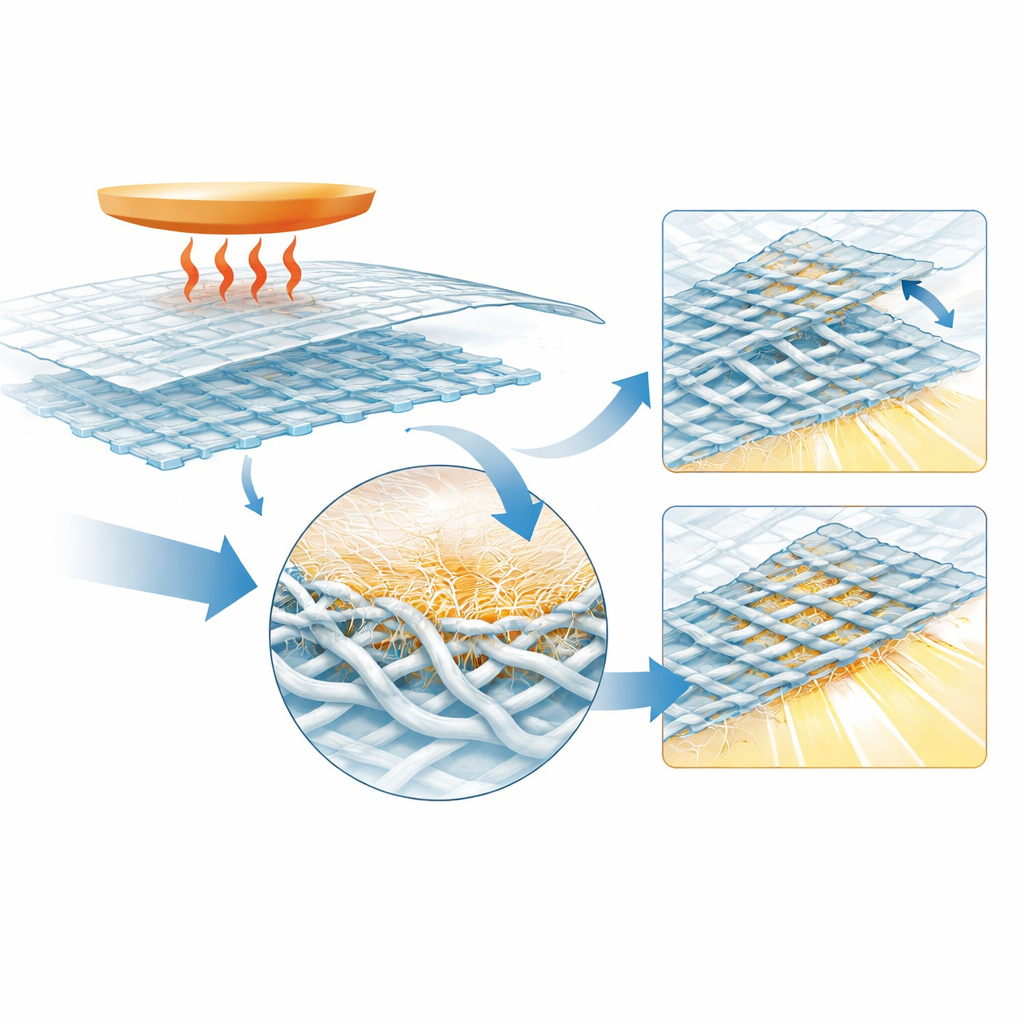
To solve this, the researchers backed PET organza with a PET mesh—a thin plastic grid—to provide hidden backbone without losing transparency. Instead of sewing or gluing, they joined the two using a controlled thermal welding process similar to drawing lines with a hot tool. Different mesh types and welding temperatures were tested, and the team pulled the welded strips apart in a mechanical tester to measure how strong the joints were. Microscopic images revealed that, at higher temperatures, the plastic threads from the organza and the mesh begin to flow into each other and become tightly entangled, forming a tough, net-like zone where they meet. This interlocking region is what allows the soft fabric to be carried by the mesh without tearing away.
Tuning Brightness with Layers
Beyond strength, a lighting material must control how much light passes through. The team measured light transmission through combinations of five organza colors welded to three mesh designs while stacking one, two, or three fabric layers. As expected, darker colors such as indigo and purple let less light through than lighter reds and grays because they absorb more visible light. Just as important, adding more fabric layers steadily reduced transmission, both because more dye absorbs light and because the extra layers scatter and redirect the light at each tiny opening in the weave. This means a designer can dial brightness and softness simply by choosing fabric color and how many layers to weld onto the mesh.
Blending New Colors from Simple Pieces
The study also treated the fabric-and-mesh sheets as a kind of physical color mixer. By welding pairs of organza pieces in different hues onto the same mesh, the team created a grid of 88 combined colors. They photographed these under standard white LEDs and converted each square into a digital color code, showing how layered textiles can yield subtle, blended tones that differ from either original fabric. This library of combinations can guide lighting designers who want precise moods, from soft pastels to deep, saturated shades, without needing custom dyes for every new project.
Soft Structures with Hardworking Joints
Altogether, the work demonstrates a practical recipe for turning a fragile, decorative fabric into a robust structural skin for free-form lamps, window shades, and ornaments. With optimized welding temperatures, the organza and mesh form strong, durable joints while keeping their airy appearance. At the same time, the number and color of fabric layers give fine control over brightness and hue. For a lay reader, the takeaway is straightforward: by smartly fusing a sheer fabric to a hidden mesh, it becomes possible to sculpt light into gentle, colorful shapes that are both beautiful and mechanically reliable.
Citation: Bae, E., Jeon, H., Chung, H. et al. Investigation of direct welding of organza textile and PET mesh for designing free-form lighting. Sci Rep 16, 10123 (2026). https://doi.org/10.1038/s41598-026-39362-1
Keywords: lighting design, textile materials, indoor atmosphere, fabric lamps, color and light