Clear Sky Science · en
Safety boundary protection control for distributed propulsion vehicle operating in plateau environment
Flying safely where the air is thin
High mountain airports sit in some of the most beautiful yet unforgiving airspace on Earth. Thin air, strong swirling winds, and nearby terrain make takeoff and landing far more demanding than at sea level. This study explores a new type of aircraft and smart control system designed to keep flights safer in these harsh plateau conditions, using many small engines spread along the wings and a protective "safety bubble" that keeps the aircraft away from dangerous flight states. 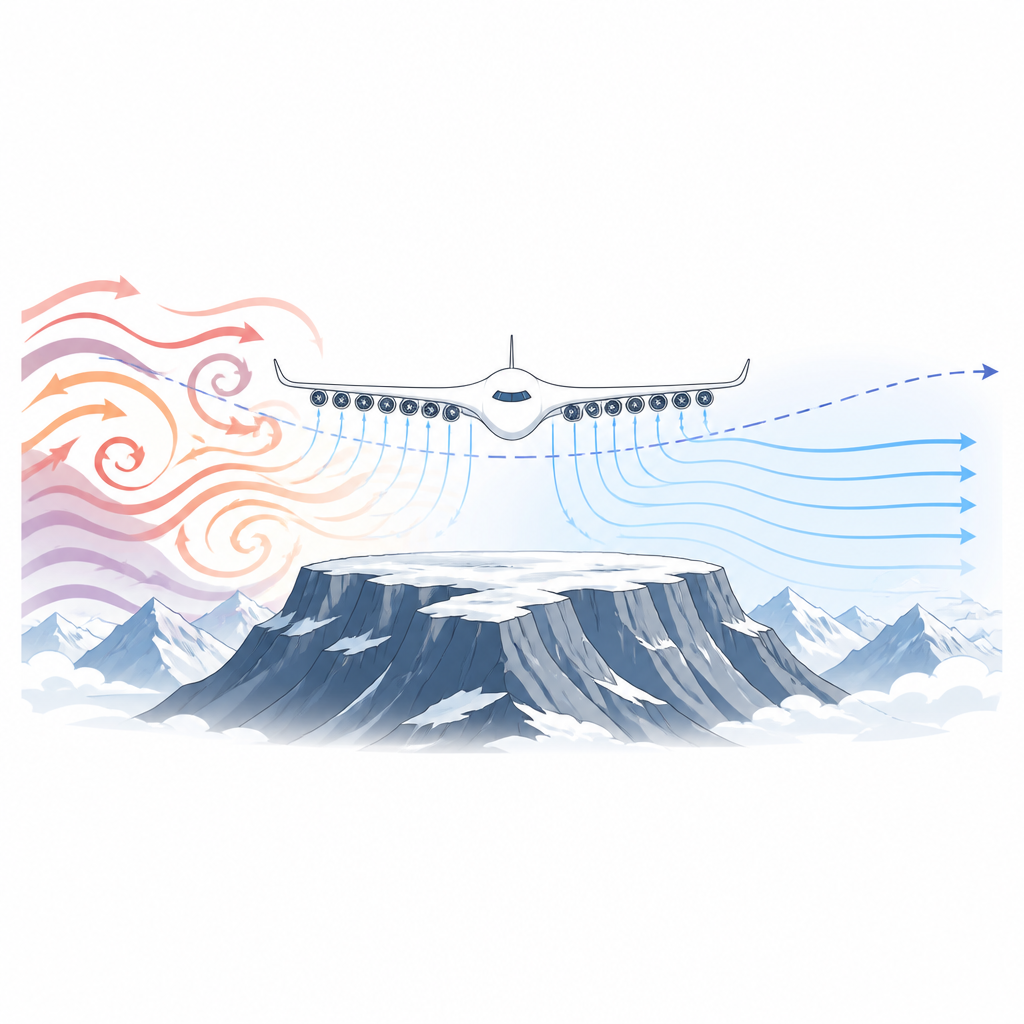
A new kind of airplane for the high country
The researchers focus on a distributed propulsion vehicle, an aircraft whose power comes from many small ducted fans mounted along the trailing edge of a blended wing. Instead of a few large engines, these compact fans pull in and energize the thin layer of air hugging the wing, which boosts lift and cuts drag. This layout is especially attractive for high-altitude airports, where the air has only about 60 percent of sea-level density and ordinary aircraft lose a large portion of their lift and control power. The chosen configuration aims to provide strong lift at low speeds, better control in crosswinds, and quieter operation thanks to the high-frequency noise of the ducted fans.
Testing how the airplane really behaves
Before any mountain flights, the team needed to understand how this unusual aircraft responds to wind and control inputs. They carried out full-scale wind tunnel tests, measuring forces and moments as they changed fan power, wing flaps, ailerons, and a V-shaped tail. The data show that powering the fans can greatly raise the lift and delay stall, widening the range of safe flight angles. They also found that deflecting ailerons, the V-tail, and especially changing fan power from side to side has a strong effect on rolling and yawing motion. These findings confirm that differential thrust from the fans can act almost like an extra set of control surfaces, particularly useful for fighting crosswinds.
Designing a pilot helper that knows the limits
With these measurements, the researchers built a detailed computer model of the aircraft’s motion and designed a set of control laws to manage speed, pitch, roll, and heading. They chose familiar PID and PD controllers for reliability and ease of tuning, then tested them in simulations to check how quickly and smoothly the aircraft responds to changes in commands. Next, they tackled a harder problem: defining a moving safety boundary that tells how close the aircraft is to stall or loss of control under different speeds, angles, bank angles, and wind conditions. By simulating more than five thousand initial states, including various crosswind strengths, they mapped out which combinations lead to stable flight and which drift toward trouble, revealing how strong winds and steep bank angles shrink the safe operating zone. 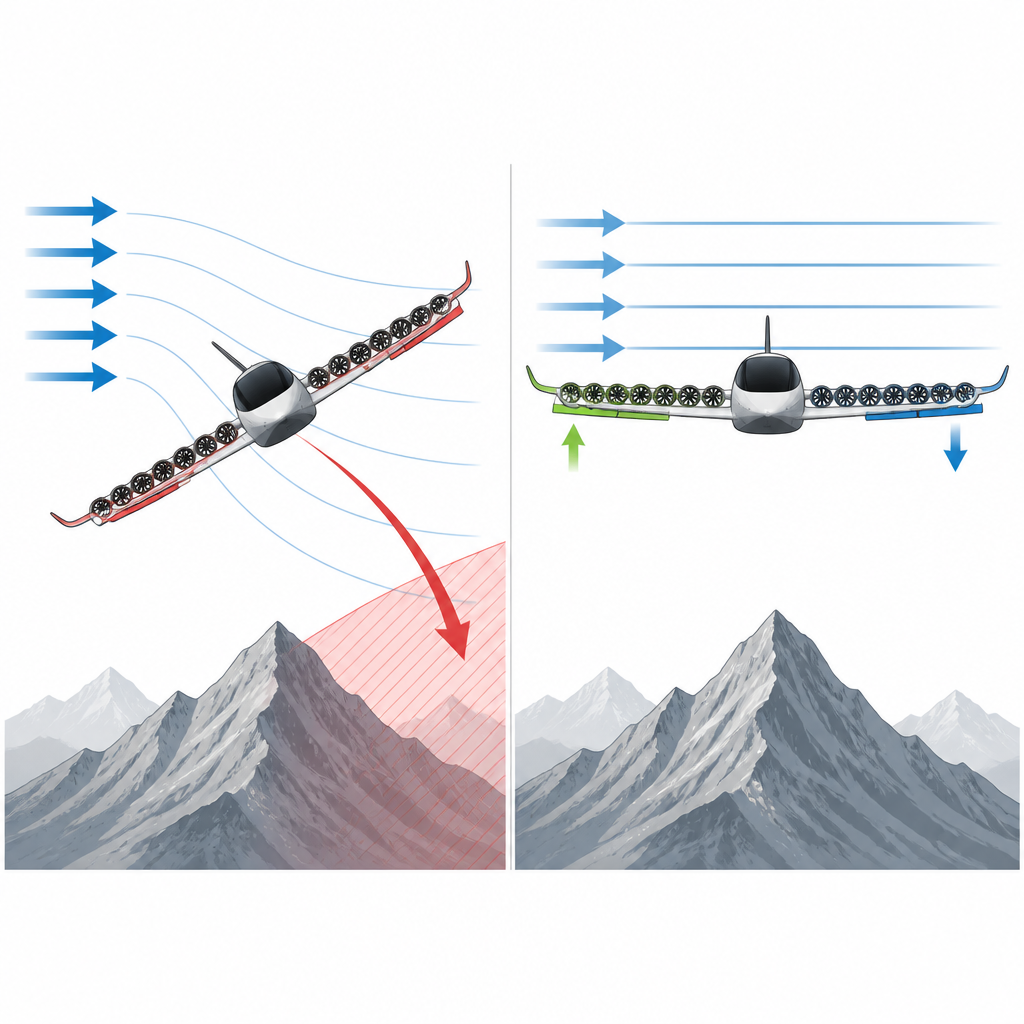
Teaching a network to guard the safety bubble
To guard against sudden gusts and the complex coupling between rolling and climbing motion, the team trained a deep neural network to act as a safety monitor. The network watches key signals in real time: wind speed, flight speed, angle of attack, bank angle, and roll rate. From the large simulation dataset, it learns to recognize when the aircraft is approaching the edge of the safe boundary. When the risk becomes high, the network commands a power difference between the left and right fan groups, adding a corrective yaw and roll moment that helps keep the aircraft away from stall. This protective layer works on top of the basic controller, intervening only when needed while respecting practical limits on fan power and control surface deflections.
Putting the system to the test in real mountains
The final proof came from flight tests at Gesar Airport, a plateau airport at about 4,100 meters elevation known for strong channel winds and turbulence. The aircraft completed taxi, takeoff, climb, turns, descent, and landing while staying within the precomputed dynamic boundary. Flight data show that it endured wind speeds up to about 19 meters per second, with the roll protection and differential power system keeping bank angles within safe bounds and preventing the angle of attack from entering the stall zone. Despite noticeable oscillations as the airplane responded to gusts, no loss of control occurred, indicating that the combined control and protection strategy can manage the demanding plateau environment.
What this means for future high-altitude flights
In simple terms, this work shows that pairing a many-engined wing with a smart, learned guardrail around its safe operating region can help aircraft cope with thin air and unruly winds at high mountain airports. The distributed fans provide extra lift and steering muscle, while the neural network continually estimates how close the aircraft is to danger and quietly nudges it back toward safety when needed. Although the authors note that more testing is required in even harsher conditions and with added uncertainties, their results suggest a practical path toward safer operations for advanced aircraft in challenging plateau and possibly urban environments.
Citation: Dong, Z., Da, X., Zhang, B. et al. Safety boundary protection control for distributed propulsion vehicle operating in plateau environment. Sci Rep 16, 15105 (2026). https://doi.org/10.1038/s41598-026-39328-3
Keywords: distributed propulsion, plateau flight, flight safety, neural network control, crosswind