Clear Sky Science · en
Integrated physiological, biochemical and hormonal traits determine drought tolerance and yield stability in cashew (Anacardium occidentale L.)
Why cashew trees matter in a hotter, drier world
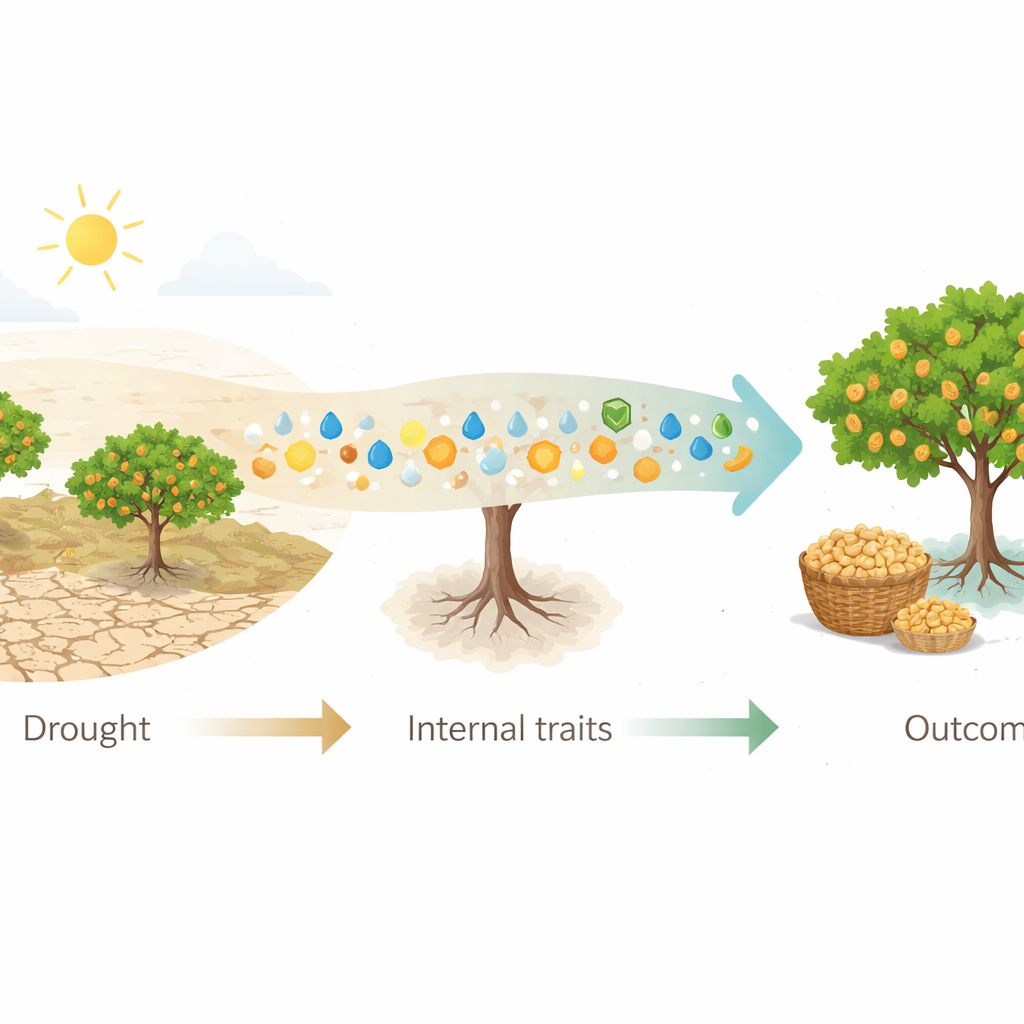
Cashew nuts are a staple for farmers and snack lovers alike, but the trees that produce them are increasingly under threat from worsening droughts. In many cashew-growing regions, especially in India, flowering and nut development happen right in the middle of the dry season. This study asks a simple but vital question: why do some cashew varieties keep yielding well when water is scarce, while others fail? By peering inside the leaves and flowers of different cashew types, the researchers uncover how water use, natural protective chemicals, and internal plant signals together decide whether a tree can still fill baskets with nuts under drought.
Testing many cashew types side by side
The team evaluated seventeen popular cashew varieties grown under realistic field conditions at a research farm in coastal Karnataka, India. Half the trees received full irrigation during flowering and nut filling, while the others went four months with no added water, mimicking severe seasonal drought. For each variety, the scientists tracked not only nut yield and flower numbers, but also leaf water content, green pigment levels, membrane damage, nutrient status, and a wide range of small molecules and hormones inside the leaves. They then used a combined ranking tool, which integrates dozens of traits at once, to see which varieties behaved most like an ideal drought-tolerant cashew.
What separates survivors from strugglers
Drought hit productivity hard overall, cutting nut yield by about two-thirds and shrinking leaf area, flower numbers, fruit set, and nut size. Yet varieties differed sharply. Trees of ‘Priyanka’ and ‘Bhaskara’ kept their leaves better hydrated, lost less green pigment, and suffered less cell damage than sensitive types like ‘Ullal-2’, ‘Vengurla-2’, and ‘Madakkathara-1’. The tolerant trees also held on to more female flowers and set more fruits, which translated into far higher nut yields under stress. In contrast, sensitive trees showed leaky cell membranes, poor leaf growth, and steep drops in nuts per canopy area.
Hidden helpers inside the leaf
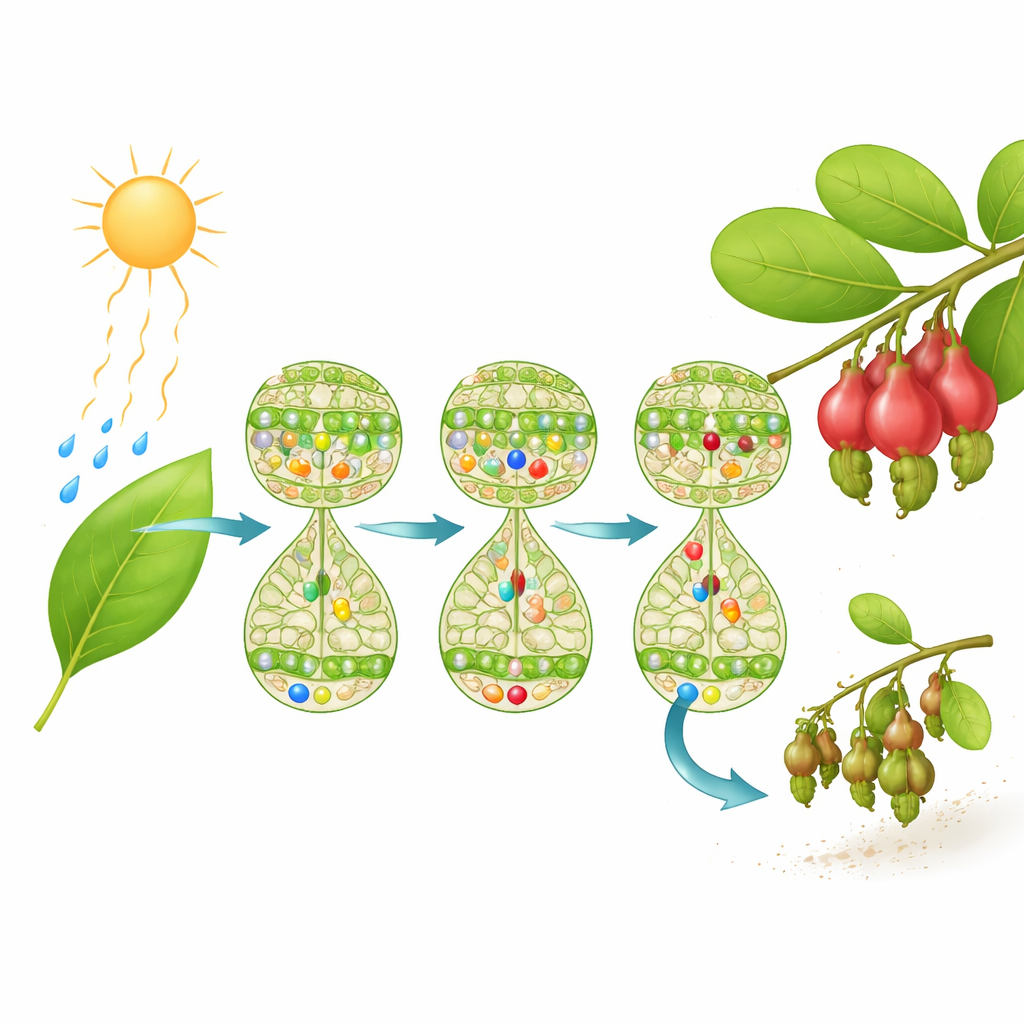
Inside the leaves, drought-tolerant cashews turned on a powerful internal protection system. They accumulated more "osmotic helpers" such as proline and soluble sugars, which act like natural antifreeze to keep cells turgid when water is scarce. At the same time, they boosted antioxidant enzymes that mop up harmful reactive oxygen molecules, and they built up stores of phenolic acids and flavonoids—plant-made compounds that act as chemical shields. Varieties like Priyanka and Bhaskara showed especially strong increases in these protective molecules and had much lower levels of markers of cell damage. Leaf nutrient levels, including nitrogen, potassium, calcium, magnesium, and boron, also stayed higher in these varieties, helping support photosynthesis and cell stability when water was limited.
Plant hormones as drought traffic controllers
The study also revealed that drought-tolerant cashews manage their internal "chemical messages" differently. Hormones such as abscisic acid, jasmonic acid, salicylic acid, and auxin rose strongly in tolerant varieties under drought, while changing little in sensitive ones. These hormones influence how widely leaf pores open, how sugars are steered toward developing nuts, and how strongly stress defenses are switched on. Tolerant varieties also increased small nitrogen-rich compounds called polyamines, which work together with hormones to stabilize cells. When the researchers correlated all traits, nut yield under drought aligned most closely with this cocktail of osmotic helpers, antioxidants, hormones, and polyamines rather than with any single factor.
From complex measurements to practical choices
Because farmers and breeders cannot measure dozens of traits in every field, the researchers used a multi-trait index to summarize the information. This approach grouped the seventeen varieties into clearly drought-sensitive, moderately tolerant, and highly tolerant clusters. Priyanka and Bhaskara, along with one more variety, consistently ranked closest to the "ideal" drought-tolerant cashew type. Sensitive varieties, in contrast, combined poor water status, weak chemical defenses, low hormone responses, and large yield losses.
What this means for cashew growers
In plain terms, this work shows that the best drought-tolerant cashew trees are those that can stay hydrated, keep their leaves green, quickly switch on natural protective chemistry, and fine-tune their internal signals so that flowers and young nuts are not sacrificed when water runs short. The identification of robust varieties such as Priyanka and Bhaskara, and of simple indicator traits like leaf water content, antioxidant activity, and certain hormone patterns, provides concrete tools for breeding and selecting cashews that can withstand drier futures while still filling sacks with nuts.
Citation: Mog, B., Harsha, S.G., Sharma, L. et al. Integrated physiological, biochemical and hormonal traits determine drought tolerance and yield stability in cashew (Anacardium occidentale L.). Sci Rep 16, 10179 (2026). https://doi.org/10.1038/s41598-026-39321-w
Keywords: cashew drought tolerance, climate-resilient crops, plant stress physiology, antioxidant defenses, crop breeding