Clear Sky Science · en
Guidelines for use of the random positioning machine as a reduced-gravity analog
Why gravity on Earth is not always enough
As humans set their sights on the Moon, Mars, and long journeys in deep space, scientists urgently need ways to study how life and materials behave when gravity is weaker than on Earth. Real space missions are rare, expensive, and limited in space and power. This paper explains how a desktop device called a random positioning machine, or RPM, can safely mimic low-gravity and partial-gravity conditions in an ordinary lab—and, just as importantly, what its limits are and how to use it correctly.
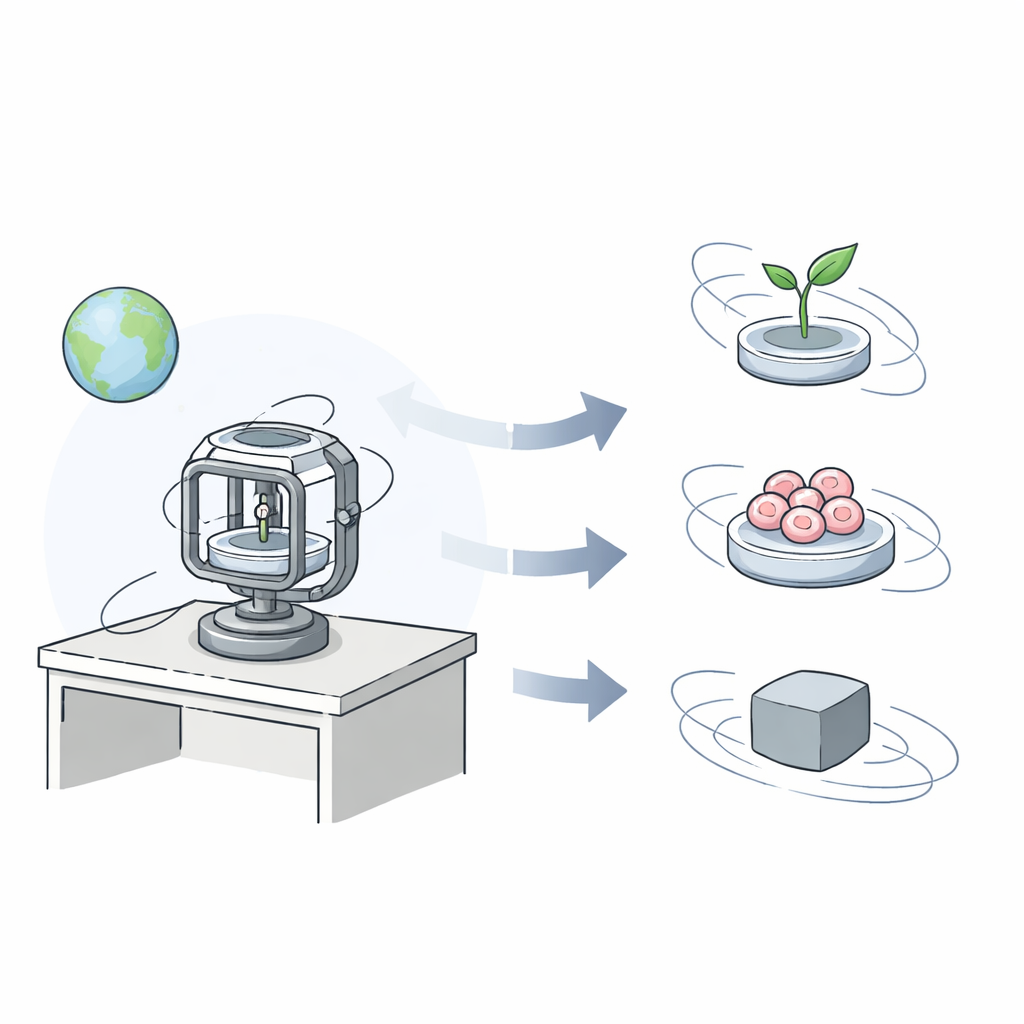
A spinning stand-in for space
The RPM tackles a simple idea: if you constantly change the direction of gravity relative to a sample, then over time the sample “feels” much less gravity on average. The device holds a sample at the center of two motorized frames that rotate around different axes in a seemingly random pattern. This study builds a detailed motion model of how the sample moves and combines that with real measurements from sensors and motion-capture cameras. By comparing theory with experiment, the authors show that under the right conditions the RPM really can stand in for microgravity on the ground.
Finding the sweet spot for spin and size
The team then probes what settings matter most. They map how the average pull of gravity on a sample changes as the inner and outer frames spin faster or slower. One surprise is that simply spinning faster does not always improve the illusion of weightlessness. High speeds add extra forces that raise the effective gravity. The best results come when the outer frame turns at least about 30 degrees per second and the inner frame turns at least 20 degrees per second slower. They also show that experiments need to run for at least 25 minutes before gravity is smoothed out enough to stay below one hundredth of Earth’s gravity, making the RPM better suited to slow processes like cell growth than to split-second events like combustion.
How big an experiment can you fit?
Another practical question is how large a sample or apparatus can be before the edges no longer experience good low-gravity conditions. Away from the exact center, spinning introduces extra accelerations that grow with both distance and rotation speed. Using their model, the authors calculate safe distances from the center for different settings. At gentle speeds, samples can extend 10–15 centimeters from the center and still approximate microgravity. But at higher speeds above about 50 degrees per second, samples should stay within roughly 10 centimeters to avoid drifting into higher, less realistic gravity levels. These guidelines help experimenters design chambers, culture flasks, and hardware that truly experience the intended environment.
From weightlessness to Moon and Mars gravity
Instead of treating these extra forces as a nuisance, the authors also show how to harness them. By carefully choosing rotation speeds and how far from the center samples are placed, a single RPM can host regions that experience microgravity, Moon-like gravity, Mars-like gravity, and even stronger-than-Earth gravity at the same time. This opens the door to “gravity dose–response” studies in which, for example, cells, tissues, or materials are tested side by side across a whole range of gravity levels without ever leaving the lab.
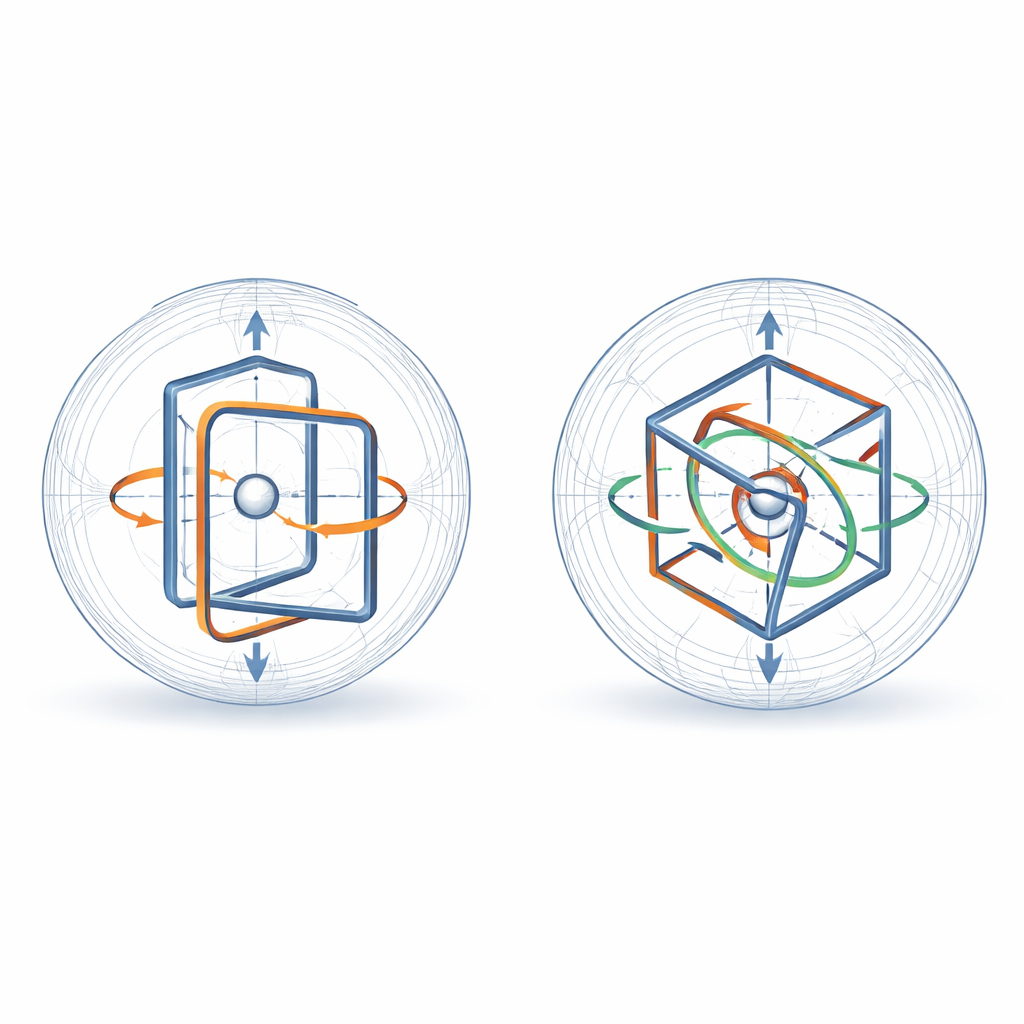
Fixing a hidden flaw in the spin
The study uncovers a subtle problem in standard two-frame RPMs called “pole bias.” Because of how the outer frame rotates, the direction of gravity lines up with the sample in the same vertical orientation twice each turn, more often than in other directions. Over long runs, the sample therefore spends too much time near two opposite “poles” of orientation, weakening the illusion that gravity comes equally from all directions. The authors propose a new design with three rotating frames. Their simulations show that this setup not only keeps the average gravity very low but also spreads gravity directions evenly over all angles, reducing pole bias without needing complex control software.
What this means for future space research
In plain terms, this paper turns the RPM from a clever gadget into a well-calibrated scientific tool. By spelling out how fast to spin it, how large samples can be, how long experiments should last, and how to avoid hidden orientation biases, the authors give space researchers a clear recipe for designing more reliable Earth-based studies. With these guidelines—and with improved three-frame designs—scientists can more confidently explore how living systems and materials respond not just to zero gravity, but to the whole spectrum from microgravity through Moon and Mars levels and beyond, helping to prepare for safer and more effective space exploration.
Citation: Wadhwa, A., Bruun, L., Petersen, J.C. et al. Guidelines for use of the random positioning machine as a reduced-gravity analog. Sci Rep 16, 10012 (2026). https://doi.org/10.1038/s41598-026-39316-7
Keywords: microgravity simulation, random positioning machine, partial gravity, space biology, ground-based space analogs