Clear Sky Science · en
Research on agricultural development issues based on comprehensive optimization strategy
Smarter Choices for Fields and Farms
For many farmers, each planting season is a high‑stakes gamble. Weather, soil, and shifting market prices can turn a carefully planned crop mix into either a windfall or a loss. This paper presents a new way to help farmers and local planners decide what to plant, where, and when by using advanced computer algorithms. The aim is to earn more income from the land while reducing the risk that bad weather or sudden price drops will devastate harvests.
Why Crop Planning Is So Hard
Agriculture in northern Anhui Province in China, like many rural regions worldwide, must balance limited farmland, changing climate, and unstable markets. Farmers grow a mix of grain crops, vegetables, and edible fungi on open fields and in different kinds of greenhouses. Simple planning tools that treat yields and prices as fixed numbers cannot capture the real‑world uncertainty of droughts, floods, or price swings at the local market. Earlier studies often optimized profits first and only checked risks later, which meant the chosen solution might look good on paper but prove fragile in practice.
A New Way to Frame the Problem
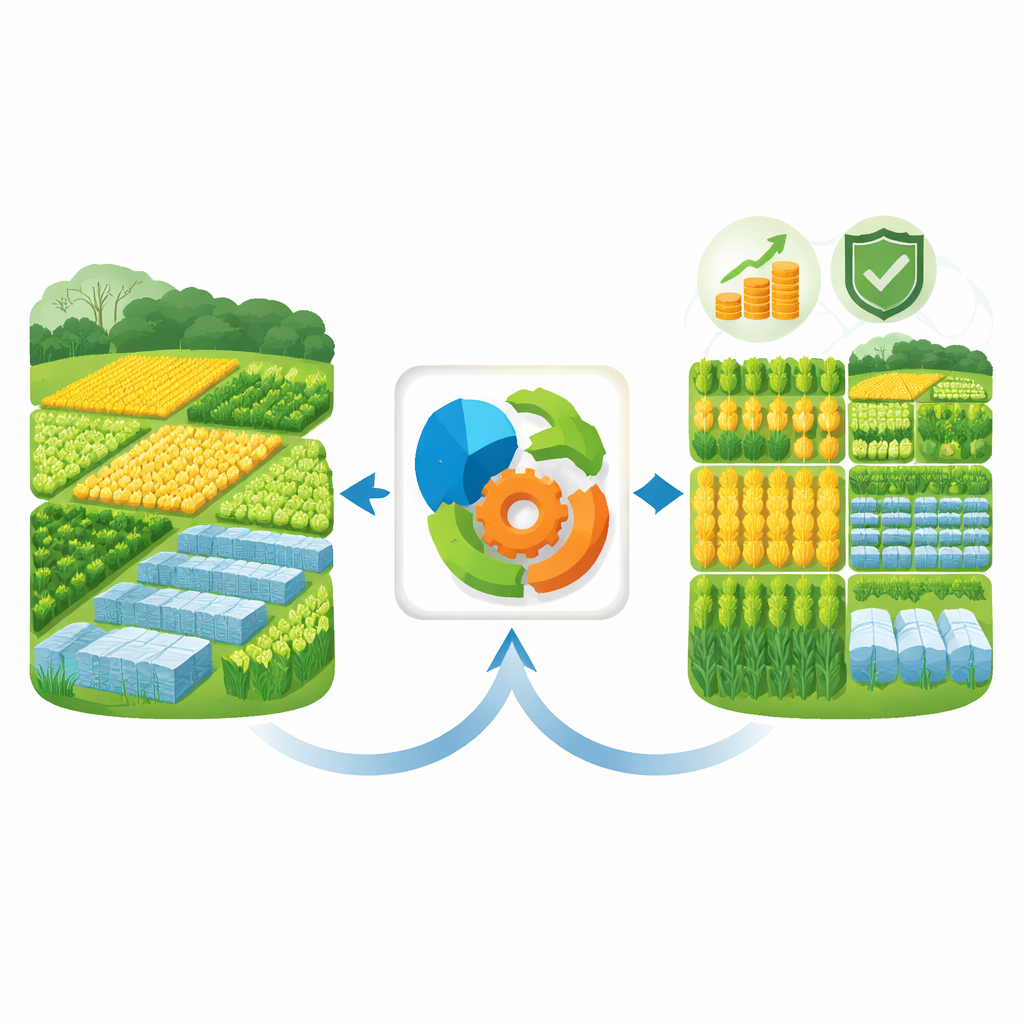
Instead of treating crop planning as a long chain of yearly decisions, the authors describe it as a single, carefully bounded decision for a given planning period. They model how much of each plot of land should be allocated to different crops while enforcing realistic rules: which crops can grow on which land, how greenhouses are used through the seasons, how often crops must be rotated, and how much the market can absorb. Within this framework, the goal is twofold: maximize farmers’ expected profits and, at the same time, keep production risk low by avoiding plans that are too sensitive to changes in yield or prices.
Three Algorithms Working as a Team
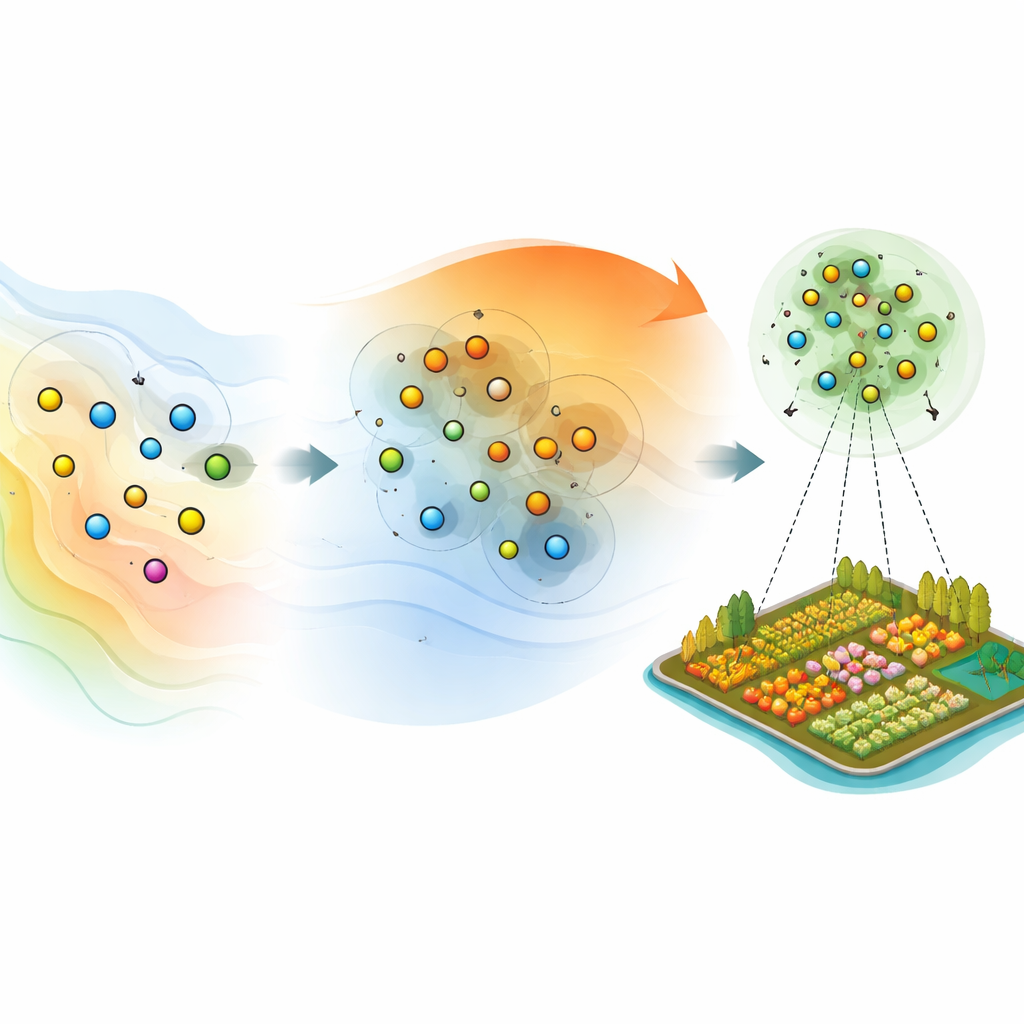
To solve this complex puzzle, the study combines three computational techniques, each with a different strength. The first, Particle Swarm Optimization, imagines many alternative planting plans as "particles" moving through a landscape of possibilities, gradually drifting toward better options. The second, Simulated Annealing, acts like a clever fine‑tuner that occasionally accepts slightly worse plans to escape local dead ends and explore a broader range of choices. The third, Monte Carlo Simulation, repeatedly “replays” the farming season under many random combinations of yields and prices, estimating the average profit and how much it might fluctuate.
What makes this approach distinctive is how tightly these pieces are woven together. Monte Carlo Simulation is not used after the fact but embedded inside each step of the search, so that every candidate cropping plan is judged by both its expected payoff and its stability under uncertainty. Simulated Annealing is applied again and again to the best plan found so far, helping the search avoid risky regions that only look good under ideal conditions. Parameters of the search are adjusted on the fly based on how volatile the simulated profits appear, steering the exploration toward robust solutions.
Putting the Method to the Test
The authors tested their framework using detailed agricultural statistics for twelve major crops in northern Anhui, including information on land types, yields, prices, and production costs. They compared four approaches: a standard particle swarm, standalone simulated annealing, a simple two‑method hybrid, and their fully integrated three‑method system. Across 30 repeated runs with different random seeds, the new hybrid delivered the highest average profit and the smallest variation in results. Expected profit rose by about 12.6 percent relative to the basic particle swarm, while the variability in yields fell by roughly 11 percent.
The optimized land‑use plans shifted more area toward high‑value crops in suitable greenhouses while still respecting rotation rules and market limits. Sensitivity checks showed that the method remained stable even when key assumptions—such as how much yields or demand can fluctuate—were changed by up to 30 percent. Most of the recommended crop–plot assignments stayed the same, suggesting that the planning advice is not overly fragile or tuned to a single narrow scenario.
What This Means for Farmers and Planners
In simple terms, the study shows that it is possible to use advanced, but transparent, computational tools to design planting plans that make more money while being less of a gamble. By weaving uncertainty directly into every step of the search, the framework identifies crop mixes and land allocations that perform well not just in an average year, but across many possible futures. Although the case study focuses on one region in China, the same structure can be adapted to other areas and crop systems wherever data on land, yields, and prices are available. The result is a practical decision‑support tool that can help rural communities plan for higher, more stable incomes in an increasingly unpredictable world.
Citation: Dayou, H., Jieyun, L., Ya, W. et al. Research on agricultural development issues based on comprehensive optimization strategy. Sci Rep 16, 12505 (2026). https://doi.org/10.1038/s41598-026-39307-8
Keywords: crop planning, agricultural optimization, farm risk management, sustainable agriculture, metaheuristic algorithms