Clear Sky Science · en
Towards a hierarchical approach and scalable semi-local centrality for key node identification in weighted complex networks
Why the shape of connections matters
From social media and airline routes to power grids and brain circuits, many systems in our lives can be seen as networks: collections of points linked by connections. In such webs, a few especially influential points can speed up the spread of news, disease, or failures. Finding these key points is vital for tasks like stopping epidemics, protecting infrastructure, or improving online services. This paper introduces a new way to pinpoint the most important spots in large, complicated networks where connections are not all equal in strength.
Looking for the real power players
Most existing tools for ranking important points in a network fall into three families. Some look only at direct neighbors, some use information from the entire network, and some aim for a middle ground by considering a few steps out. These methods have been useful, but they struggle when networks become huge, when connection strengths vary widely, or when different neighbors matter to different degrees. A link to a casual acquaintance, for example, is not the same as a link to a close collaborator. The authors argue that to truly find the power players, we must account for how strong each connection is and how influence can ripple several steps away, without paying the heavy cost of analyzing the whole network at once.
Building smart local views of a big network
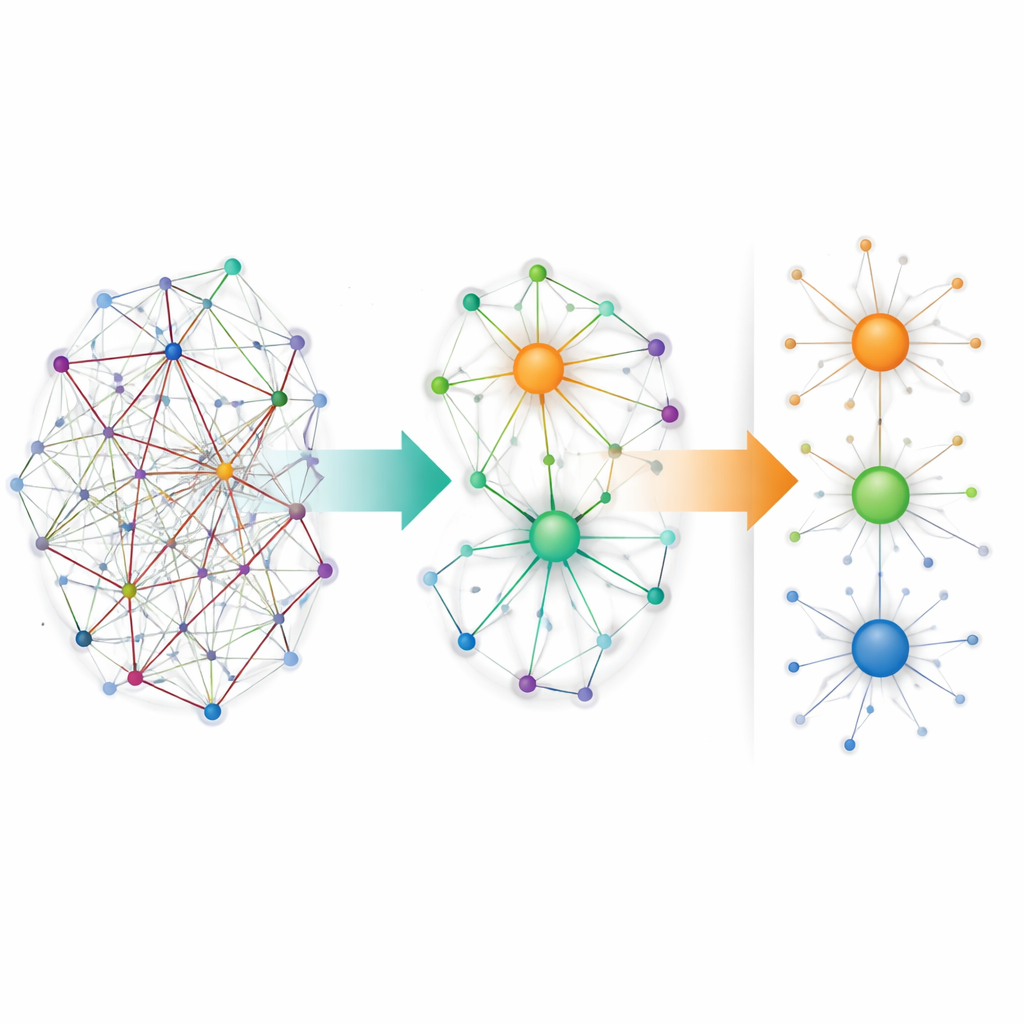
The study proposes a framework called Hierarchical and Scalable Semi-Local Centrality, or HSSLC. Instead of repeatedly scanning the entire network, HSSLC builds a small, tailored neighborhood around every point. These mini-networks include nodes within a few connection steps, but only along links strong enough to matter. This approach works for both networks that already have weights and those where weights must be inferred from how many connections each node has. By focusing on these weighted local subgraphs, the method keeps computations manageable even when the overall network contains hundreds of thousands of nodes.
Using uncertainty to weigh neighbor influence
HSSLC adds another twist by using ideas from information theory, which studies how to measure uncertainty. In this context, uncertainty reflects how diverse and uneven a node’s surroundings are. If a node is linked to many neighbors that themselves sit in different types of positions, it carries more varied influence. The authors extend an existing entropy-based model so that it looks not just at direct neighbors, but also at neighbors several steps away inside each local subgraph. The further a neighbor is, the less it counts, but strong paths can still boost a node’s score. This multi-level view helps separate genuinely influential nodes from those that merely sit in a busy but narrow part of the network.
Blending simple counts with richer patterns
To avoid relying on one signal alone, HSSLC blends this entropy-based view with an enhanced version of a simple count of connections. This enhanced count considers both a node’s own links and the links of the nodes in its extended neighborhood, scaled by how reliable the paths between them are. A tuning factor controls how much weight is given to the entropy part versus the connection-count part, and another factor controls how strongly neighbors’ degrees affect the final score. Through careful testing, the authors show that these settings can be chosen so that the method works robustly across networks of different sizes and densities.
Putting the method to the test
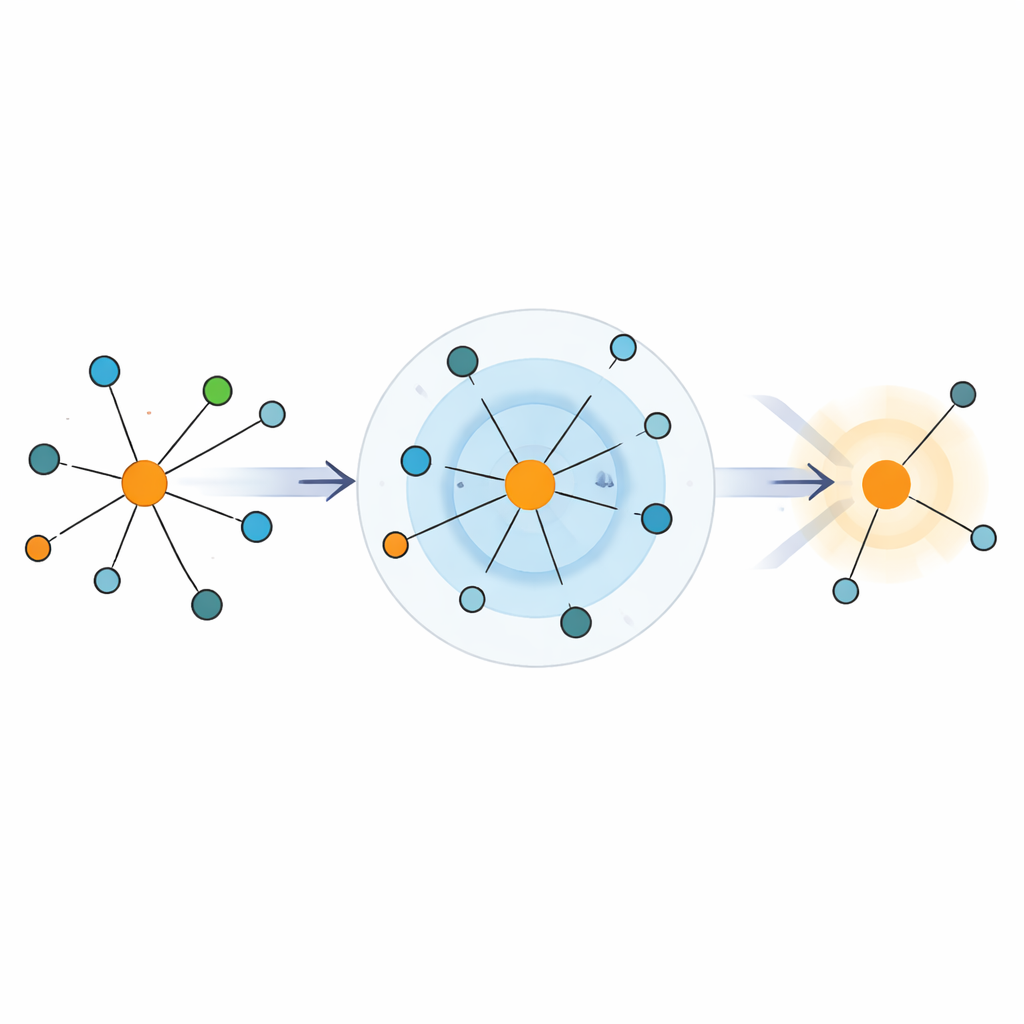
The researchers evaluated HSSLC on six real-world networks, including social, transportation, and online systems. To see whether their rankings match real influence, they simulated the spread of an infection using a standard three-state epidemic model, where nodes are healthy, infected, or recovered. If nodes ranked highly by a centrality measure tend to infect more of the network when chosen as starting points, that measure is doing its job. Compared with both classic tools and several recent advanced methods, HSSLC produced rankings that more closely aligned with the simulated outbreaks, slightly improving a standard measure of ranking agreement. It also tended to pick influential nodes that are spread more widely across the network, which helps reach more distant regions faster.
What this means for real-world systems
In plain terms, this work offers a smarter and still efficient way to find the most critical points in very large, uneven webs of connections. By combining a local, layered view of the network with a measure of how varied and strong surrounding connections are, HSSLC can better single out nodes that truly drive spreading processes. That makes it a promising tool for tasks such as targeting vaccination, safeguarding key infrastructure, or choosing strategic routers in communication networks. While the study focuses on how things spread, the same ideas could be extended to finding points that matter for network stability, control, or recovery in many complex systems.
Citation: Kong, L., Xie, W. & Abshirini, A.A. Towards a hierarchical approach and scalable semi-local centrality for key node identification in weighted complex networks. Sci Rep 16, 11545 (2026). https://doi.org/10.1038/s41598-026-39304-x
Keywords: complex networks, influential nodes, network centrality, information spreading, weighted graphs