Clear Sky Science · en
Association of ACAG with short-term mortality in liver failure patients: a retrospective analysis based on the MIMIC-IV database
Why a blood salt test matters in liver failure
Liver failure is one of the most dangerous conditions treated in intensive care units, with many patients dying within just a few weeks. Doctors need quick, inexpensive ways to spot which patients are most at risk so they can act early. This study asks whether a simple calculation based on routine blood tests—called the albumin‑corrected anion gap, or ACAG—can help flag liver‑failure patients who are in the greatest danger of dying soon.
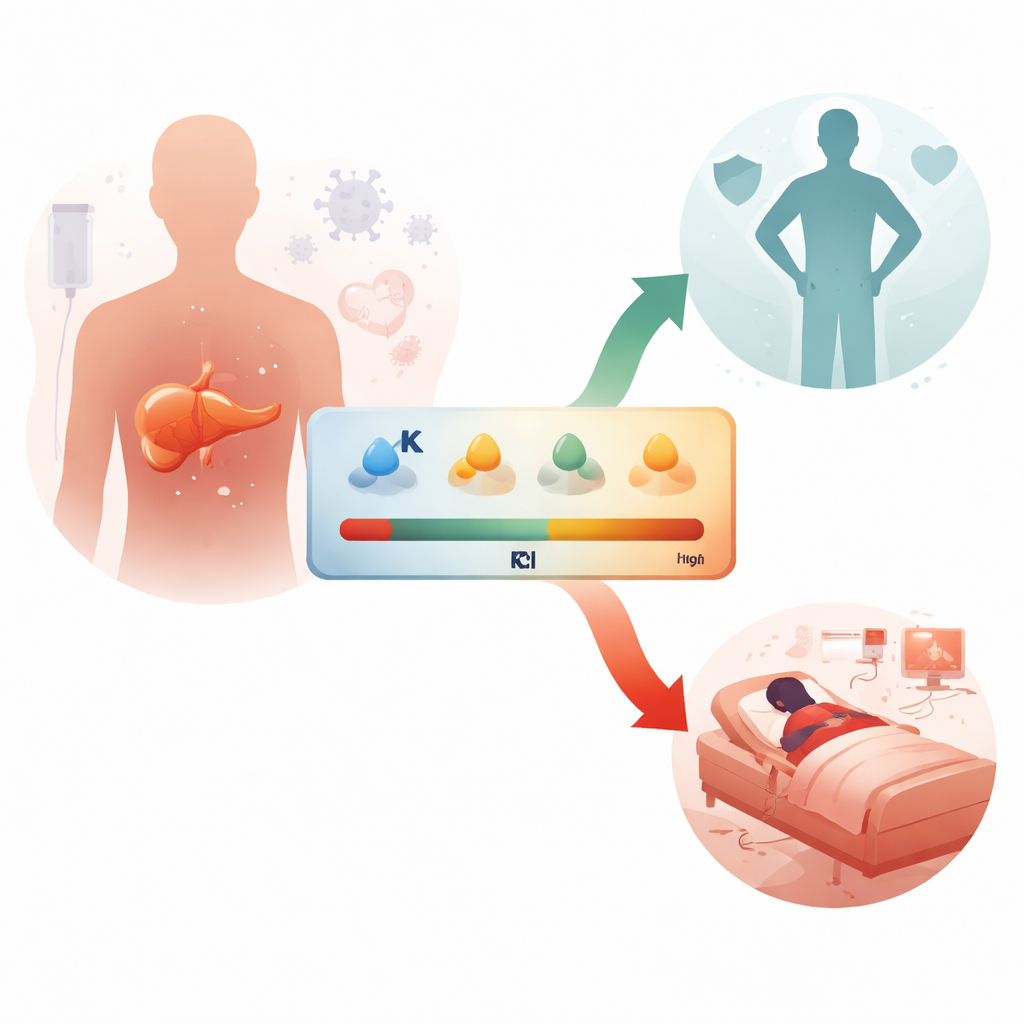
A closer look at sick livers in the ICU
The researchers dug into a large public database of intensive‑care patients known as MIMIC‑IV, which contains anonymized records from a major hospital in Boston. They identified 2,016 adults who had some form of liver failure and who had key blood tests measured within the first day in the ICU. These patients were mostly in their early 60s, and about three out of five were men. The team sorted them into four groups based on their ACAG values, from lowest to highest, and then tracked who survived for 30 days and 90 days after ICU admission.
What this special blood number means
ACAG is based on substances in the blood that carry electrical charge. It starts with the “anion gap,” a measure doctors already use to judge acid–base balance in the body, and then adjusts that value for the level of albumin, the main protein made by the liver. In liver failure, albumin often drops sharply, which can hide how severely the body’s chemistry is disturbed. By correcting for albumin, ACAG is designed to uncover the true burden of unmeasured acids that reflect how stressed the body is. A higher ACAG suggests deeper metabolic trouble.
Higher ACAG, higher short‑term death risk
When the team compared outcomes across the four ACAG groups, a stark pattern emerged: the higher the ACAG, the more patients died. In the lowest group, about 16 percent died within 30 days; in the highest group, nearly 38 percent did. The picture was similar at 90 days. Statistical models that accounted for age, illness severity scores, and other lab values showed that each step up in ACAG was linked to a higher risk of death, and this relationship looked roughly like a straight line rather than a curve. Importantly, people who died tended to have clearly higher ACAG values than those who survived, regardless of the specific type of liver failure.
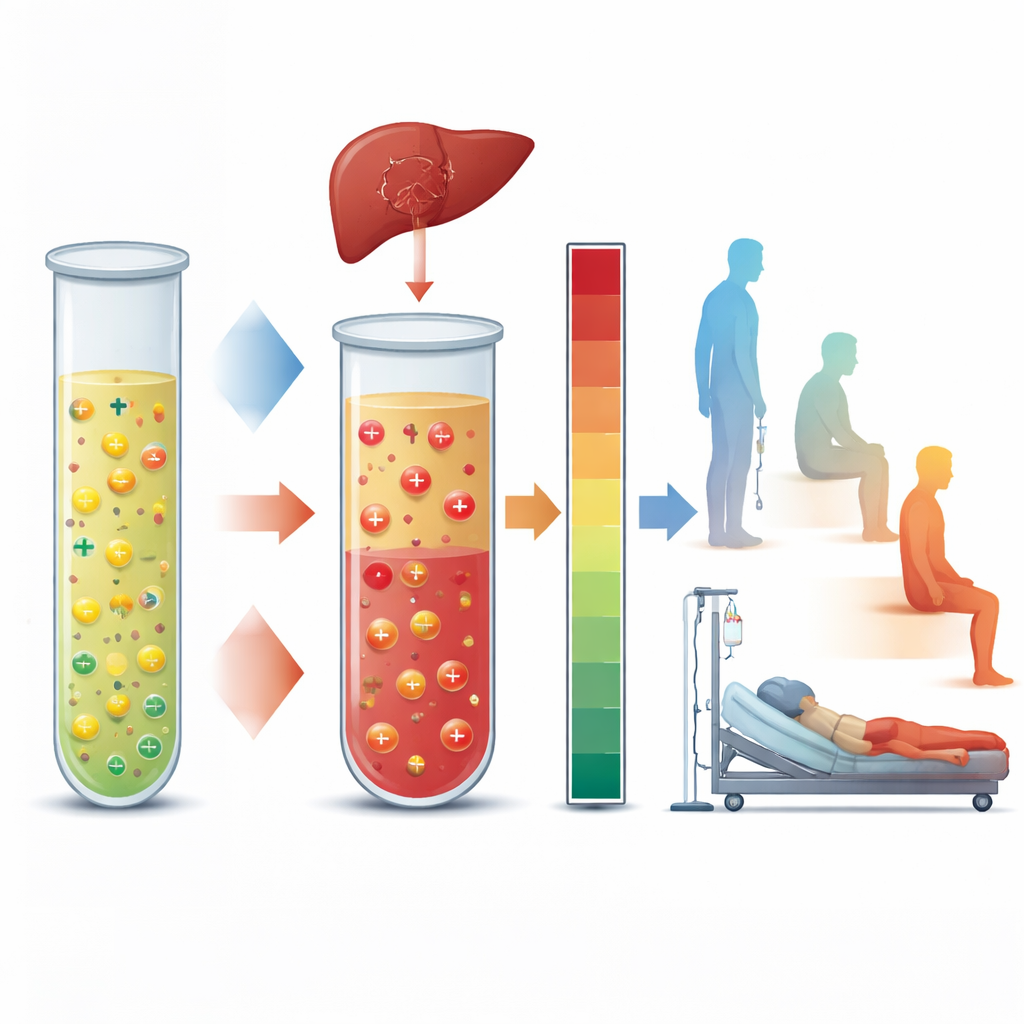
How this measure stacks up against existing tools
Doctors already use the MELD score, a widely accepted index based on several lab tests, to judge how sick liver‑disease patients are. The study compared how well ACAG alone, MELD alone, and a combination of the two predicted death at 30 and 90 days. ACAG and MELD performed similarly, each showing moderate ability to distinguish survivors from non‑survivors. But when the two were combined, prediction improved: the joint model better separated high‑risk from lower‑risk patients than either measure alone, especially in terms of identifying patients who were unlikely to die in the short term.
What this could mean for patients and care teams
The findings suggest that ACAG, calculated from routine blood tests, could serve as a practical early warning signal in liver‑failure patients. On its own, it performs about as well as established scoring systems, and when paired with the MELD score it sharpens doctors’ view of who is at greatest short‑term risk. Because ACAG is inexpensive and easy to compute, it could help clinicians in busy or resource‑limited settings identify fragile patients sooner and focus intensive treatments where they are most needed. The authors note that larger, prospective studies are still required, but their work points to a simple blood‑based index that may one day help save lives in liver failure.
Citation: Wang, H., Li, S., Lai, S. et al. Association of ACAG with short-term mortality in liver failure patients: a retrospective analysis based on the MIMIC-IV database. Sci Rep 16, 14482 (2026). https://doi.org/10.1038/s41598-026-39253-5
Keywords: liver failure, ACAG, ICU outcomes, risk prediction, blood chemistry