Clear Sky Science · en
Investigating the factors influencing vertical stress ahead of the undercutting line in block caving
Why digging deep can be risky
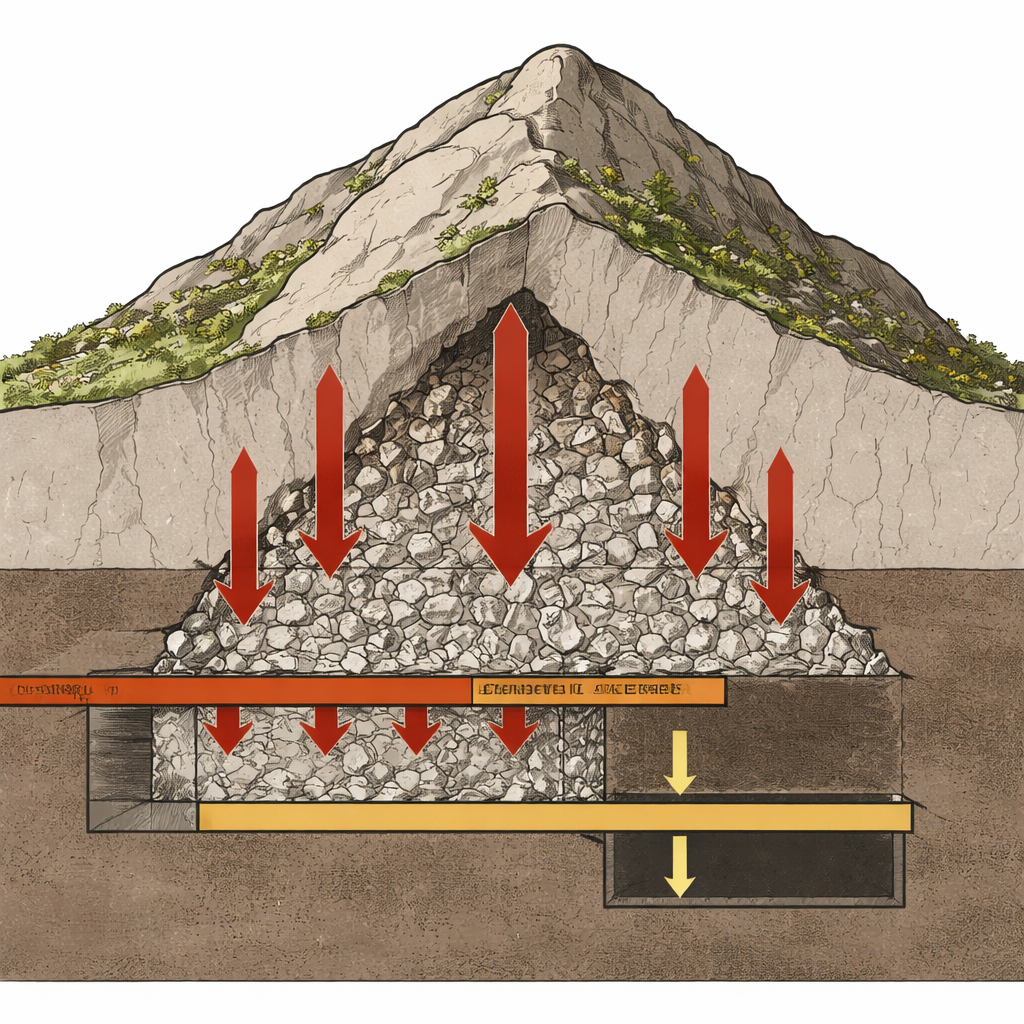
Modern copper mines often reach far below the surface, carving out enormous underground caverns to extract low-grade ore cheaply. A popular approach, called block caving, lets gravity do much of the work: engineers undercut a huge block of ore so it breaks and falls into tunnels below. But as rock is removed, the forces inside the mountain shift. If these shifting forces concentrate in the wrong place, tunnels can crack, cave in, or even collapse, putting workers and equipment at risk. This study looks closely at what controls those dangerous force buildups so that deep mines can be designed to stay safe for decades.
Cracks, cave-ins, and a stressed mountain
The research centers on China’s Pulang Copper Mine, where engineers have already seen serious damage underground. Ahead of the mining front—the "undercutting line" where rock is actively being removed—tunnels have suffered roof falls, sidewall breakouts, and cracking of concrete support pillars. These problems forced the construction of new roadways and disrupted production. Observations like these made it clear that rock pressure was building up in front of the advancing excavation, but it was not obvious exactly why, how far this stressed zone extended, or which mine design choices made things better or worse.
A simple picture of invisible forces
To understand what was happening, the authors started from a classic idea in rock engineering: when you hollow out a space underground, the remaining rock tends to form a kind of natural arch that carries the weight above it. Around that arch, some areas become more squeezed while others are relieved. Using basic mechanics, the team treated the undercut area as a rectangular opening and worked out how the squeezing, or vertical stress, should grow around it. Their analysis showed that three features matter most: how wide the undercut span is, how deep it lies below the surface, and how strong and frictional the rock mass is. Wider and deeper openings were predicted to create stronger stress hot spots in front of the mining front, and weaker, more slippery rock was expected to develop a larger damaged zone.
Testing the mountain in a virtual lab
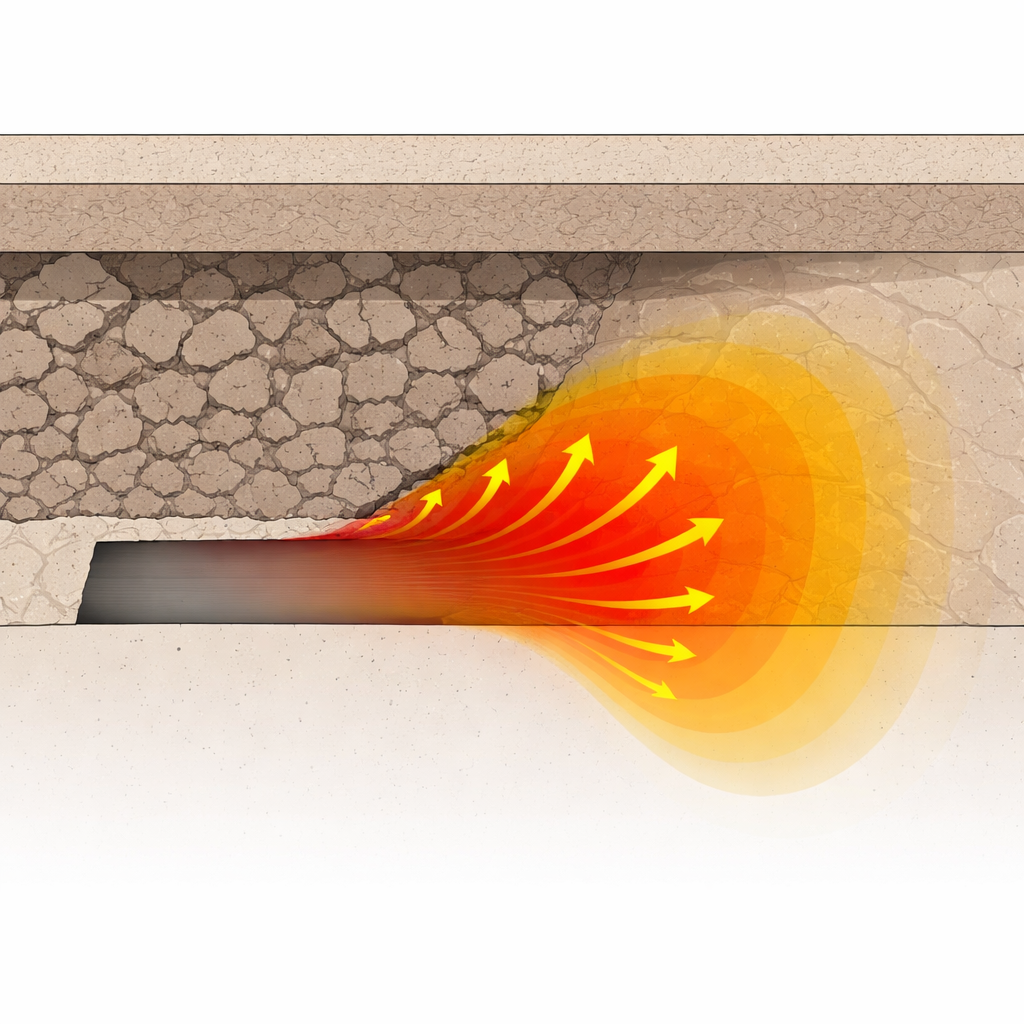
Equations alone cannot capture the full complexity of a real ore body, so the researchers built a detailed three-dimensional computer model of the Pulang mine. They reproduced the layout of the undercut and production levels, the measured rock properties, and the in‑situ stress field dominated by strong sideways tectonic squeezing. They then simulated step‑by‑step undercutting and watched how the vertical stress in the rock changed. The virtual mine showed a clear stress peak forming some meters ahead of the advancing undercut line, with the location and height of this peak shifting as the undercut grew and as the depth of the excavation changed.
What controls where the rock fails
The simulations confirmed that undercut span and depth are the main levers controlling dangerous stress build‑up. As the span increased, the peak vertical stress ahead of the mining front rose at first but eventually leveled off, suggesting that the overlying rock had formed a new stable arch and could not transmit much more load. Greater depth, however, consistently produced both higher peak stresses and a longer zone of yielded, damaged rock stretching ahead of the excavation. When the team varied the internal friction angle—a measure of how easily rock fragments slide past each other—they found that rocks with lower friction developed a longer failure zone, while higher‑friction rock confined damage to a shorter region, even though the maximum stress itself changed only modestly.
From numbers to safer designs
Field measurements at Pulang, including ground movement and observed cracking, lined up well with the model predictions: deeper sections of the mine showed larger tunnel deformations and stronger stress transfer from the undercut level down to the production level. Putting theory, simulation, and field data together, the authors conclude that vertical stress concentration ahead of the undercut line—and the size of the damaged zone it creates—are mainly governed by undercut depth, span, and rock friction. For mine planners, this means that carefully choosing how deep and how wide to undercut, and tailoring support systems to the local rock quality, can greatly reduce the chance of sudden failures, helping ensure that large block‑caving mines remain both productive and safe.
Citation: Cao, Y., Hua, X., Zhai, S. et al. Investigating the factors influencing vertical stress ahead of the undercutting line in block caving. Sci Rep 16, 11505 (2026). https://doi.org/10.1038/s41598-026-39231-x
Keywords: block caving, underground mining, rock stress, mine stability, numerical modeling