Clear Sky Science · en
Nitrogen oxides removal from hydrogen flue gas by direct photolysis
Why cleaning hydrogen exhaust matters
Hydrogen is often promoted as a clean fuel because it does not release carbon dioxide when burned. Yet even a hydrogen flame in ordinary air can create nitrogen oxides, a family of gases that irritate lungs, worsen smog, and contribute to acid rain. This study examines whether ultraviolet (UV) light—more familiar from sunburn warnings and germicidal lamps—can be used to scrub these nitrogen oxides from the exhaust of hydrogen-fired boilers, making hydrogen heat truly cleaner for cities and industry. 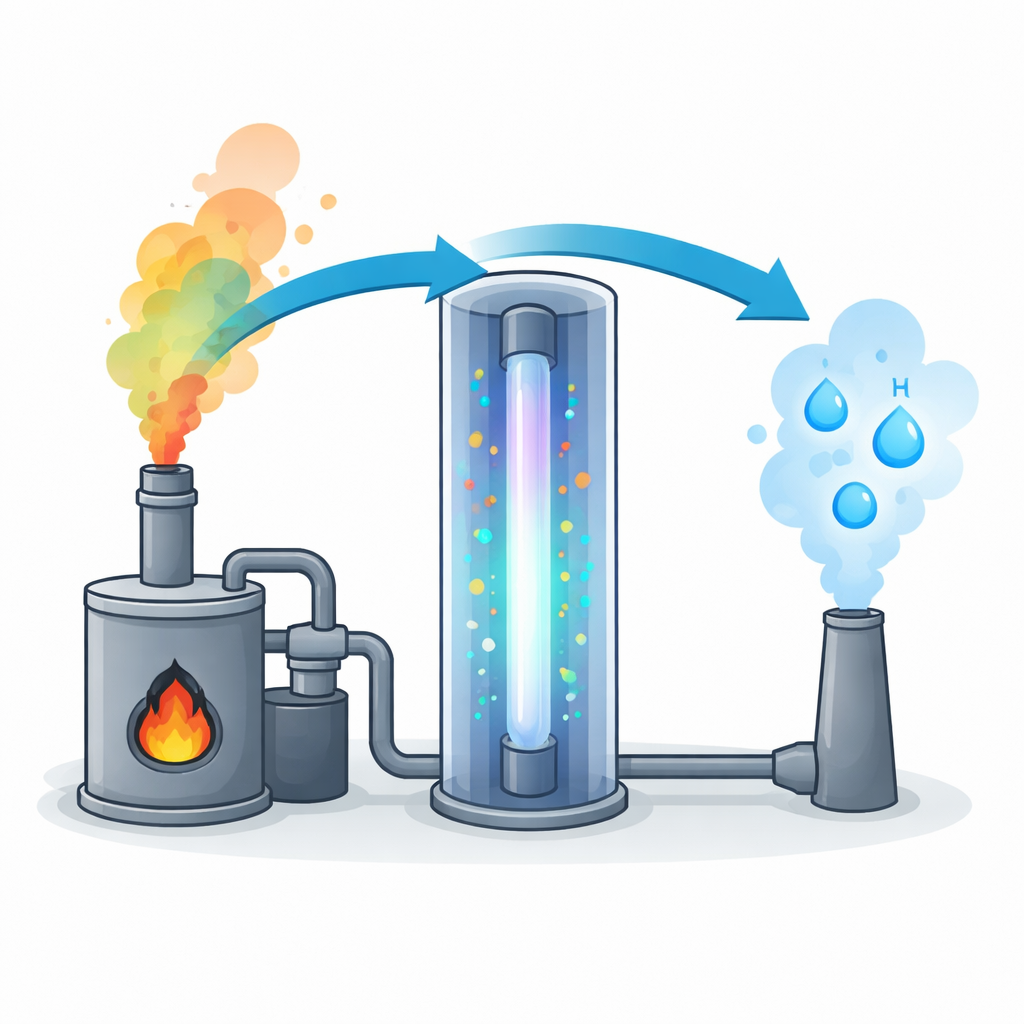
Hydrogen heat without hidden side effects
Hydrogen offers several advantages as a future fuel: high energy content, no carbon or sulfur in its exhaust, and the possibility of being produced with renewable electricity. For heating buildings or industrial processes, simply burning hydrogen in a boiler can be cheaper and more efficient than using fuel cells. The catch is that when hydrogen burns in air, the very high flame temperature causes normally stable nitrogen in the air to react with oxygen, forming nitrogen oxides (often grouped as “NOx”). These gases damage health and the environment, so any large-scale move to hydrogen boilers needs a reliable way to remove NOx from their flue gases.
Shining a new kind of light on exhaust cleaning
Today’s NOx control technologies, such as catalytic converters and exhaust gas recirculation, work well but add cost, complexity, and energy use. The authors explore a different idea: exposing the hot exhaust from a hydrogen burner directly to intense UV light, a process called photolysis. UV photons carry enough energy to break certain chemical bonds in gas molecules. When nitrogen oxides absorb these photons, they can split into simpler fragments such as single nitrogen and oxygen atoms, which then react further to form more harmless products like nitrogen gas, oxygen, or nitric acid that can be trapped by water or alkaline solutions. The team focused especially on high‑energy UVC wavelengths, which are the most effective for breaking strong bonds in gases. 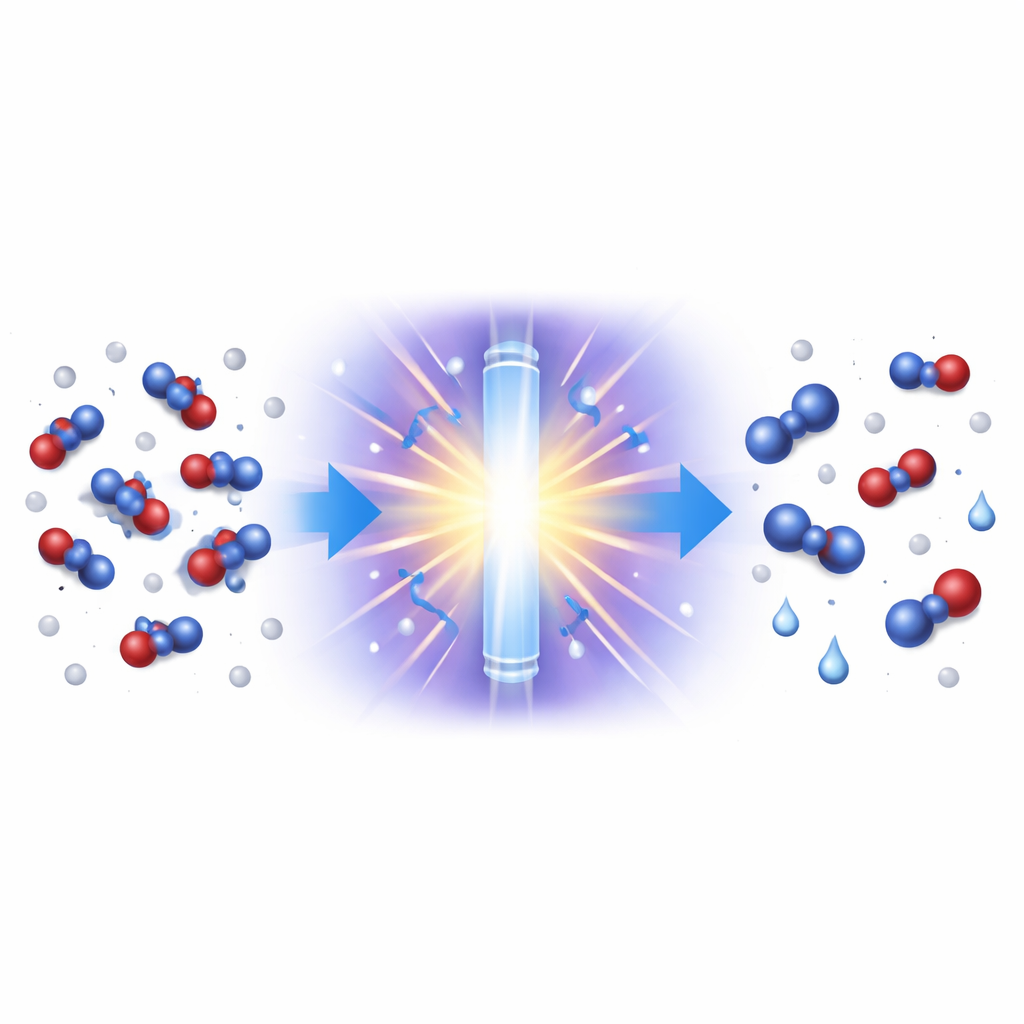
Building a small boiler and UV cleaning column
To test this concept under realistic conditions, the researchers built a laboratory system that mimics a small hydrogen boiler operating at normal atmospheric pressure. Hydrogen and oxygen were produced together in an electrolyzer, so the burner received the right mix of gases without needing outside air. As the hydrogen–oxygen flame burned in air, it created hot exhaust containing water vapor, leftover oxygen and nitrogen, and small amounts of nitric oxide (NO) and nitrogen dioxide (NO₂). This exhaust flowed upward through a two‑meter‑tall transparent column containing a powerful 160‑watt mercury UV lamp. Sensors placed at different heights measured how much NO, NO₂ and total NOx remained in the gas with the lamp switched on or off, and at different burner pressures and flow rates.
What happened to the exhaust gases
Turning on the UV light consistently drove the level of nitric oxide down, in some cases all the way to zero within the measurement range. At the same time, the amount of nitrogen dioxide increased, as some of the NO was converted rather than fully destroyed. Whether this trade-off led to cleaner exhaust overall depended strongly on how much NOx was present to begin with and how quickly the gas moved past the lamp. At the lower exhaust flow rate, where starting NOx levels were higher, the system achieved a real net reduction: for one operating point, total NOx fell by about 12 percent. At higher flow or very low initial NOx levels, however, total NOx actually increased, suggesting that the UV mainly reshuffled nitrogen oxides between forms rather than removing them. The lamp also warmed the gases slightly, but this temperature rise was too small to explain the chemical changes by heat alone.
What this means for cleaner hydrogen heat
The study shows that strong UV light can change the mix of nitrogen oxides in hydrogen boiler exhaust and, under the right conditions, modestly lower the total amount. The best performance seen here—around 10 percent removal—came with relatively high starting NOx levels and enough time for the exhaust to linger in the light. Although this is less effective than some advanced plasma methods, the UV approach uses much less supplied energy and may be easier to integrate into real boilers. For the public, the key message is that hydrogen heating is not automatically pollution‑free, but new tools like UV photolysis could help keep its hidden emissions in check if carefully engineered and optimized.
Citation: Kreft, D., Szczodrowski, K. & Marszałkowski, K. Nitrogen oxides removal from hydrogen flue gas by direct photolysis. Sci Rep 16, 13238 (2026). https://doi.org/10.1038/s41598-026-39200-4
Keywords: hydrogen boilers, nitrogen oxides, ultraviolet treatment, flue gas cleaning, air pollution control