Clear Sky Science · en
Enhancing deep learning based multi-parameter fire detection by training on simulated and combustion experimental dataset
Why smarter fire alarms matter
Most of us trust that the smoke alarms on our ceilings will warn us if something catches fire. Yet these simple devices can miss slow, smoldering incidents—or go off when someone burns toast or stirs up dust. This study explores a new kind of "smart" fire detection system that watches how heat and a key gas from flames change over time, and it trains its brain using both computer-made fires and real laboratory burns. The goal is a quieter, more trustworthy alarm that reacts quickly when it should and stays silent when it must.

Limits of today’s one-track alarms
Traditional home and building alarms mostly rely on smoke. That works for many blazes, but some fires, such as those fueled by clean alcohol, give off little smoke even as flames grow. Slow-burning materials can smolder with only a whisper of particles. At the same time, steam from a shower or dust in the air can fool smoke sensors into shrieking for no good reason. Many existing systems also watch just one signal at a time, like smoke alone or a single gas, which makes them easy to trick in everyday situations involving stoves, heaters, or exhaust fans.
Listening to heat and fire gas together
The researchers focus on two simple, powerful clues that nearly every fire produces: temperature and carbon monoxide (CO). Under normal indoor conditions, CO levels are very low. When materials burn, CO tends to rise early and steadily, even when smoke is scarce, making it a strong early warning sign. Temperature changes more slowly but provides a stable second opinion, helping to tell real fires apart from harmless sources of CO or sensor quirks. By combining these two readings from multiple ceiling-mounted sensors, the system can spot not only open flames but also smoldering materials and noisy non-fire heat sources.
Creating many fires without burning many things
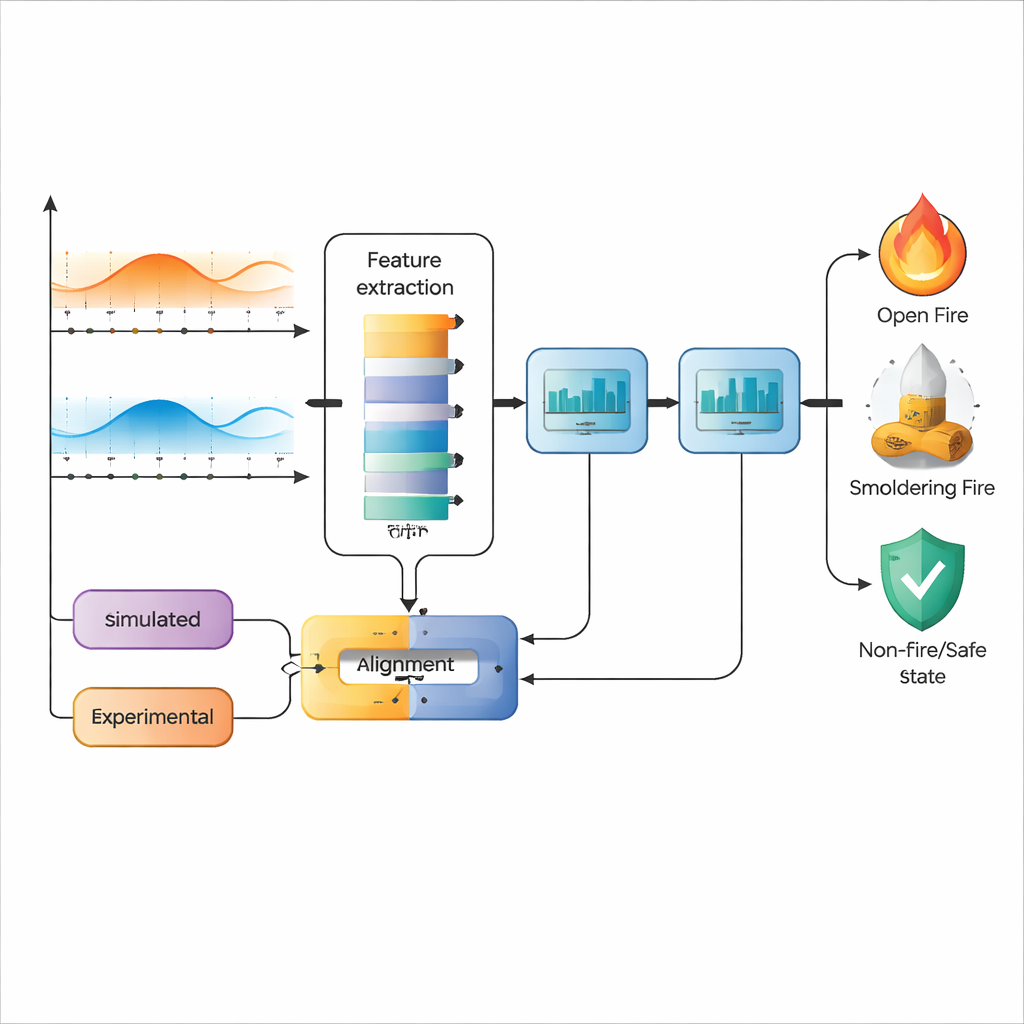
Teaching a modern pattern-recognizing algorithm typically demands huge amounts of data. Running hundreds of full-scale fire experiments is costly, time-consuming, and sometimes dangerous. To get around this, the team built a detailed computer model of a standard test room, matching their real laboratory chamber in size and sensor placement. With a widely used fire simulation program, they created twelve virtual scenarios, including different fuels, room layouts, vents, and harmless heat sources, and recorded how temperature and CO would behave at each sensor. They then ran matching real-world burns with liquids, plastics, wood, and cotton under varied ventilation and interference conditions, capturing genuine sensor readings to complement the simulated ones.
How the learning engine understands fire
At the heart of the system is a time-aware learning model called a gated recurrent unit, or GRU. Instead of judging each sensor reading in isolation, the GRU looks at short sequences—one-minute slices that show how temperature and CO rise or fall together. Before reaching this "brain," the raw signals pass through simple filters that pull out key local patterns while reducing noise. A second part of the model handles what the authors call domain adaptation: it gently forces internal features from computer-made data and from real experiments to line up, so that lessons learned from plentiful simulations still apply when the device faces real fires. Unlike many approaches, the classifier itself is trained on both types of labeled data, helping it learn the true structure of real-world fire, smoldering, and safe conditions.
What the tests reveal
When the researchers trained a conventional GRU only on the limited experimental data, or only on simulations, its decisions were noticeably less accurate. Mixing both data sources without any adaptation helped somewhat but still left too many errors. Once they added the domain adaptation strategy on top of the GRU, accuracy on real-world test data rose to about 96 percent, with strong precision and recall for open flames, smoldering events, and non-fire cases. The model also held up well when artificial noise was added to mimic electrical disturbances and messy environments, maintaining useful performance even when the signals were heavily corrupted.
What this means for safer buildings
For a layperson, the bottom line is that this study shows a practical path toward fire alarms that are both more sensitive and more selective. By watching how heat and a key fire gas evolve over time, and by using computer-simulated fires to safely multiply training examples while carefully aligning them with real tests, the proposed system sharply reduces both missed fires and nuisance alarms. Although it is still a research prototype, the approach offers a blueprint for next-generation detectors that could give people earlier, more reliable warnings in homes, offices, and public buildings without the constant risk of false alerts.
Citation: Liu, X., Zhang, Q., Zhang, Y. et al. Enhancing deep learning based multi-parameter fire detection by training on simulated and combustion experimental dataset. Sci Rep 16, 10178 (2026). https://doi.org/10.1038/s41598-026-39191-2
Keywords: fire detection, carbon monoxide sensors, deep learning, time-series analysis, building safety