Clear Sky Science · en
Axial load behaviour of concrete infilled and partially encased cold formed double sigma composite columns
Stronger Building Columns for Everyday Structures
As cities grow taller and construction speeds up, engineers are searching for columns that are not only strong and safe but also quicker to build and kinder to the climate. This study looks at a new way to make building columns by combining thin steel shells with a special flowing concrete packed with volcanic rock fibers. The researchers ask a simple question with big consequences for future buildings: which column layout gives the best mix of strength, toughness, and lower carbon footprint?

How Thin Steel Shells Become Tough Columns
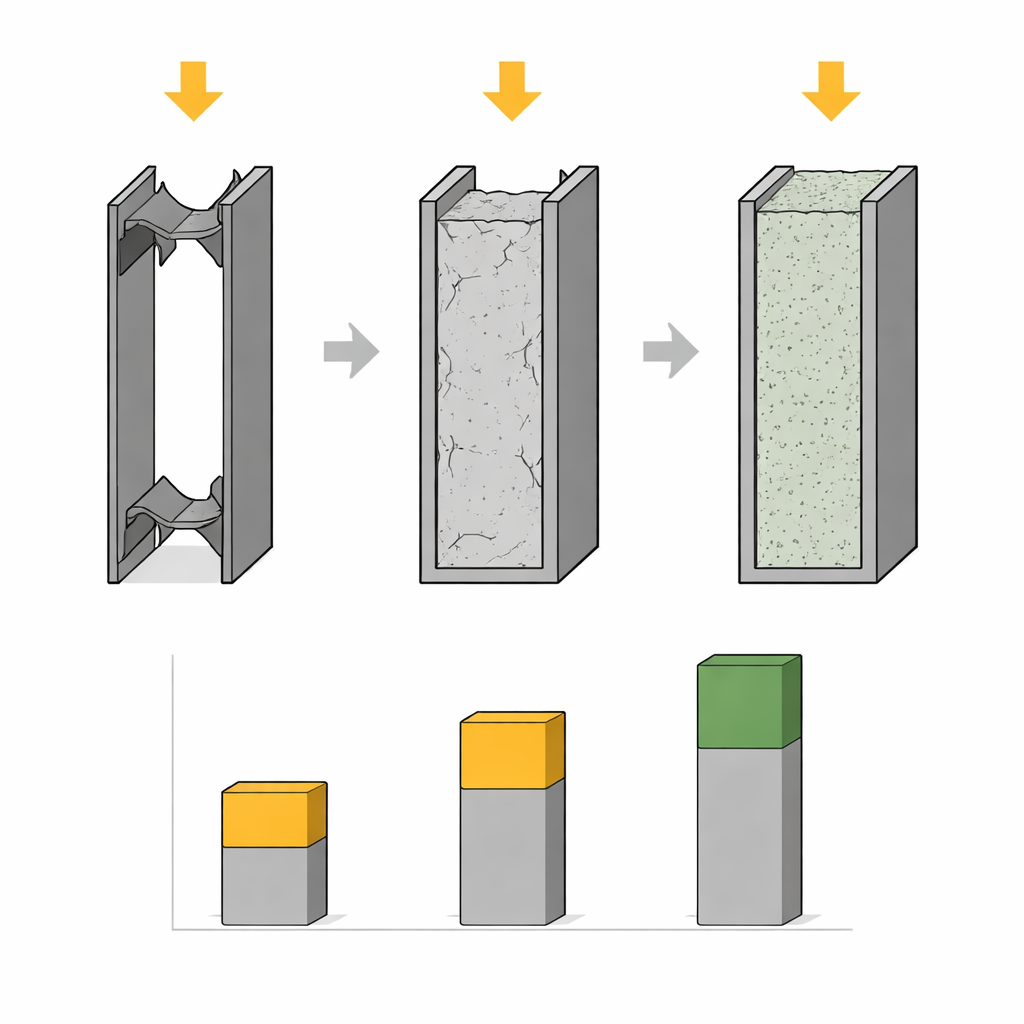
Modern buildings often use cold-formed steel, made by bending thin sheets into stiff shapes. These lightweight pieces are easy to transport and perfect for modular construction, but on their own they can crumple like a drinks can when heavily compressed. To overcome this, the team built columns by pairing two sigma-shaped steel sections in two ways: closed face-to-face to form a steel box, and open back-to-back with a gap that can be wrapped in concrete. Each style was tested in three versions: bare steel only, filled or encased with normal self-compacting concrete, and filled or encased with a more advanced concrete reinforced with tiny basalt fibers.
A New Kind of Flowing, Fiber-Rich Concrete
The concrete used here is designed to pour and spread under its own weight, flowing around tight corners and crowded reinforcement without vibration. The researchers improved this mix by replacing part of the cement with fly ash and silica fume—industrial by-products that help pack the material more densely—and by adding short basalt fibers made from volcanic rock. Under the microscope, these fibers weave through the hardened concrete, bridging microcracks and gripping the surrounding material. This combination produces a denser internal structure that can better resist cracking and deform more gracefully instead of breaking suddenly.
Pushing Columns to Failure in the Test Lab
To see how the different columns performed, the team loaded each specimen straight down the center until it failed, carefully tracking shortening along its height and sideways bending. Bare steel versions buckled early, with thin walls folding in or twisting. Adding normal self-compacting concrete more than doubled the load capacity, because the concrete core helped hold the steel in shape while the steel confined the concrete. The real standout was the closed, fully filled column with basalt-fiber concrete, which carried nearly three times the load of the empty steel column and about one-third more than the version with plain concrete. It also shortened less and could deform much further after yielding, showing much higher ductility—an important safety margin during earthquakes or extreme events.
Simulations, Design Rules, and Carbon Footprints
The researchers used detailed computer models to reproduce the crushing tests, confirming that their digital twin matched the real-world failures and strengths very closely. They then compared their measurements with predictions from Indian and international building design codes, adjusting formulas originally written for heavier, hot-rolled steel and ordinary concrete. The updated approach predicted the new columns’ strength reliably and remained slightly on the safe side. In parallel, a cradle-to-grave carbon assessment added up emissions from producing steel and concrete, transporting materials, construction, maintenance, and end-of-life recycling. While adding concrete increases total emissions compared to bare steel, the huge gain in load capacity means each unit of carbon buys much more structural performance—especially in the fiber-reinforced, fully filled columns.
Balancing Safety and Sustainability in Future Buildings
Seen through everyday eyes, this work shows that carefully shaped thin steel shells, combined with a smart, fiber-rich concrete, can create columns that are lighter, stronger, and more forgiving in failure than conventional options, while using less carbon per unit of carrying capacity. The closed, basalt-fiber-filled columns in particular offer high strength, better control of cracking and buckling, and improved life-cycle efficiency. That mix of safety, durability, and reduced environmental impact makes them promising candidates for the next generation of modular, mid- to high-rise buildings that need to stand up to both heavy use and a changing climate.
Citation: Sharon, R.P.O., Senthilpandian, M. Axial load behaviour of concrete infilled and partially encased cold formed double sigma composite columns. Sci Rep 16, 11497 (2026). https://doi.org/10.1038/s41598-026-39171-6
Keywords: composite columns, cold-formed steel, basalt fibre concrete, self-compacting concrete, embodied carbon